ridermagazine.com
2026 Mecum Indy Auction Preview: Elegant Antiques
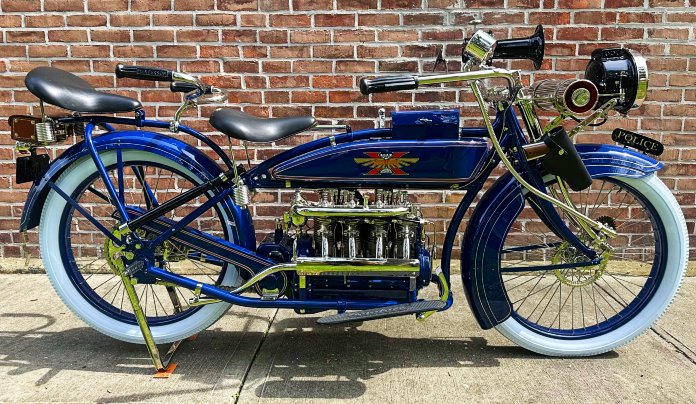
1919 Henderson Four (Lot S60)
We’re less than two weeks away from the start of Dana Mecum’s 39 Annual Spring Classic, known as the Indy auction, which kicks off on Friday, May 8, and continues through Saturday, May 16, at the Indiana State Fairgrounds in Indianapolis. As of today (April 28), there are 109 motorcycles listed on the Mecum website that are up for sale at the Indy auction. More are being added as the auction draws near.
In our previous posts, we highlighted classic Harley-Davidsons, Japanese classics, British beauties, and a variety of unusual and unexpected motorcycles. Today we’re taking a closer look at antique motorcycles.
The Antique Motorcycle Club of America considers any motorcycle that is 35 years or older an antique, which would include motorcycles built in 1991 or earlier. (Sheesh…I graduated high school in 1991; does that mean I’m an antique too?) For the purposes of this post, however, we’ll look at a selection of motorcycles built between 1904 and 1971 that will cross the block at the Indy auction.
(We highlighted some antiques in our earlier posts, including a 1936 New Imperial Model 30, a 1937 Harley-Davidson EL Knucklehead, and a 1964 Honda Dream 305, among others.)
1904 Indian Single Camel Back Racer
1904 Indian Single Camel Back Racer (Lot T116)
(Lot T116): Built three years after the Indian Moto(r)cycle Company was founded (which was called Hendee Manufacturing Company until 1923), this 1904 Indian Single Camel Back Racer represents one of the earliest purpose-built American racing motorcycles. Powered by a 213cc F-head single-cylinder engine that made 1.5-2 hp, it featured a distinctive “camelback” fuel tank mounted over the rear fender, a hallmark of early Indian design. Lightweight and mechanically simple, it was built for competition on dirt tracks and board tracks of the era. Despite modest power, its speed and agility helped establish Indian’s racing reputation.
1919 Henderson Four
1919 Henderson Four (Lot S60)
(Lot S60): Built from 1912-1931, the Henderson Four was a landmark American inline-Four, known for smooth power and long-distance capability. Positioned alongside the luxury-focused Pierce Four, the performance-oriented Ace Four, and the later refined Indian Four, the Henderson struck a balance of reliability, speed, and accessibility. Its longitudinal crankshaft and advanced engineering helped define the American 4-cylinder tradition, influencing both Ace and Indian designs. Widely used for touring and endurance riding, the 1919 Henderson Four remains a cornerstone of early multi-cylinder motorcycle development. This example, which has a 70ci engine, was comprehensively rebuilt by Road Oiler Restoration.
1928 BMW R62
1928 BMW R62 Lot (T11)
(Lot T11): The first BMW motorcycle, the 494cc R32, was built in 1923, and it featured a boxer (flat) Twin engine and shaft final drive that are still hallmarks of many BMW motorcycles today. The BMW R62, produced in 1928-1929, built on this foundation a larger 745cc engine, increased power, and improved performance. Designed for higher speeds and longer-distance touring, the R62 retained the signature longitudinal crankshaft layout and durability of its predecessor. This example was brought from Germany to the U.S. in 1984, where it was restored, displayed in a museum, and maintained in running condition.
1938 Indian Four
1938 Indian Four (Lot F93)
(Lot F93): Like the Henderson Four above, the Indian Four carried this distinctly American engine configuration forward. Indian Fours were built from 1928 (after Indian acquired the Ace Motorcycle Company and its Four model) until 1942 – the last longitudinal Four built in the U.S. This example is one of a purported 300 Model 438 Fours, known for their Art Deco styling and valanced fenders, built in 1938. It was restored by Eugene Keiffer in 1988, purchased from Keiffer’s collection in 1990, and in the David A. Berg Collection for over 35 years.
1946 Indian Chief
1946 Indian Chief (Lot T5)
(Lot T5): The 1946 Chief marked Indian’s postwar return with one of the most iconic American motorcycles ever built. Designed for comfort and long-distance touring, the Chief appealed to soldiers returning home after World War II. Powered by a 74ci (1,200cc) V-Twin, it combined strong torque with smooth, reliable performance. Its deeply valanced fenders, sprung frame, and classic styling defined the look of Indian motorcycles for decades to come (well beyond the company itself, which went bankrupt in 1953). This example has undergone a comprehensive “nut and bolt” restoration.
1952 Vincent Comet
1952 Vincent Comet (Lot T4)
(Lot T4): The Vincent Comet, produced from 1935-1955, is a classic British bike known for combining performance with advanced engineering. Its 499cc OHV Single delivered strong, reliable power for its class. The Comet shared many features with Vincent’s larger Twins, including a rigid upper frame member and cantilever rear suspension, giving it excellent handling and ride quality for the era. With its clean lines, distinctive black finish, and refined performance, the Comet remains one of the most respected and collectible postwar British motorcycles.
1959 BMW R26
1959 BMW R26 (Lot W7)
(Lot W7): The R26 was BMW’s first postwar single-cylinder model with a full swingarm rear suspension, replacing earlier rigid-frame designs. Powered by a 247cc overhead-valve engine, it delivered smooth, efficient performance suited to everyday transportation. The R26 retained BMW’s signature shaft drive and high build quality while improving comfort and handling. Reliable and easy to maintain, it became popular across Europe as practical mobility in the early 1950s. This example was purchased from a private collection and put on display at Rocky’s Great Outdoors of Burton, Michigan, for 19 years. It is now being offered with no reserve as part of the Paul “Rocky” Roll Estate Collection.
1971 Honda CB350
1971 Honda CB350 (Lot G258)
(Lot G258): Honda’s CB350 helped define the approachable, reliable Japanese motorcycle. Powered by a 325cc parallel-Twin with a smooth-revving overhead-cam design, it offered lively yet manageable performance. Its electric start, dependable build quality, and easy maintenance made it especially popular in the growing U.S. market. With classic styling, nimble handling, and everyday usability, the CB350 became one of Honda’s best-selling models and a cornerstone of the early-1970s motorcycle boom. This running example underwent an extensive and meticulous frame-off restoration. The engine, frame, and chrome are original, and it is finished in its original color of Candy Blue.
To see all the motorcycles up for auction in Indianapolis, go to the Mecum website, click on the Buy drop-down menu at the top, select Motorcycles, and click on “View Lots.”
A Mecum auction is a must-attend event for any gearhead, but if you can’t be there in person, you can bid online or by phone – just fill out the registration form on the Mecum website.
The post 2026 Mecum Indy Auction Preview: Elegant Antiques appeared first on Rider Magazine.








 New Posts (Home)
 ChatBox
 Popular Posts
  Game Zone
 Top PodCasts