flashbak.com
Karl Alexander Wilke’s Wicked Women
“Lock up your libraries if you like; but there is no gate, no lock, no bolt that you can set upon the freedom of my mind.”
― Virginia Woolf, A Room of One’s Own, 1929
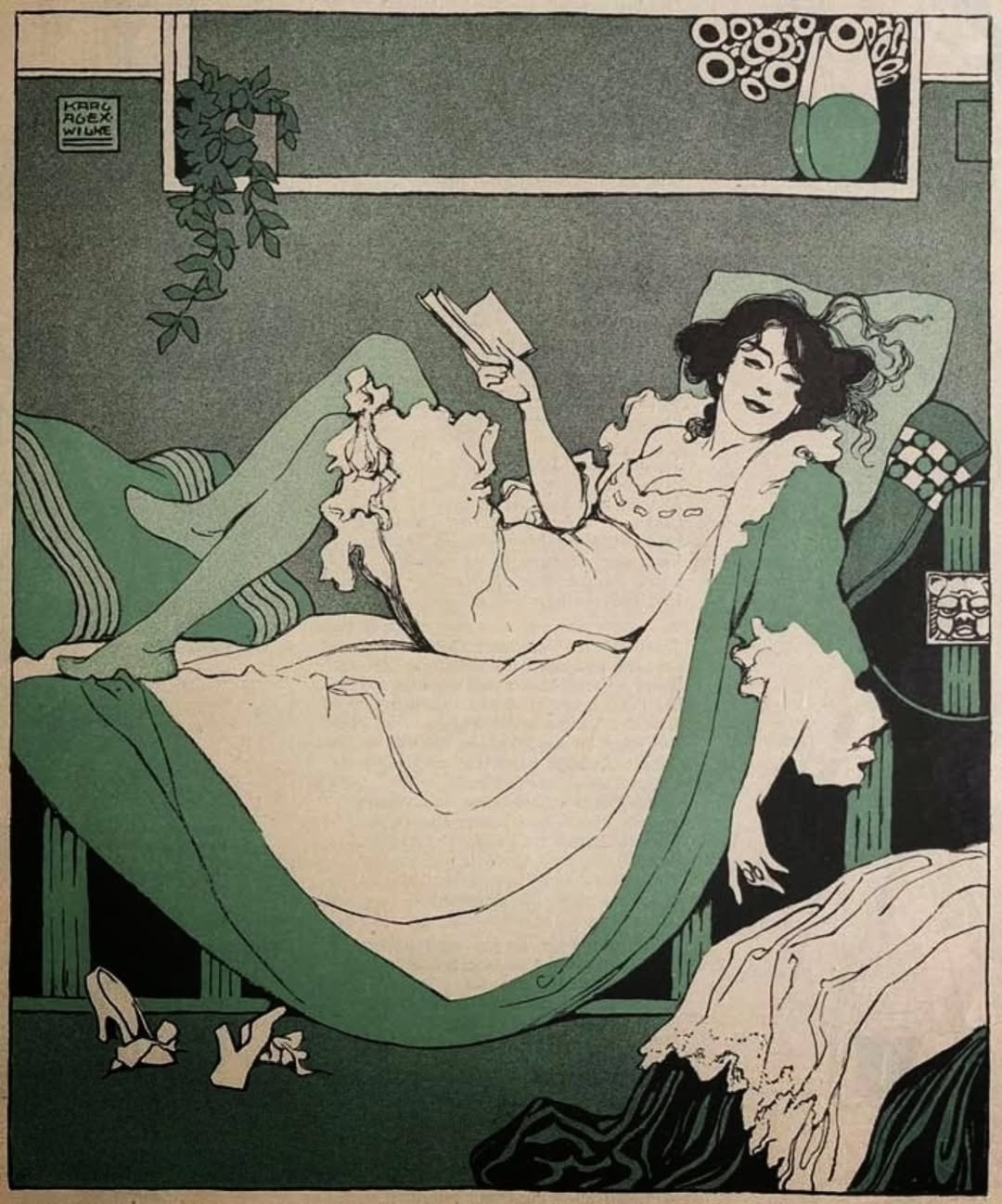
It looks benign by today’s standards. But Karl Alexander Wilke’s image of a woman reading caused a stir.
His daring picture (above) shows a woman lying on her back reading a book. Her cleavage is exposed. Her hair is messy. Her shoes are off. And, crucially, she’s looking at us.
Karl Alexander Wilke (July 16, 1879 – February 27, 1954), a graduate of the Leipzig Academy of Fine Arts, was staff illustrator for Die Muskete magazine from 1905 to 1918. As the best-known weekly humour and men’s magazine in Austria-Hungary, it covered the military, politics and Viennese society.
Wilke, who was also head of sets and costumes at Vienna’s Burgtheater from 1913 to 1923, worked his stage designs into his illustrations.
So now look at his image a second time. The woman is not on a sofa. She’s raised on a stage. Things are arranged in a deliberate manner. Her demeanour is theatrical. And we are her audience.
So the image is now a tale of sex, gender and social mores.
And if she’s reading, it means that she’s thinking. And women were not supposed to do that because reading books and listening to other people’s ideas without a male filter leads to certain disaster. It’s what’s known as Madame Bovary Syndrome or Bovarysme.
Antoine Joseph Wiertz: The Reader of Novels
Madame Bovary Syndrome
Madame Bovary Syndrome is something that occurs among different female protagonists of the nineteenth century. Based on Gustave Flaubert’s novel Madame Bovary, this syndrome was defined by French philosopher Jules De Gaultier to describe chronic affective dissatisfaction with one’s life.
In Flaubert’s book, Bovary lives beyond her means in order to escape the ennui of provincial life. In search of romance, she leaves her nice but dull husband, has amorous affairs, runs up a huge debt and kills herself, leaving her young daughter orphaned.
As Audrey C. Giesler, of Eastern Kentucky University, writes: “The Madame Bovary Syndrome can be applied to the female protagonists in George Sand’s Indiana, Charlotte Perkins Gilman’s The Yellow Wallpaper and Kate Chopin’s The Awakening. Each protagonist in these stories exemplifies chronic feelings of dissatisfaction, hopelessness, and despair due to the lack of control over their lives.”
So books are bad for women. In 1853, Belgian artist Antoine Wiertz (22 February 1806 – 18 June 1865) hammered home the point in his painting The Reader of Novels. Beside the naked reading women, the Devil is handing her more books (above).
As with Wiertz, Wilke’s sexualised, autonomous women says a lot about historical anxieties.
Trump – You don’t impress me, Mr. Devil! by Karl Alexander Wilke, “The Musket”, Dec. 17, 1926
Look at homo sapiens, drawn by Karl Alexander Wilke (Die Muskete, #22, March 1, 1906)
Not a fairy tale, drawn by Karl Alexander Wilke, “The Musket”, Nov. 26, 1925
Their Path, by Karl Alexander Wilke, “The Musket”, #27, April 5, 1906
The Devil’s Grandmother, drawn by Karl Alexander Wilke, “Mocca”, #12, 1933
The winner, drawn by Karl Alexander Wilke, “Die Muskete”, #134, April 23, 1908
Resurrection, drawn by Karl Alexander Wilke, “The Musket”, March 28, 1907
The post Karl Alexander Wilke’s Wicked Women appeared first on Flashbak.








 New Posts (Home)
 ChatBox
 Popular Posts
  Game Zone
 Top PodCasts