www.newsbusters.org
Hair on Fire: ABC, CNN, MS NOW Seethe Over SCOTUS Case on Black Districts
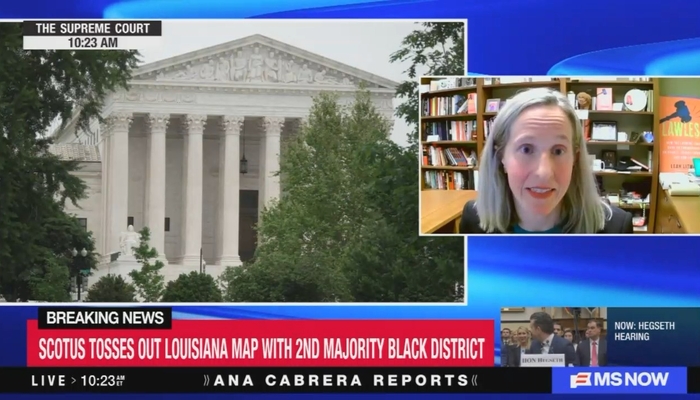
The Supreme Court released a blockbuster ruling in Louisiana v. Callis that struck down one of the Bayou State’s two majority-black congressional districts, possibly paving the way for more such districts to fall across the south. Of course, the liberal, elite media were enraged by the decision that they believe was done by the six-justice majority to prevent black Americans from participating in our constitutional republic by voting or assuming office, ending our “multiracial democracy” in favor of the “pre-Reconstruction era.”
On CNN, chief Supreme Court analyst Joan Biskupic was apoplectic, asserting the six Republican-appointed justices helped Trump in “diminishing the ability to vote and go to the polls.” She also floated a conspiracy theory that the justices handed down this ruling as some sort of favor or in coordination with Trump because they were at Tuesday night’s State Dinner for King Charles III:
CNN’s chief Supreme Court analyst Joan Biskupic says the Supreme Court ruling about Louisiana’s majority-minority districts helps Trump in “diminishing the ability to vote and go to the polls” and floats a conspiracy this ruling came a day after the six majority justices were at… pic.twitter.com/rRq9KJUcGl
— Curtis Houck (@CurtisHouck) April 29, 2026
Biskupic hit another crescendo by arguing it’s not “far-fetched” or “hyperbole” to state the justices have ushered in the “diminish[ment]” of “black representation nationwide and essentially return us to the pre-Reconstruction era,” aka Jim Crow.
CNN chief Supreme Court analyst Joan Biskupic says it’s not “hyperbole” to say the six Supreme Court justices in the Louisiana case have chosen to diminish the ability for African-Americans to assume elected office...
“I don’t think it’s far-fetched, only based on what states… pic.twitter.com/G2gSzKaYKe
— Curtis Houck (@CurtisHouck) April 29, 2026
Chief national affairs correspondent Jeff Zeleny invoked Civil Rights Movement figure and one of the left’s moral compasses, the late Democrat Congressman John Lewis (D-GA):
CNN’s Jeff Zeleny laments what the late John Lewis would think of today’s Supreme Court ruling on majority-minority districts...
“I’m thinking back right now to 13 years ago, when Congressman John Lewis was standing in his office watching as the first pillar of the Voting Rights… pic.twitter.com/vLWwQvHi1M
— Curtis Houck (@CurtisHouck) April 29, 2026
Unsurprisingly, ABC was rather forlorn about this ruling. During a Special Report, correspondent Devin Dwyer bemoaned the “setback for the landmark Voting Rights Act of 1965, which was passed to guarantee equality in how we vote” and fight “systemic and historic racial discrimination” as if to suggest those things are returning to America.
“So, a setback for minority voters in Louisiana,” Dwyer added.
Liberal contributor James Sample similarly fretted the rule “almost completely constitutionalizes a color blindness principle to the point that even race-conscious remedies designed to remedy racial discrimination are unconstitutional.”
ABC’s legal folks were in shambles when they broke in this morning for the Supreme Court ruling on Louisiana’s congressional districts...
“[I]t’s a significant decision in a setback for the landmark Voting Rights Act of 1965, which was passed to guarantee equality in how we… pic.twitter.com/2Do9se7Fjf
— Curtis Houck (@CurtisHouck) April 29, 2026
Chief White House correspondent Mary Bruce — perhaps the most-biased TV correspondent on the beat — joined CNN in suggesting a conspiracy was afoot between the President and conservative justices:
WATCH: ABC’s Mary Bruce points out during a Special Report on SCOTUS striking down Louisiana’s congressional map with two Black Democrats that the ruling came “just the morning after the President had six conservative Supreme Court justices on the guest list here last night for… pic.twitter.com/i1Wky2quqs
— Curtis Houck (@CurtisHouck) April 29, 2026
Bruce said later in the hour on ABC News Live that the decision was in line with President Trump’s “eager” efforts “put additional restrictions on voting writ large” and “undermine confidence in the voting system ahead of the midterms,” including by “calling for this legislation, requiring proof of U.S. citizenship when registering to vote.”
ABC’s Mary Bruce says the SCOTUS decision on majority-minority districts is in line with President Trump’s “eager” efforts “put additional restrictions on voting writ large” and “undermine confidence in the voting system ahead of the midterms,” including by “calling for this… pic.twitter.com/7jHIf9W8VB
— Curtis Houck (@CurtisHouck) April 29, 2026
Meanwhile, MS NOW had senior legal reporter Lisa Rubin lead off by complaining congressional lines could now “be drawn in a way that disperses the votes of African Americans in the state of Louisiana, such that their voices will not be heard in the way that we have traditionally understood the Voting Rights Act to support.”
Next came two Resistance keyboard warriors. First, former Obama U.S. Attorney Barbara McQuade bemoaned black voters would no longer be able to claim discrimination under a key plank of the Voting Rights Act while Leah Litman insisted the value of black voters will be diluted because “there’s racial polarization in voting, so race and party are inextricably linked” because, in this oversimplified world, black people are Democrats and white people are Republicans.
On MS NOW immediately after the #SCOTUS opinion on Lousiana's congressional map, liberal podcaster and Resistance warrior Leah Litman insisted the value of black voters will now be diluted because “there’s racial polarization in voting, so race and party are inextricably linked”… pic.twitter.com/oBEPIQTFV0
— Curtis Houck (@CurtisHouck) April 29, 2026
She also declared the ruling in Louisiana v. Calais will mark end of America as “a multiracial democracy” with black voters now deemed less important and thus the former will “never” again be able to “elect the candidates of their choice”
Far-left legal expert Leah Litman complains on MS NOW that the SCOTUS ruling on Louisiana will now undo America being “a multiracial democracy” pic.twitter.com/byhyI09bxz
— Curtis Houck (@CurtisHouck) April 29, 2026
Litman doubled down moments later on this “candidates of their choice” fantasy:
Moments later, Litman declared black voters will now have a “much harder” time being able “to actually select the candidates of their choice” without majority-minority House districts....
“So one expert on voting rights, professor Nick Stephanopoulos at Harvard Law School,… pic.twitter.com/07OyZTxkBx
— Curtis Houck (@CurtisHouck) April 29, 2026
In the next hour, host Ana Cabrera went back to Rubin, who touted Justice Elena Kagan’s dissent to insist this issue with congressional districts should be solved in Congress, not the Courts. Bookmark this for the next time these types argue the Court has a place to rule on every nook and cranny of our lives (click “expand”):
CABRERA: And I want to read part of Justice Kagan’s dissent, in which she writes in part: “The Voting Rights Act was born of the literal blood of Union soldiers and civil rights marchers. It ushered in awe inspiring change, bringing this nation closer to fulfilling the ideals of democracy and racial equality. And it has been repeatedly and overwhelmingly reauthorized by the people’s representatives in Congress. Only they have the right to say it is no longer needed. Not the members of this Court.” Lisa, what do you make of that argument that this change to the Voting Rights Act should be done by Congress, not the court?
RUBIN: I think the justice has a very solid point there, because what is happening here is that the Court is technically upholding Section II of the Voting Rights Act, but changing the sort of the goalpost about what it means to show that the lines are drawn in a racially discriminatory manner. And Justice Kagan is saying we should not be the ones to change the meaning of this act. This was done by congress to remedy racial discrimination, not to prohibit the use of race, to sort of act as a remedial factor. And so those are decisions that belong to Congress. Congress should be doing its job. I should note, Ana, also that many of the justices who are in the majority of today’s decision have in other decisions this term essentially said the same thing, that Congress should be the one making those policy decisions, not the court.
Over on CBS, the opposite took place with longtime legal correspondent Jan Crawford at the helm:
While plenty of legal commentators were lighting their hair on fire this morning (and afternoon) over the SCOTUS ruling on the Voting Rights Act, CBS's Jan Crawford jumped on the CBS News Special Report mere minutes after it came down and did, well, the opposite.
Just the… pic.twitter.com/4MvbTF5iiC
— Curtis Houck (@CurtisHouck) April 29, 2026
Crawford also closed out the Special Report, emphasizing “the Court could have gone a lot further” and donw what “Louisiana and other states like Alabama were arguing that they should just basically strike down Section II of the Voting Rights Act.”
“The Court is not doing that. They’re taking a kind of a more middle ground, but still nonetheless a very broad ruling that even as Justice Thomas says and his concurrence should largely put an end to this ‘disastrous misadventure in voting rights jurisprudence,’” she said.
To see the relevant transcripts from April 29, click here (for ABC), here (for CBS), here (for CNN), and here (for MS NOW).








 New Posts (Home)
 ChatBox
 Popular Posts
  Game Zone
 Top PodCasts