www.thegospelcoalition.org
Why Escaping Atheism Isn’t Enough
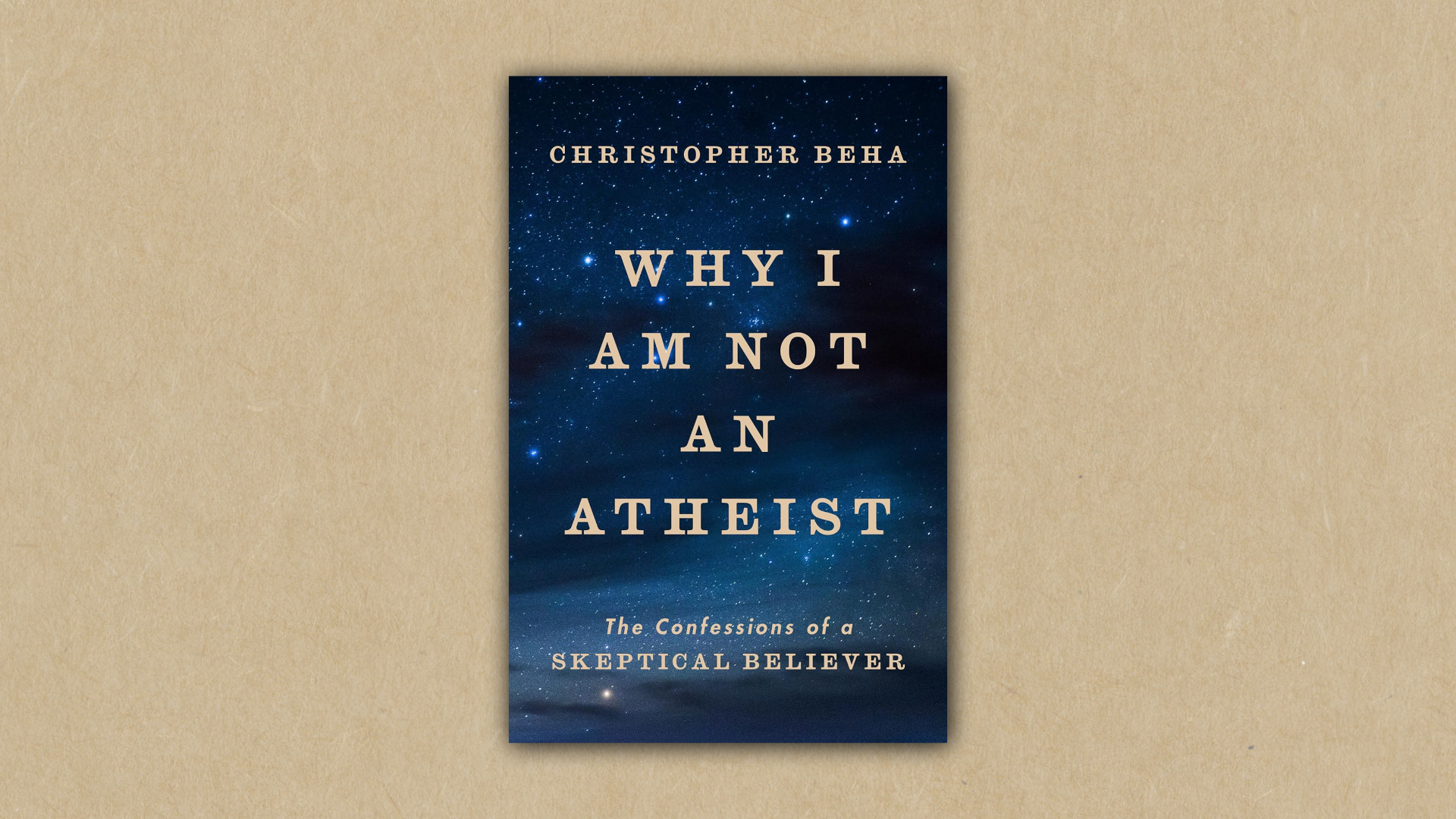
What would it look like to be truly skeptical—to doubt not only the supernatural but the “scientific” and “rational”? According to Christopher Beha, former editor of Harper’s Magazine, it might look like a journey through the different species of “unbelief” only to arrive back at a cautious yet hard-earned faith in God, love, and meaning. That’s the path he traces in Why I Am Not an Atheist: Confessions of a Skeptical Believer.
Written in response to Bertrand Russell’s famous book Why I Am Not a Christian, Beha’s volume is part memoir and part intellectual history of modern secular thought. It’s anything but dispassionate or dry. Instead, it reads like a “there and back again” tale, following Beha from childhood faith, to “trying on” every form of atheism he could find, to making his way (tentatively) home to God.
Beha recounts experiences that unsettled his belief: an angelic visitation he tried to dismiss as sleep paralysis, his battle with cancer during college, growing dissatisfaction with prominent atheist writers, and finally the transformative experience of love. The book is less focused on abstract proofs of God’s existence than on a practical question: Is it possible to live a meaningful life without God? Beha’s answer is ambiguous but hopeful, and worth reading.
Scientific Materialism
Beha argues that modern atheism can be broken down into two broad traditions. Neither is a “default” worldview into which reasonable people fall in the absence of religious belief. Both are systems of belief in their own right.
The first system, which he calls “scientific materialism,” begins with the premise that all knowledge comes from the study of objective matter. This is the atheism of Richard Dawkins, Christopher Hitchens, and Carl Sagan, who famously declared that “the cosmos is all that is, or ever was, or ever will be.” Materialism dismisses as superstition anything that can’t be measured, observed, or experimentally verified.
Beha traces scientific materialism back to Francis Bacon. But it evolved through the political theories of Thomas Hobbes and John Locke, the philosophy of Auguste Comte, the utilitarian ethics of J. S. Mill and Jeremy Bentham, as well as the scientific theories of Charles Darwin. Though these thinkers differ, Beha sees a family resemblance: Reality is reducible to physical processes; every “why” can be reframed as a “how” and every “how” as a “that.”
Therein lies the problem, argues Beha. Scientific materialism can’t answer the most important question: How should I live?
Scientific materialism can’t answer the most important question: How should I live?
The materialists who tried to answer suffered mental breakdowns, postulated absurdities, or became shockingly racist. Worse, materialism casts a shadow over freedom and mental experience, since it assumes that every phenomenon is reducible to physics, to cause and effect. You can’t believe in materialism without accepting that your beliefs are themselves caused by atoms colliding in your skull—making the whole worldview “internally contradictory” (44).
Romantic Idealism
The second atheistic system, which Beha dubs “romantic idealism,” seems more compelling and less internally incoherent. Here, subjective experience rather than objective matter becomes the starting point of knowledge.
As Beha observes,
[Romantic idealism] takes seriously, in a way that materialism does not, the question of what it means to view ourselves as the originators of whatever value and meaning exists in the world. This meaning-making project is the starting point of [the romantic idealist’s] work. They treat the nonexistence of God as a premise rather than a conclusion. (200)
According to Beha, the romantic idealist lineage runs through figures such as Immanuel Kant and G. W. F. Hegel, Jean-Jacques Rousseau, Arthur Schopenhauer and Friedrich Nietzsche, Edmund Husserl and Martin Heidegger, Jean-Paul Sartre and Albert Camus. Though not all were atheists, and they often stridently disagreed with each other, Beha links these men through a shared emphasis on the primacy of consciousness. The mind, not matter, is fundamental.
Unlike materialism, romantic idealism takes seriously the human hunger for meaning. It gives “creative imagination a central place in the meaning of life” and brings the “why” and even “who” of philosophy back into the picture (252). Only, in place of God, the “who” is the human individual, conditioning or entirely creating reality and giving it meaning, and the “why” is a question only we can work out for ourselves.
Leap of Faith in Love
Yet constructing your own worldview is also “incredibly isolating.” When we base reality on our own consciousness, writes Beha,
We each live alone. Other people exist as paper cutouts, characters in our world-making drama rather than fellow inhabitants of a shared world and we exist for them in just the same way. An unbridgeable gap separates us, and real community across the gap is impossible. (336)
Beha didn’t have a mental breakdown like Nietzsche or conclude like Camus that suicide is the only serious philosophical question. But he was afflicted with the chronic anxiety common to his heroes, reliant on alcohol, and less attracted to the existential romance of self-creation. Ironically, that’s when actual romance found him and led him back to God (sort of).
Meeting his wife was the death knell for Beha’s atheism. Her love was real to him in a way nothing else ever had been. And for something so wonderful to come from outside his head must mean that there really were things outside his head. If the love of this woman was real, why not the love of God?
Meeting his now-wife was the death knell for Beha’s atheism. Her love was real to him in a way nothing else ever had been.
In Christian existentialist Søren Kierkegaard, Beha found the final piece, a shocking alternative to both scientific materialism and romantic idealism: Yes, faith in the Christian God is absurd and unprovable from the outside. But so is every other worldview. “Belief,” Beha writes, “is something that we must live out. We must keep choosing it, and we won’t know until we are done whether we have chosen correctly” (382).
That choice ultimately led Beha back to the Roman Catholicism of his childhood, and to the Christian mystic teaching that not only is God love (1 John 4:8) but love is God (or the summation of his nature) (369). Yet by the end, the Christianity Beha professes still seems to owe as much to romantic idealism as it does to the book of Romans.
‘Not an Atheist’ Isn’t Enough
Beha seems strangely nonchalant about the fact that his wife prefers not to go to church or share in his beliefs, though Christianity traditionally holds that such people are in spiritual peril. He argues that a person who doesn’t really believe in Christ but goes through all the motions would functionally be a believer. And he seems unconcerned about sin, hell, or the judgment of God, all of which readers will be left thinking of as optional frills to open-ended faith in a nonspecific deity: “I try to act as though it were true,” Beha writes, “which I take to be a form of belief” (389).
It’s possible to read this as the faith of that father of a demon-possessed boy whom Jesus commended (“I believe; help my unbelief!” Mark 9:24). It’s also possible, and probably right, to see Christopher Beha as a smoldering wick God will not extinguish (Isa. 42:3). He may, like C. S. Lewis, be on his way through a vague theist phase that will end in orthodox belief.
Yet after reading a book like this, we’re still right to wonder whether being “not an atheist” is enough. What about revelation? What about Jesus and his “hard sayings” (John 6:60; 14:6)? Can we really experience and introspect our way to faith, or do we need Someone to reach in from outside and reveal truths philosophy could never have discovered? Is faith enough if someone glosses over the doctrines that make up the faith? Christianity’s answer is clear and stubbornly exclusive.
Why I Am Not an Atheist is an effective, often moving account of how unsatisfying it is to put some other idea—whether matter or mind—in God’s place. But it should also leave readers wondering whether its author is truly ready to let God define himself. It’s also a reminder for Christians that being spiritual can never substitute for the belief in the gospel.








 New Posts (Home)
 ChatBox
 Popular Posts
  Game Zone
 Top PodCasts