www.thegospelcoalition.org
Follow the Science . . . to God
“Follow the science” has been a pillar of the secular creed for some time—reaching a crescendo in the last decade as “Science Is Real” became a core confession in those briefly ubiquitous creedal yard signs.
But these pseudo-religious, virtue-signaling appeals to science were always selective to the “science” that supported certain political views. It was never “follow the science wherever it leads, even if it contradicts my bias,” but rather “follow the science when it leads to my side.”
But bias-confirming “science” isn’t science. True commitment to the scientific method means openness to confronting your bias—even having your mind changed. And as much as it may surprise ears conditioned by years of “faith vs. science” narratives, unbiased science has always been a friend to faith, not an adversary.
Unbiased science has always been a friend to faith, not an adversary.
This truth is increasingly unavoidable the more science discovers about the natural world. Science isn’t an obstacle to faith. As it has been in history before, it’s becoming again: a powerful draw into faith—an ally in evangelism, apologetics, and discipleship.
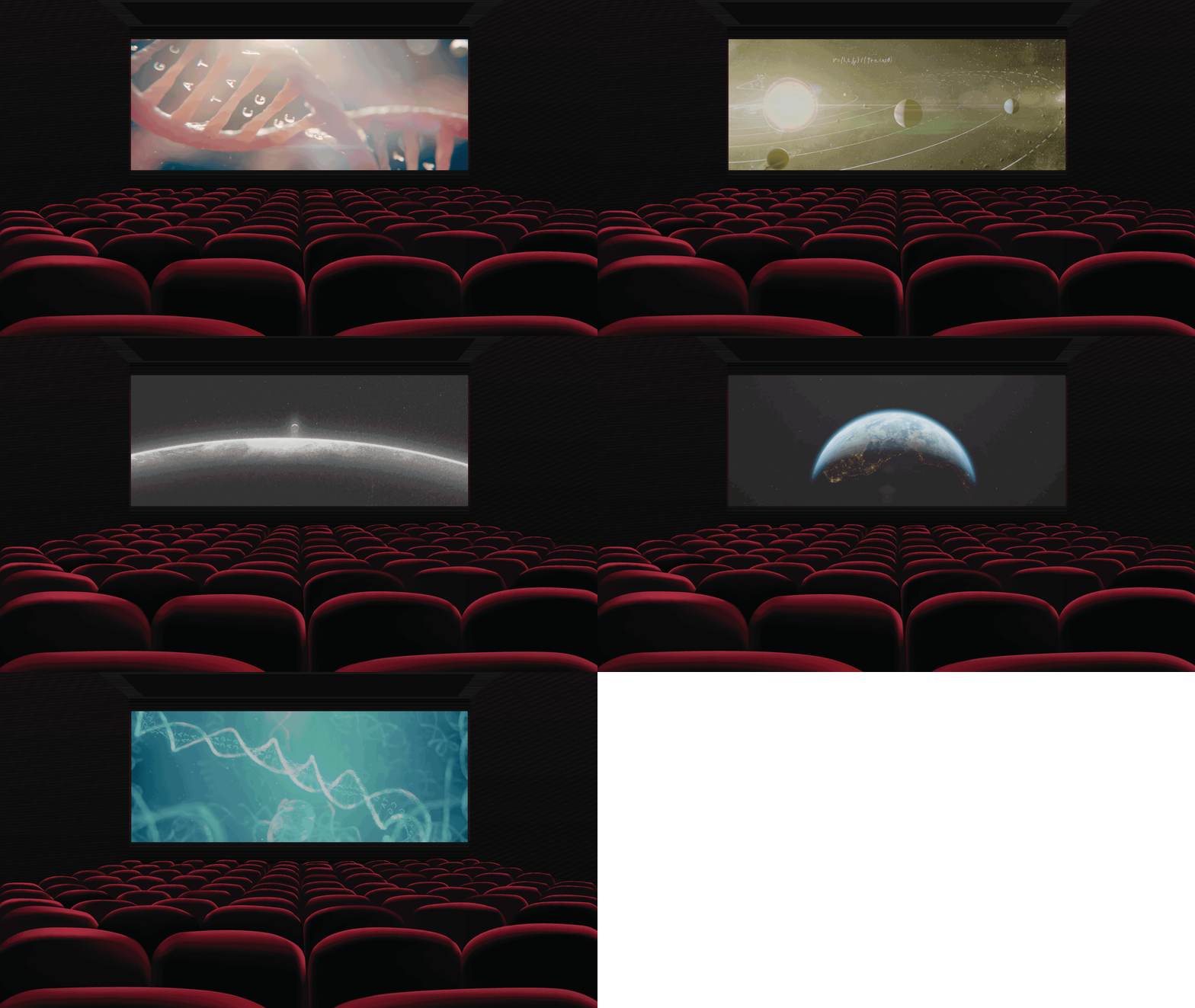
A new documentary, The Story of Everything (in theaters April 30 to May 6), does a great job showing why.
The Universe Began. Things That Begin Require a Cause.
Lee Strobel serves as executive producer of The Story of Everything. The film is narrated by Stephen C. Meyer and based on his best-selling book Return of the God Hypothesis: Three Scientific Discoveries That Reveal the Mind Behind the Universe.
The film features interviews with an impressive roster of scientists, cosmologists, and philosophers—John Lennox, Brian Keating, Sarah Salviander, and James Tour, to name a few. Meyer helpfully walks the viewer through a history of “the problem” of the universe’s beginning, citing Albert Einstein, Stephen Hawking, Fred Hoyle, Allan Sandage, and many others along the way.
With a title that riffs on the 2014 Stephen Hawking film, The Theory of Everything, The Story of Everything makes a powerful case for the mounting scientific evidence that an intelligent first cause—something outside space and time—created the universe.
What evidence makes this conclusion harder to refute? On the cosmological level, it mostly has to do with the undeniable fact that the universe isn’t infinite but finite—it began to exist at a point in the distant past. And as philosopher Timothy McGrew puts it in the film, “Whatever begins to exist is caused to exist by something else.” If the Big Bang set the universe in motion, what set the Big Bang in motion?
The “philosophical stopping point” of a first cause is a real problem for materialists—one they try to solve with far-fetched theories about multiverses and simulations. But these theories are simply “appealing to something supernatural to avoid the supernatural.” The simpler explanation is the theistic story: that an intelligent God outside space and time created space and time and everything in it.
The Universe Is Intricately Tuned. Who Is the Tuner?
The most compelling evidence presented in the film—and arguably the scientific frontier most threatening to the materialist worldview—concerns not the celestial but the cellular. The vastness of the cosmos is one thing; the complexity of the most minuscule building blocks of life (protein structures, DNA, RNA) is a whole other level of “wow!” It’s a “wow!” becoming more and more jaw-dropping with every discovery.
Scientific evidence is mounting that an intelligent first cause—something outside space and time—created the universe.
Cells were once thought to be amorphous blobs, but now scientists know a cell is “an enclosure of a sophisticated information storage, transmission, and processing system.” The informational character of molecular structures feels notably similar to binary code, which raises a question: If there is code in nature, who is the coder? Information indicates a programmer; it arises from consciousness, not material processes.
From the stars to the cells, and everything in between, the fine-tuning of the natural world everywhere speaks of an intelligent design.
Rising Generations Won’t See Science and Faith in Conflict
Films like The Story of Everything helpfully summarize how science points to a Creator. But I suspect the younger generations won’t even need to be convinced.
Science may have posed a threat to Christian apologetics in previous generations, but it won’t pose the same challenges for the next. The narrative that science and Christianity conflict already feels passé. For my kids’ generation, the conflict will probably only register as a curious period of history from the 19th and 20th centuries—from Darwin to Dawkins—when the “two books” of Scripture and nature were oddly pitted against each other.
Insofar as science studies the natural world and further uncovers its intricate mysteries, science will lead people toward God, not away from him. It’s only the science that focuses on technological transcending of the natural—transhumanism, transgender interventions, artificial wombs, and so forth—that will lead people away from God. The former reveals the logic of God’s created order. The latter replaces it.
The God-transcending, God-replacing form of science is alive and well, especially in the AI sector. But even those foolish paths of scientific hubris are bound by the immovable laws and logic of God’s reality. We’re seeing this now with the rapid collapse of the “science” behind transgender treatments and sex-change operations, which obviously lead to tragic outcomes. When you go against the grain of God’s design, you get splinters. There are two paths for science: Seek to understand and marvel at God’s reality, or seek to overcome it and get burned.
There are two paths for science: Seek to understand and marvel at God’s reality, or seek to overcome it and get burned.
I pray that many Christian young people today will pursue the former path—the God-honoring science modeled by Galileo, Kepler, Pascal, and Newton that enhanced theology and never sought to replace it. I pray that kids today will find heroic the sort of science modeled by Artemis II pilot Victor Glover, who recently led humans deeper into space than they’d ever gone. Glover is a scientist at the top of his field but also an outspoken Christian who speaks of “the beauty of creation” rather than a random nature. His faith even seems to have rubbed off on his nonreligious coastronauts.
Glover’s impromptu Easter dispatch from space (in an interview with CBS News) captures what The Story of Everything also conveys. Our planet is privileged, unique—one might say, graced. The perspective from space underscores it:
You guys are talking to us because we’re in a spaceship really far from Earth, but you’re on a spaceship called Earth that was created to give us a place to live in the universe, in the cosmos. . . . In all of this emptiness—this is a whole bunch of nothing, this thing we call the universe—you have this oasis, this beautiful place that we get to exist [in] together.
I love the image of an oasis. In the vast, cold darkness of the cosmos, we’ve been given a vibrant home, Earth, that isn’t only bountiful but beautiful. And the more we learn about our home—including our bodies within it—the more it feels less like a random wilderness and more like a master-planned garden. Less like an empty void and more like Eden.








 New Posts (Home)
 ChatBox
 Popular Posts
  Game Zone
 Top PodCasts