www.newsbusters.org
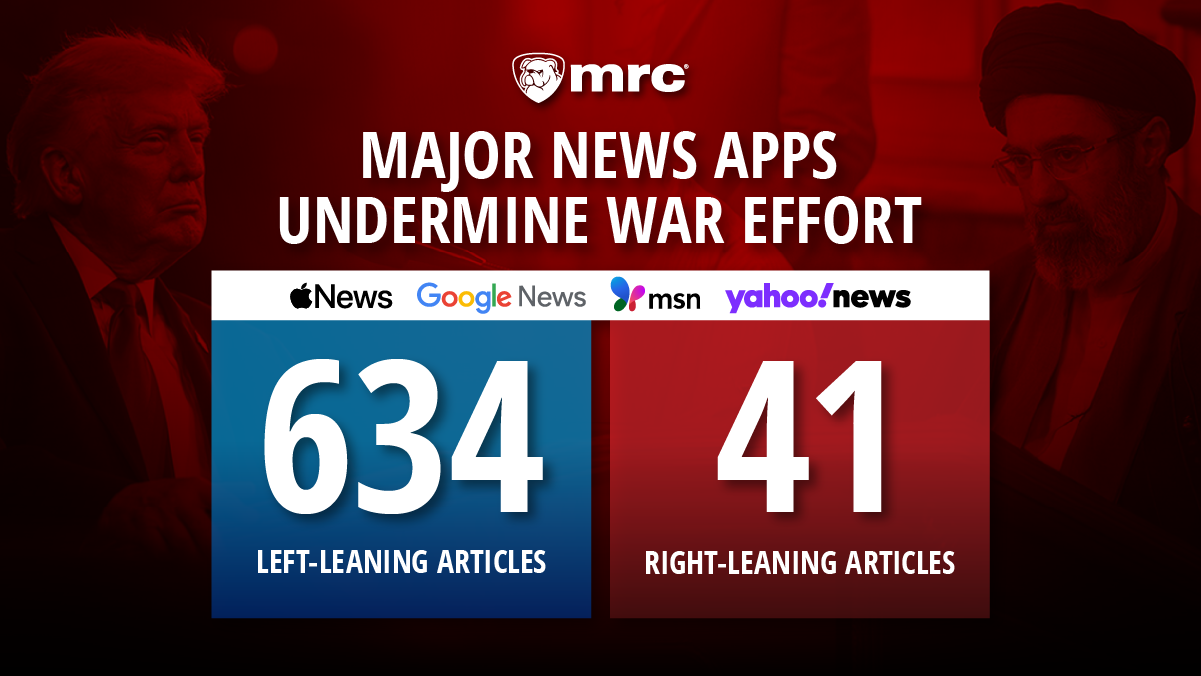
Special Report: 634 Left vs. 41 Right — While Trump Fights Iran, Big Four News Apps Attack Trump
EXCLUSIVE: Secretary of War Pete Hegseth sent the media into a frenzy after comparing their anti-American smears to the Pharisees’ plot against Jesus. His point wasn’t far off, but he left out a key piece: the Big Four News Apps amplified that same narrative.
The Media Research Center found that since the day after the Iranian conflict began, Apple News, Google News, Microsoft’s MSN and Yahoo News have launched a 50-day barrage targeting President Donald Trump and U.S. military operations against the Islamic regime with 634 articles from left-leaning outlets compared to a paltry 41 articles from right-leaning outlets. For example, Google News promoted a story from The New York Times headlined, “Trump’s Iran Threats Look Like Self-Incrimination for Potential War Crimes.”
Despite the unprecedented success of the U.S.-led action, the news aggregators’ curation of stories ensured that most Iran coverage in its top 20 morning editions from March 1 through April 19 came from left-leaning outlets, often using sensational, negative and fear-driven framing that undercut the United States and undermined the Trump administration’s efforts to win the war.
MRC’s Findings:
The Big Four News Apps all but shut out right-leaning coverage of the Iran conflict, restricting it to under 5% of total stories on the war (897) from AllSides-rated outlets, as left-leaning and other outlets dominated the narrative. Outlets like CNN, The Associated Press, The New York Times, CBS, The Guardian, NBC, The Washington Post and even Al Jazeera, Bloomberg and Salon enjoyed prominent placements.
Apple News: 232 stories — just 2 right-leaning vs. 143 left-leaning
Google News: 371 stories — 10 right-leaning vs. 284 left-leaning
Microsoft’s MSN: 136 stories — 22 right-leaning vs. 67 left-leaning
Yahoo News: 157 stories — 7 right-leaning vs. 139 left-leaning
The Big Four News Apps’ coverage distorted major developments in the conflict, portraying the Trump administration as unprepared.
The stories rarely included in their headlines a mention of the unparalleled success of the military action, including the complete destruction of the Iranian military capabilities and the elimination of its top command.
In response to these findings, MRC President David Bozell said: “We’re looking at one of the most effective military campaigns in modern history, Iran’s navy crippled, its air force grounded, its leadership dismantled, yet the Big Four News Apps, alongside the elitist media, are working overtime to undermine President Trump. It should outrage every American that Trump and Secretary Hegseth are fighting an information war at home while preventing Iran’s regime from obtaining a nuclear weapon.”
How the Big Four News Apps Tilted Iran War Coverage Left, Suppressing the Right
Hegseth has long rebuked the elitist media for unfairly smearing the administration and peddling attacks against the military. The barrage has been relentless, ranging from false accusations about U.S. strikes on drug-trafficking vessels to distorted reporting on internal personnel matters and wartime casualties.
Trust in media is collapsing, perhaps thanks at least in part to the Big Four News Apps. The MRC has long documented persistent bias across these platforms, which wield outsized influence over how Americans consume news.
Drawing more than 550 million visits each month, Apple News, Google News, Microsoft’s MSN and Yahoo News act as powerful gatekeepers, amplifying the left’s agenda-driven narratives while largely sidelining conservative perspectives.
This pattern of bias has played out across major political fights, from spinning the issue of border security and covering up for California’s hospice fraud to hiding scandals connected to Democratic officials. This time, the Big Four News Apps’ focus has turned to the U.S. armed conflict with the Islamic Republic of Iran.
In total, MRC identified approximately 897 stories related to the U.S.-Iran conflict. Of those, more than 70% came from left-leaning sources, while fewer than 5% came from their right-leaning counterparts. The imbalance, including the suppression of center outlets, meant millions of Americans who access news on their phones, computers and digital devices were largely exposed to one-sided coverage of one of the most consequential geopolitical conflicts of the modern era.
Hegseth has been sounding the alarm on this for years. In his bestselling book, The War on Warrior, he laid out what he sees as a sustained cultural campaign against the U.S. military, driven in large part by the same elitist media institutions shaping public perception. Those outlets now enjoy prominent placement across the Big Four News Apps.
Apple News, Google News, Microsoft’s MSN and Yahoo News have promoted some centrist and, to a very limited extent, right-leaning outlets within their top 20 selections, including Fox News. Still, the overall presence of center and right-leaning voices is relatively small in the broader dataset compared to the volume of elitist media outlets and wire services, most of which skew their reporting to the left. In coverage of the Iran conflict, the Big Four News Apps promoted the following outlets the most:
Reuters — 81
Yahoo-owned sites — 76
CNN — 67
The Associated Press — 66
The Wall Street Journal — 55
The New York Times — 45
CBS News — 44
The Guardian — 40
Fox News — 38
NBC News — 33
The Washington Post — 32
Al Jazeera — 27
Bloomberg — 26
BBC — 22
Apple News-owned pages — 22
Salon — 19
The Hill — 18
CNBC — 18
Axios — 18
Newsweek — 18
NPR — 16
ABC News — 15
Politico — 14
For Iran war coverage in particular, the Big Four News Apps did not promote the following outlets a single time over 50 days: the New York Post, The Daily Wire, The Washington Times, The Federalist, American Spectator, American Thinker, National Review, Washington Examiner and Washington Free Beacon, to name a few.
MRC found that many of the headlines and sources elevated by the digital news gatekeepers reflected consistent partisan framing, often aligning with narratives more commonly associated with Democratic talking points than neutral, fact-based reporting.
For instance, on April 16, Google News featured The Atlantic to explain the Trump administration’s rationale for its blockade of the Strait of Hormuz. The piece by The Atlantic, however, offered little in the way of explanation and instead tore into the administration’s move. By contrast, several other outlets covering the same development were excluded. The New York Post, American Thinker and Hot Air all had strong analyses to explain what The Atlantic purported to address, but failed.
This pattern spans nearly every major aspect of the conflict. Coverage from right-leaning sources is virtually nonexistent across the Big Four News Apps. Instead, coverage on Apple News, Google News, Microsoft’s MSN and Yahoo News — including oil prices, inflation, national security developments and broader international implications — was shaped by a predominantly left-leaning media ecosystem.
The Big Four News Apps’ Coverage Distorted Major Developments in the Iran Conflict
Some of the headlines promoted across the Big Four News Apps painted an apocalyptic view of the conflict by emphasizing terror alerts in the U.S., while other headlines painted the Trump administration as unprepared or unhinged.
On Apple News:
“Democrats grow bolder on talk about removing Trump from office after his Iran threats,” by Associated Press, promoted April 10.
“US faces elevated terrorism threats against backdrop of Iran war and cuts at FBI, Justice Department,” by The Associated Press, promoted March 15.
“Iran war puts many in US on high alert, but synagogue attack shows limits,” by Reuters, promoted both March 14 and March 15.
On Google News:
“‘Whole region is going to burn’: Iran's ‘living hell’ warning to US amid Donald Trump's threats of striking power plants,” by the Hindustan Times, promoted April 6.
“Trump Humiliated by Allied Pilot Who Downed $100 Million Worth of U.S. Jets,” by The Daily Beast, promoted March 5.
“How Trump and His Advisers Miscalculated Iran’s Response to War,” by The New York Times, promoted March 11.
On Microsoft’s MSN:
“Trump’s Chances of Being Removed by 25th Amendment Climb,” by Newsweek, promoted April 6.
“Pete Hegseth’s panicky, angry, weirdly religious Iran war briefing was painful to watch,” by The Independent, promoted April 17.
“'Disgusting and evil.' Trump faces MAGA backlash on Iran,” by USA Today, promoted March 3.
On Yahoo News:
“Trump’s new plan for Iran doomed to backfire,” by Salon, promoted March 5.
“Trump’s misguided ‘Christian’ war is anything but,” by Salon, promoted March 8.
“You Can Smell It Now: The Trump Presidency Is in Total Free Fall,” by The New Republic, promoted April 6.
“No One Is Intimidated by Trump Anymore,” by The New Republic, promoted April 7.
MRC found the Big Four News Apps flooded users with alarmist headlines warning of soaring oil prices and economic fallout, amplifying the 88% negative war coverage that MRC also observed across the evening newscasts of ABC, CBS and NBC from March 15 and April 15. Headline after headline directly tied rising gas prices and inflation to the Iran conflict, reinforcing a narrative of immediate crisis for American consumers.
MRC Vice President of Free Speech America Dan Schneider elucidated the point, stating, “Confusion around the world's most one-sided battle is fueled by tech giants spreading anti-Trump propaganda. Secretary Hegseth commands the world's greatest military, yet the Big Four News Apps and media push the Democrat narrative instead of acknowledging our troops' success in eliminating threats. ”
On Apple News:
“Trump says Iran war is ‘very complete, pretty much’ as economic toll rises,” by The Guardian, promoted on March 10.
“‘Outrageous': Sky-high gas prices are changing the way Americans live,” by USA Today, promoted April 1.
“Gas prices eclipse $4 a gallon in the US, the highest since 2022,” by The Associated Press, promoted April 1.
“March inflation report to offer first glimpse of Iran war's economic impact,” by NBC News, promoted April 10.
On Google News:
“Massive war price tag could be a massive problem for GOP leaders,” by Politico, promoted March 6.
“Trump’s Hormuz Deadline Lays Bare Scant Options,” by Bloomberg News, promoted April 7.
“Trump’s War in Iran, and Rising Gas Prices, Collide With Midterm Agenda,” by The New York Times, promoted March 10.
“What the Iran war could mean for gas prices, flights and your wallet,” by The Washington Post, promoted March 12.
“Oil is back above $100 despite Trump’s comments on ending the war,” by CNN, promoted March 24.
“Oil Market Set for Tumultuous Week as Kharg Attack Raises Stakes,” by Bloomberg, promoted March 15.
On MSN:
“Nobel economist Paul Krugman says the Iran war could be the 'straw that breaks the camel's back' for a fragile US economy,” Business Insider, promoted March 5.
“The fog of war is coming from inside the White House—and it cost oil markets $84 million in 10 minutes,” by Fortune, promoted March 12.
“It was supposed to be another boom year for the economy. March changed everything,” Business Insider, promoted March 30.
“Something is different about Trump’s $1 trillion war on Iran and its stress on the national debt, Harvard Kennedy scholar says,” by Fortune, promoted April 18.
On Yahoo News:
“America's average gas price saw its largest single-day jump in 4 years,” by Business Insider, promoted March 4.
“5 Everyday Items That Will Become More Expensive If the Iran Conflict Continues,” by Yahoo Finance, promoted March 4.
“Why the Iran war could make everything, not just oil, more expensive,” by Salon, promoted March 30.
“Are We on the Brink of a Global Debt Crisis?” by The New Republic, promoted April 6.
The Big Four News Apps Pushed Stories Rarely Including US Military Successes in Headlines
Another theme MRC identified was the consistent portrayal of Iran as muscular and defiant, even after the Trump administration and Israel annihilated much of its top leadership and severely degraded its military capabilities. Put together, these headlines read like outright cheerleading for a regime infamous for human rights abuses, threats against Western civilization and its relentless pursuit of nuclear weapons.
“Never before has the U.S. military been so effective,” said Schneider. “It is a spectacular military campaign, but you wouldn’t know it if you’ve been getting your news from these digital propagandists.”
On Apple News:
“Iran’s Supreme Leader Stays Off Camera to Issue Defiant Statement,” by The Wall Street Journal, promoted March 13.
“Iran Worries Talks Might Be a Trap,” by The Wall Street Journal, promoted March 24.
“Iran Vows to Escalate Attacks as Trump Hails Progress in War,” by Bloomberg, promoted March 5.
On Google News:
“Trump’s Iran Threats Look Like Self-Incrimination for Potential War Crimes,” by The New York Times, promoted April 8.
“To Open the Strait of Hormuz, Trump Wants to Blockade Iran. Experts Are Skeptical.” by The New York Times, promoted April 13.
“Iran warns U.S. troops will be ‘set on fire’ if Americans launch ground operation,” by CBS News, promoted March 30.
“Trump and Netanyahu want regime change, but Iran’s regime was built for survival. A long war is now likely,” by The Conversation, promoted March 1.
“Iran war updates: Trump vows hard strikes; Tehran says will not surrender,” by Al Jazeera, promoted March 7.
“The Most Dangerous Man,” [referring to Mojtaba Khamenei] by The Atlantic, promoted on March 9.
On MSN
“Iran sends first significant message of de-escalation, but with a major caveat,” by CNN, promoted March 8.
“Iran gives Trump an ultimatum on JD Vance,” by The Daily Beast, promoted March 25.
On Yahoo News:
“Defiant message from Iran as vessels attempting to cross Hormuz report gunfire,” by Reuters, promoted April 18.
“Iran doubles down on closing Strait of Hormuz as ceasefire nears expiration,” by Politico, promoted April 19.
Recommendations
Fairer, more balanced coverage: The Big Four News Apps should integrate quality journalism from more right-leaning sources into their platforms to ensure a diverse range of perspectives is available to their audiences. Unlike what Google News did, pushing The Atlantic to explain Trump’s reasoning for the “blockade” of Iran, the digital news gatekeeper could have turned to right-leaning outlets that wrote the story instead, like the American Thinker, HotAir or the New York Post. This approach would not only help mitigate bias but also enrich the diversity of news content provided, fostering a more comprehensive understanding of current events among users.
Transparency: News aggregators should implement greater transparency in the algorithms and editorial decisions used for curating news content. These algorithms should be audited regularly by independent third parties to ensure that they are not suppressing content from either end of the ideological spectrum. Public reports on these audits would increase accountability and provide insights into how content is selected and displayed.
Respond to the FTC: To address public concerns and demonstrate accountability, it is crucial for Apple's CEO, Tim Cook, to respond promptly and transparently to the FTC's letter regarding Apple News. A thoughtful response could include outlining steps Apple is taking to address any identified issues, thereby reinforcing public trust and demonstrating leadership in promoting a diverse media landscape.
Methodology: During the time period March 1, 2026 - April 19, 2026, MRC researchers examined the top 20 stories featured on Apple News, Google News, Microsoft’s MSN and Yahoo News each day in the mornings at approximately 8:30 AM ET. MRC researchers used the AllSides media bias ratings, which categorize an outlet as “left,” “lean left,” “center,” “lean right” or “right” to determine the overall bias presented by the Big Four News Apps and analyzed the results. MRC searched the specific keywords in the data sets, in addition to a manual review in search of Iran-related stories. Those keywords were: Gas, Hezbollah, Hormuz, Iran, Iranian, Iraq, Israel, Jet, Khamenei, Kharg, Lebanon, Middle East, Middle East War, Mideast, Oil, Pentagon, Strait, Tanker, Tehran and War.








 New Posts (Home)
 ChatBox
 Popular Posts
  Game Zone
 Top PodCasts