www.upworthy.com
Why some shoppers avoid self-checkout (even when it’s faster), according to psychologists
Which lane do you choose at the grocery store?
To your left, the self-checkout area: a collection of blinking, beeping, whirring, computer-speaking machines with bright LED screens and audible prompts to “please select a payment type.” To your right, a single lane with a human cashier…and a line that snakes into the next aisle and out of sight.
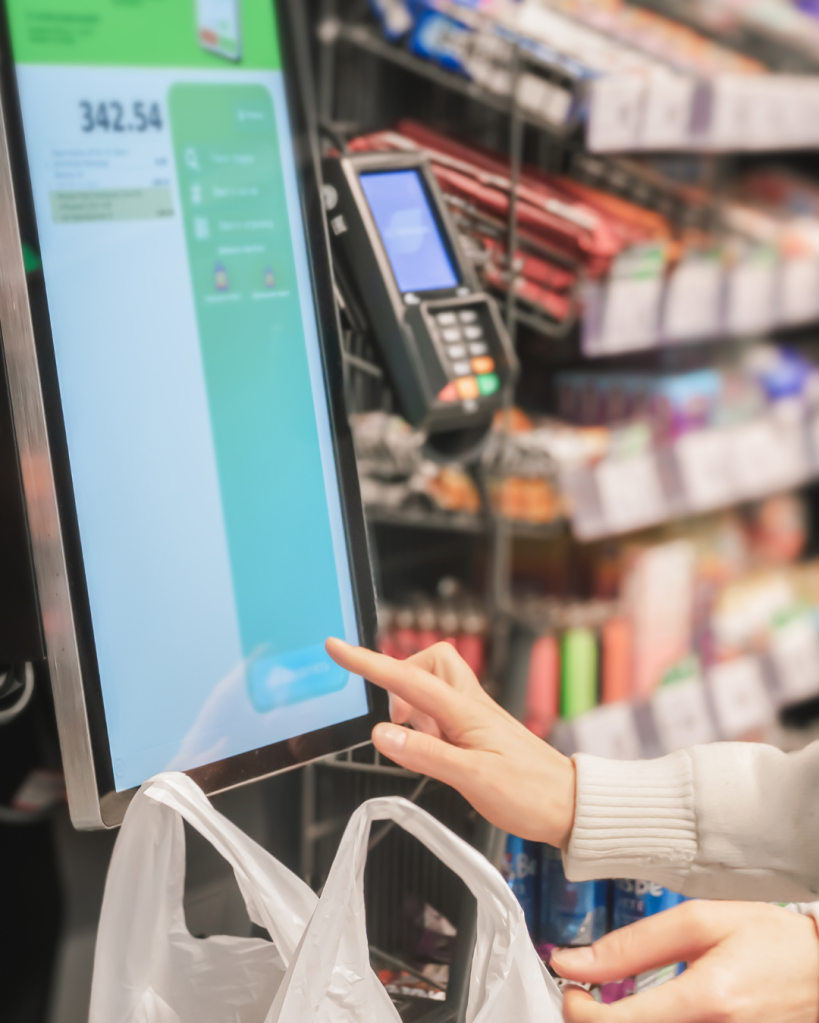
A person using the self-checkout at a grocery store. Photo credit: Canva
You look down. You have six things; the math is obvious. The kiosks will be faster.
But somehow, you and your little basket find yourselves at the back of that winding line.
What’s going on here? If you have ever steered your cart away from self-checkout, even when it is the faster, more efficient option, you are not alone. It may seem like a simple preference on paper: You’re either a “kiosk person” or a “not-kiosk person.” Optimized or old-school. But for many shoppers, that choice is rooted in a human desire for connection and emotional safety, and a small, stubborn refusal to do more work under cameras.
A ritual quietly disappears
Within a single generation, grocery shopping moved from “you hand your stuff to a person” to “you become the person.” For most of the 20th century, buying groceries meant interacting with at least one other human: You chose the lane, loaded items onto the belt, and handed your entire life—cloves of garlic, wine that costs $2, strawberry ice cream, tissues infused with lotion and Vicks VapoRub—to another person. They scanned, bagged, and told you, “Have a good night.”
Today, 40% of checkout lanes at major U.S. grocery chains are self-checkout. They are everywhere: In 2026, 96% of grocery stores in the U.S. offered self-checkout technology, while 86% of consumers claim to use it. You scan. You bag. You look up codes for organic green onions. You do all this on camera, with a disembodied voice ready to tell you about an “unexpected item in the bagging area.”
There was a time when a “full-service checkout” meant that someone else—a trained professional—handled everything. They asked about your day, made sure that egg cartons never wound up at the bottom of your bag, and sometimes carried everything out to your car. It felt like being taken care of.
Self-checkout machines didn’t just replace a series of tasks. They erased the human at the end of a grocery trip.
The importance of “weak ties”
So, you avoid self-checkout lines. Psychologists say a few different things are going on here.
Researchers use the term “weak ties” for the small, casual relationships we maintain with people we don’t know well: the kind cashier who always smiles, the guy behind the fish counter who saves his best salmon for you, and the bus driver who recognizes your face even if they don’t know your name.
Weak-tie connections make you feel important in the world. Photo credit: Canva
Brief, ordinary, easy to overlook—and, for many people, irreplaceable. Toni Antonucci, a professor of psychology at the University of Michigan, explained the significance to the Daily Mail: Weak ties are “somebody who makes you feel important in their world—somebody who makes you feel human.”
When self-checkout replaces the cashier, it eliminates one of the last reliably recurring weak-tie interactions in many people’s daily lives.
Studies on social connectedness show that these fleeting moments play an important role in our day-to-day lives and measurably improve our mood and sense of belonging, particularly for people who otherwise move through their days in relative isolation.
Imagine the person who works from home or whose apartment falls quiet by 9 a.m. When that cashier remembers something they mentioned weeks ago, they experience the “weak-tie connection.” It’s not friendship. But on certain days, it’s the only exchange that reminds them they exist outside their apartment. It’s a microdose of belonging: proof that they still live in the minds of others.
When habits don’t meet expectations
Researchers who study checkout behavior note that many shoppers—particularly older ones—carry a strong expectation that being served by a person is simply part of what it means to be a customer. It is not entitlement in the pejorative sense. It is a social contract that made sense for decades: You bring items to the cashier, and they handle the transaction. When a kiosk breaks that contract and hands the transaction back to you, it is not just inconvenient; it feels like a small breach in the way the world works.
If you have spent 50 years handing your groceries to a human, your nervous system quietly codes that as “how this is supposed to work.” A touch screen, no matter how “user-friendly,” does not feel like a convenient feature. It makes many older shoppers ask, “Wait, why am I suddenly doing this part myself?”
“These systems aren’t really about innovation or collaboration between companies and consumers,” said Mathieu Lajante, a business management professor at Toronto Metropolitan University. “They’re about maximizing profits while weakening social norms of reciprocity and responsibility.”
Layer tech anxiety on top of that—worrying about “doing it wrong,” getting stuck in the bag selection menu, holding up the line—and the kiosk feels antagonistic. It is an intrusion into a ritual they have followed for decades.
“Am I supposed to be doing this? Really?”
People who do not like self-checkout often hold a strong sense of how labor should work. They remember when a grocery trip included a checker, a bagger, and sometimes even someone who walked your cart out. In their mental contract, paying for groceries includes paying for human help: people who do the things you’re bad at, like the game of Jenga happening in your brown paper bag.
Handing that job to a machine—and, by extension, back to them—can feel like a tiny erosion of what they’re owed as a customer.
When they say, “I’m not doing that—that’s not my job,” it’s not “self-entitlement” or brattiness: it’s a fairness instinct kicking in. They’re refusing to do unpaid work.
All the small stuff in between
Research shows that people who prefer human lanes are often at least partly extroverted: They get energy from small talk, feel safer in familiar social scripts, and like the feeling of being known in their regular spots. Even if they’re shy in other areas of life, the grocery line gives them a structured stage where they know their role and the beats.
And for some, there’s a softer motive: protection. They want to preserve human workers and, by extension, a way of life. They’ve watched their local supermarket cut hours, close lanes, and replace faces with screens. Choosing a cashier feels like a tiny act of solidarity: “If I keep standing here, maybe this job doesn’t disappear as fast.”
3 big reasons you might be right
Then there are the people who see that same setup—self-checkout kiosks to the left, a single checkout lane, and a long line to the right—and make the opposite call.
@idanabada Self checkout store in LAX. The future is here! #ai #lax #store #shopping #cheetos #doritos ♬ original sound – Idan Abada
You know them: the person who snakes past the full‑service lanes and beelines for the one open machine. They move at their own pace, bag their groceries the way they like (frozen together, produce on top, no smashed bread), and skip the part where they talk to a stranger. They can buy late‑night junk food, an embarrassing product, or six cans of cat food and wine without bracing for a comment.
“When you’re at a cashier register, the cashier sees everything you purchase. When you’re at self-checkout, you can control what others see, so you might be more likely to buy embarrassing items.” – Becca Taylor, University of Illinois Urbana-Champaign
Plenty of introverts and people with social anxiety describe kiosks this way. They don’t hate people; they have a limited social battery, and they’d rather use it for work, friends, kids, or a long Lyft ride to the airport. A machine that lets them coast through in near‑silence feels like mercy.
1. You’re doing unpaid labor
Here’s where the research complicates the convenience story. Across four separate experiments, researchers found that shoppers using self-checkout felt less rewarded, less satisfied, and less likely to return compared to those who used a staffed lane.
According to these studies, when you do everything—scan, bag, troubleshoot—this extra effort can shrink the feeling of reward. That means dollars saved and loyalty points don’t hit the same when you’ve had to work for them. You feel like you’re owed something.
Are you doing labor at the self-checkout lane? Photo credit: Canva
Santiago Gallino, a professor at The Wharton School of the University of Pennsylvania, states this plainly: “For retailers, it’s a combination of cutting labor and adding flexibility. It’s not to make checkout more efficient. They are basically transferring the labor to the customer.”
Self-checkout didn’t show up because shoppers begged for more chores; it showed up because it lets stores shift paid labor onto us without lowering prices. We didn’t vote for fewer workers; we voted for the only thing the store put in front of us.
2. It’s possible you’re being watched while you work
Self-checkout stations rely on a kind of slightly menacing, almost dystopian level of ambient suspicion: overhead cameras, weight sensors that double-check every bag, pop-ups that demand an attendant’s key before you can move on. AI-based loss-prevention systems increasingly use computer vision and facial recognition to flag suspected shoplifting.
Retailers say this is necessary—theft occurs at a much higher rate at kiosks than traditional lanes—but the solution includes treating everyone like suspects. When you use a self-checkout kiosk, you can see yourself on a little security screen in the corner. So can their security team, and they’re watching closely.
Psychologists would call this a fairness gap: doing more work while being trusted less. Investigations have found that these cameras and the AI systems running them mis‑flag people of color more often, which makes every beep feel a little more loaded.
“AI technologies frequently mirror existing inequalities as they are developed by individuals in environments lacking diversity, which prevents the technology from being fair. If the same stereotypes that are used to profile Black individuals in daily interactions are integrated into algorithms, the resulting facial recognition systems will perpetuate those stereotypes as a human would.” – Shaun Harper, Forbes
3. The plight of the kiosk keeper
Meanwhile, the workers who once stood at a single lane are now sent to babysit the self-checkout kiosks, responsible for eight machines at once. They half‑jog from flashing light to flashing light while a walkie‑talkie crackles in their ear and apologize for errors they didn’t cause. Helper and hall monitor, all in one fluorescent vest. The employee who runs the self-checkout corral holds an impossible dual role: be warm, be helpful, and also watch for theft while fielding the frustration of kiosk users who all think their machine is broken.
Research from the Harvard Shift Project, which surveyed tens of thousands of service-sector employees, found that stores with self-checkouts were more likely to be chronically understaffed and that understaffing drove higher rates of customer hostility aimed at the employees who remained.
So, what’s your choice? Photo credit: Canva
What’s really at stake at the checkout lane
Let’s be clear: self-checkout lanes aren’t evil. But when we reduce everything to “convenience,” we miss what’s really at stake.
That little fork in the floor—screens on one side, a person on the other—has become one of the everyday places where we decide how much work, how much watching, and how little conversation we’re willing to accept in exchange for speed.
The post Why some shoppers avoid self-checkout (even when it’s faster), according to psychologists appeared first on Upworthy.








 New Posts (Home)
 ChatBox
 Popular Posts
  Game Zone
 Top PodCasts