www.newsbusters.org
Capehart Insists Assassination Attempt Was Just Common Gun Violence
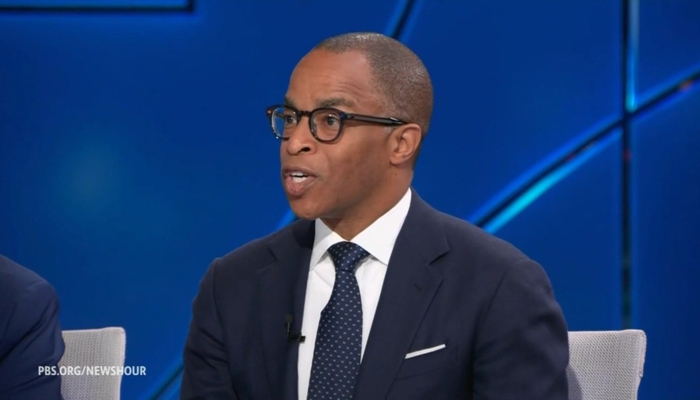
MS NOW host Jonathan Capehart had a rough Friday night on PBS News Hour. For one thing, he got triggered when the usually amenable The Atlantic staff writer David Brooks pointed out that progressives are more likely to support political violence than conservatives, which hurt his ability to argue the Saturday assassination attempt against President Trump was just another incident of common gun violence. Capehart later, and without evidence, also alleged the Supreme Court’s Voting Rights Act decision earlier in the week is dragging the country back to the way it was prior to 1965.
Brooks was looking to the future with a sense of dread when he declared, “And I look at the 2028 election with a great sense of foreboding. And if you look at who thinks violence is justified, it tends to be younger people by a lot. Most progressives and most conservatives oppose violence, but you get two and a half times as many progressives say it's justified than not.”
MS NOW host Jonathan Capehart had a rough night on PBS last night. First, he didn't appreciate David Brooks pointing out progressives are more likely to support violence than conservatives, "I'm not going to just let the comment that, you know, progressives, you know, more than… pic.twitter.com/9vt9SlFklh
— Alex Christy (@alexchristy17) May 2, 2026
He also lamented how casual some recent assassins or would-be assassins have been, “But what strikes me about this guy, about the guy who shot in Butler, about the guy who shot Charlie Kirk, they don't seem to have thought about it that much. It's not like they have—they're radicals who have a big manifesto and an ideology. It seems almost flippant the way they go into these things, almost like half thought through and jokey. And I can't quite make sense of what that kind of light-hearted nihilism that drives people to, on a whim almost, do something that is horrific and life-changing.”
Capehart began his response by huffing, “I'm not going to just let the comment that, you know, progressives, you know, more than folks on the far-right are, you know, think that violence is justified. It is something that the American people feel—they're a little more comfortable with it than they were, say, five, 10 years ago.”
It is telling that Capehart objected to Brooks’s claim, but he never actually disproved it. The polls show what they show and they show Brooks is correct. However, Capehart moved on to his recollections of being at the WHCD on Saturday, “I have never been in a situation like that. But as an American and certainly as a journalist, having to cover all of these things and to listen to the recordings and the films, you sort of learn through osmosis what to do.”
That led him to claim, “The bigger issue here is gun violence, that why was I not surprised that this had happened? And I have been to that dinner at least a dozen times since 2000. And so, yes, there's an issue of, you know, people feeling that political violence is the way to go and that we are in a highly charged atmosphere. But what's been, sort of, a specter over all of us for even longer is the scourge of gun violence.”
Later, Capehart reacted to the Supreme Court’s VRA ruling by trying to chastise the majority, "For those justices in the majority to say that, ‘Oh, well racism is over in voting and we don't need this anymore,’ I keep thinking about what Justice Ginsburg said in her dissent in the Shelby v. Holder case, which invalidated Section 5, the preclearance portion.”
Later, with no evidence, Capehart also suggested the Supreme Court is dragging the country back to the way it was prior to 1965, "for Justice Alito to focus on the elections of 2008 and 2012, when there was a black man on the ballot, to say that racial disparities are no longer a… pic.twitter.com/tlT9w8RzSh
— Alex Christy (@alexchristy17) May 2, 2026
Quoting Ginsburg, he continued:
She wrote, ‘Throwing out preclearance, when it has worked and is continuing to work to stop discriminatory changes, is like throwing away your umbrella in a rainstorm because you are not getting wet.’
And so for Justice Alito to focus on the elections of 2008 and 2012, when there was a black man on the ballot, to say that racial disparities are no longer a problem, and then ignoring that Shelby in 2013 led to just a rush of changes in voting laws in the states, is to ignore reality and to ignore history and to drag us back to a time when America was not America.
Again, Capehart never attempted to prove that post-Shelby laws are akin to “a time when America was not America,” probably because it is an absurd thing to claim.
Here is a transcript for the May 1 show:
PBS News Hour
5/1/2026
7:29 PM ET
DAVID BROOKS: And I look at the 2028 election with a great sense of foreboding. And if you look at who thinks violence is justified, it tends to be younger people by a lot. Most progressives and most conservatives oppose violence, but you get two and a half times as many progressives say it's justified than not.
But what strikes me about this guy, about the guy who shot in Butler, about the guy who shot Charlie Kirk, they don't seem to have thought about it that much. It's not like they have—they're radicals who have a big manifesto and an ideology.
It seems almost flippant the way they go into these things, almost like half thought through and jokey. And I can't quite make sense of what that kind of light-hearted nihilism that drives people to, on a whim almost, do something that is horrific and life-changing.
AMNA NAWAZ: Jonathan, how do you look at it?
JONATHAN CAPEHART: Well, excuse me, I'm not going to just let the comment that, you know, progressives, you know, more than folks on the far-right are, you know, think that violence is justified.
It is something that the American people feel—they're a little more comfortable with it than they were, say, five, 10 years ago. Amna, you and I were in that room. We walked through the magnetometers together. We stood in that spot.
NAWAZ: Right
CAPEHART: The thing now, a week out, that I have been thinking about, and I keep coming back to it, is that, when I heard the five bangs, I remember hearing five very loud bangs, my immediate action was so instinctive, drop to the floor under the table and be quiet.
I have never been in a situation like that. But as an American and certainly as a journalist, having to cover all of these things and to listen to the recordings and the films, you sort of learn through osmosis what to do.
And, to me, the bigger issue here is gun violence, that why was I not surprised that this had happened? And I have been to that dinner at least a dozen times since 2000. And so, yes, there's an issue of, you know, people feeling that political violence is the way to go and that we are in a highly charged atmosphere.
But what's been, sort of, a specter over all of us for even longer is the scourge of gun violence.
…
CAPEHART: The Voting Rights Act of 1965 is what killed Jim Crow. The VRA is only 61 years old.
When it was passed and became law, it was the first time America truly was a democracy, meaning that the words in the Constitution equally applied to all of its citizens, including African Americans, by giving them the right to vote, 61 years. I am 58 years old. My mother is 84.
So, my mother is older than true American democracy. And so for those justices in the majority to say that, “Oh, well racism is over in voting and we don't need this anymore,” I keep thinking about what Justice Ginsburg said in her dissent in the Shelby v. Holder case, which invalidated Section 5, the preclearance portion.
And she wrote, "Throwing out preclearance, when it has worked and is continuing to work to stop discriminatory changes, is like throwing away your umbrella in a rainstorm because you are not getting wet."
And so for Justice Alito to focus on the elections of 2008 and 2012, when there was a black man on the ballot, to say that racial disparities are no longer a problem, and then ignoring that Shelby in 2013 led to just a rush of changes in voting laws in the states, is to ignore reality and to ignore history and to drag us back to a time when America was not America.








 New Posts (Home)
 ChatBox
 Popular Posts
  Game Zone
 Top PodCasts