www.thegospelcoalition.org
Carl Trueman’s Answer to the Modern Self
Every generation has a defining theological challenge: a doctrine thrust into public view by events and cultural pressures. For example, 25 years ago, the September 11 terrorist attacks required reflection on the nature and character of the triune God of the Bible in juxtaposition to Allah. Our particular moment—riddled with moral issues like pornography, abortion, same-sex marriage, transgenderism, artificial reproduction, and physician-assisted suicide—demands articulation and defense of the image of God.
Carl Trueman, professor of biblical and theological studies at Grove City College, has kept publishers and readers busy with his responses to cultural challenges related to theological anthropology. In 2020, Trueman’s Rise and Triumph of the Modern Self introduced many to expressive individualism, an anthropology developed through Jean-Jacques Rousseau, Friedrich Nietzsche, and Charles Darwin. After reducing and reworking Rise and Triumph’s content in Strange New World, Trueman produced a treatment of critical theory and identity politics in To Change All Worlds.
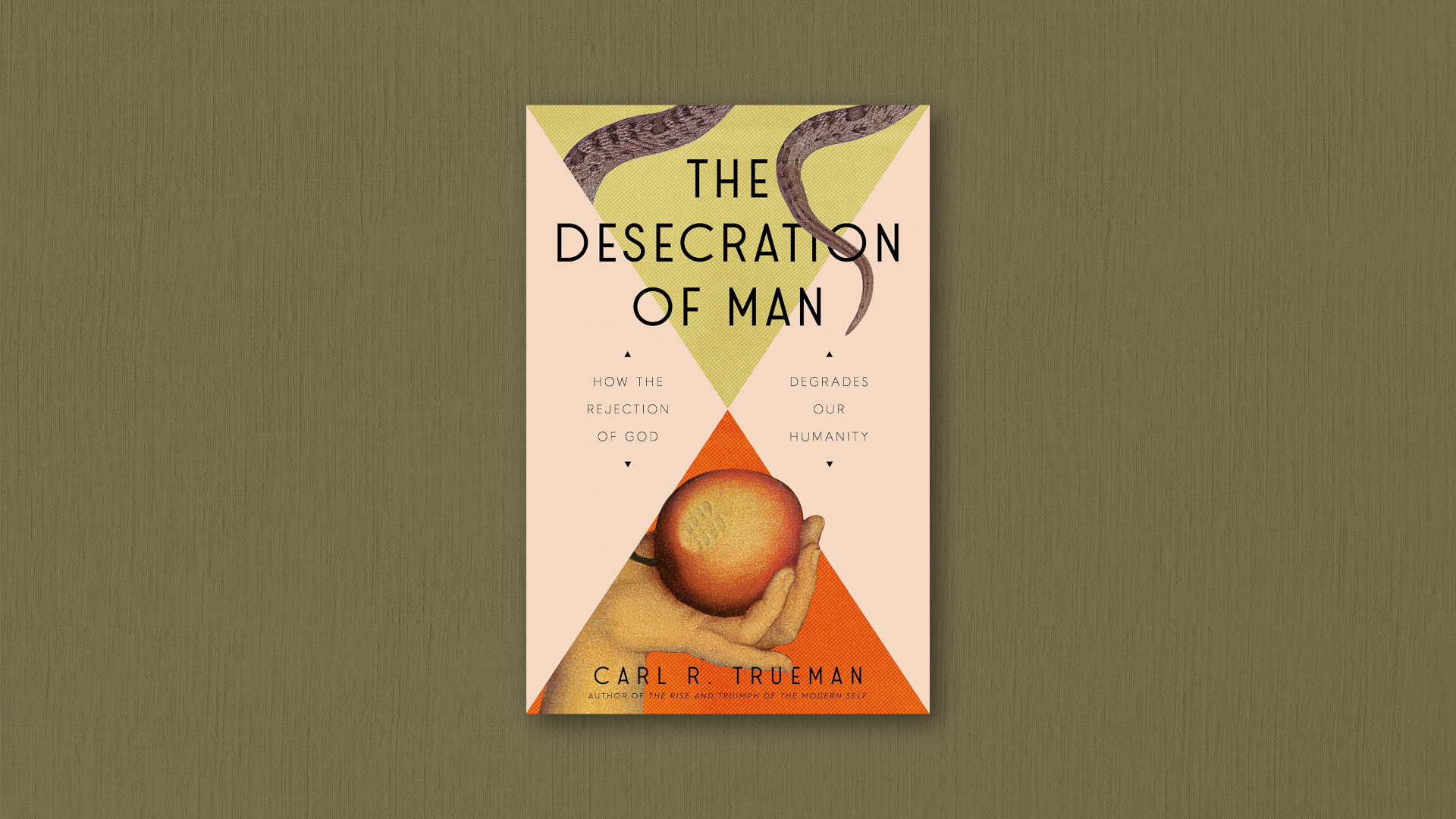
Trueman’s latest work, The Desecration of Man: How the Rejection of God Degrades our Humanity, introduces a wider audience to the importance of theism and theological anthropology for social ethics. This is an important volume for understanding our culture.
Importance of Anthropology
The book’s setup is a question Trueman was asked on the Triggernometry podcast: “Is it possible to build a moral society without a belief in God?” (2). In prior generations, this question by the atheistic hosts would have been a “gotcha” moment, but in Trueman’s telling it was a sincerely asked question, and The Desecration of Man is Trueman’s sincere answer. In short, he says no.
Western morality is grounded in a conception of man as made in God’s image. As Trueman explains,
Man is who and what he is because God has made him so. Any significance, any meaning, any value he has is rooted in the divine act of creation that assumes the reality of God as divine creator. . . . Anthropology is inseparable from theology. (6)
He goes on to argue,
[Morally,] human beings are created by God with a given set of dependencies and obligations, limits, and ends. We are rational, dependent, limited, and teleological beings. And the ways in which we formalize these traits are the moral codes that define what it means to be human. (12)
Accepting this definition is particularly important in light of evolving technologies.
The anthropological question isn’t a 21st-century problem; it has roots in early modernity. In Nietzsche’s parable of the madman, a prophetic character arrives in a modern city square populated by atheists and accuses them of killing God, with the result that man would need to become gods themselves.
Western morality is grounded in a conception of man as made in God’s image.
Nietzsche’s prophet is mocked for two reasons. First, though severed from theistic roots, the anthropological and moral flowers hadn’t yet begun to wither. Second, the lack of certain technologies meant there was neither the social imaginary nor the capability to throw off certain aspects of Christian anthropology and morality. Technology has since significantly expanded our capability to pursue “godlike aspirations” by changing the way we relate to time, nature, and our own physical bodies (36).
Technology and Humanity
Few readers will be surprised that Trueman makes the case that abortion, contraception, and pornography desecrated sex and, therefore, humanity. However, even some conservative evangelicals will likely be uncomfortable as he evaluates other technologies like those involved in assisted reproductive technologies and surrogacy.
For example, Trueman argues,
By detaching conception from sexual union, IVF reinforces the logic of the sexual revolution. . . . If contraception, legalized abortion, and antibiotics allowed us to think of sex as recreation rather than something that carried obligations and thus commitment, so with IVF the imaginative breach between sex and reproduction is further strengthened. Sexual union of a man and a woman is no longer essential. It becomes merely one option for the creation of children. (123)
Trueman handles IVF and surrogacy with care, recognizing the natural human desire to be a parent and the suffering of infertility that often drive people toward those technologies. However, he’s also clear that right-wing tech bros who use IVF and offer surrogacy coverage in their employee benefits aren’t morally blameless.
On the other hand, some faithful evangelical ethicists argue for a qualified embrace of reproductive technologies while also valuing theological anthropology. Though I agree with Trueman’s final position on IVF, aspects of the ethical analysis were simplified as he made his bigger cultural argument.
IVF is one example of several that Trueman offers, but it’s significant because too often conservative theologians chastise feminists who shout their abortions yet don’t stop to consider the antihuman tendencies of those who hew closer to their own ideology. A robustly biblical worldview will critique trends to both the left and the right.
Technology and Ideas
Popular books on society and technology, like Jonathan Haidt’s The Anxious Generation and Christine Rosen’s The Extinction of Experience, are generally uninterested in the origins of particular technologies. Rather, they focus on technology’s detrimental effects and what institutional leaders and parents can do to respond. Yet it’s always helpful to ask where those technologies came from so we can get ahead of their effects.
Trueman traces the history of the ideas that drive humanity’s desecration. He notes that in earlier stages of modernity, “the belief that there was such a thing as human nature” kept society “from devolving into pure subjectivism” (52). Technology changes our perception of human nature, but our perception of human nature also shapes the technologies we develop. We exist along a spiral, not a linear vector, of change. That means there’s hope for a recovery of more humane ideas.
In The God Who Is There, Francis Schaeffer expresses concern that religious leaders were late in dealing with the movement of ideas through culture. Ideas usually begin in academic philosophy. Then ideas move into art and music, which in turn shape popular culture. Schaeffer observes that because Christian leaders weren’t paying attention to the upstream issues, ordinary Christians were encountering persuasive ideas before the church had a theological framework for them.
A robustly biblical worldview will critique trends to both the left and the right.
In large part, Trueman is doing what Schaeffer prescribes by wrestling with the ideas that shape our culture before they’re fully entrenched.
Yet Trueman and Schaeffer have different approaches. Trueman’s “is not a book of Christian apologetics.” This volume, published by Sentinel rather than an evangelical publisher, points people toward the need to “embrace the Christian faith, with its dogmas, its cultic practices, and its ethics,” but it doesn’t provide a roadmap to get there (xix–xx). It’s a book that points toward the church from outside.
In contrast, Schaeffer wrote primarily to the church, so the particulars of the gospel are much clearer. Hopefully, Trueman’s careful arguments will lead readers to further investigate the truths he points toward.
Trueman’s title echoes that of C. S. Lewis’s The Abolition of Man. Both books address the ways subtle cultural trends undermine a biblical view of humanity. Like Lewis’s classic, The Desecration of Man will help church leaders understand the philosophical currents shaping our culture.








 New Posts (Home)
 ChatBox
 Popular Posts
  Game Zone
 Top PodCasts