www.newsbusters.org
CBS Mornings Documentary Preview Blames End of Roe v. Wade for Maternal Deaths
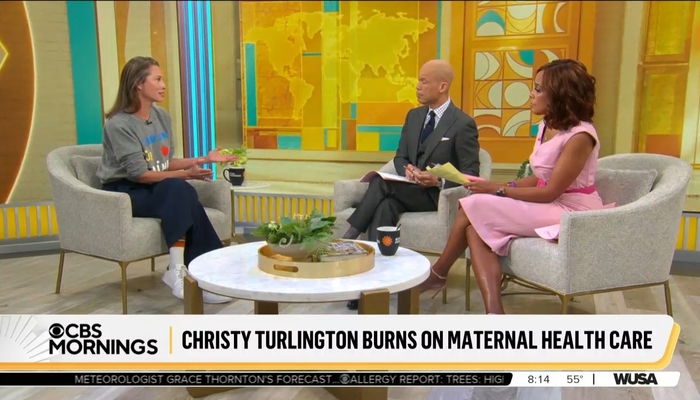
On Thursday’s CBS Mornings, the show promoted a documentary by supermodel Christy Turlington Burns titled “Perilous Passage: Birth in America” that placed blame for maternal mortality on the Dobbs decision that created a post-Roe vs. Wade environment and also echoed other liberal political points. Burns also discussed possible discrimination against black and indigenous mothers.
Host Gayle King introduced Burns and the documentary and noted Burns created a non-profit after her own pregnancy complications. King framed the documentary as a response to the Supreme Court’s 2022 decision:
Her new documentary, "Perilous Passage," I love this title, “Birth in America,” explores Maternal healthcare following the end of Roe vs. Wade.
CBS's Morning promoted a new documentary that explored maternal healthcare complications and mortality. King introduced the documentary and said it "explores Maternal healthcare following the end of Roe vs. Wade."
The creator, model Christy Turlington Burns, also discussed… pic.twitter.com/2Cxqch4ZjW
— Nick (@nspin310) May 7, 2026
The show played a trailer-like package of the documentary that included lines about America’s birth mortality rate. It also tried to rope the closure of rural hospitals into the abortion debate: “It has become the epidemic that hospitals are shutting down, especially in rural America.”
After the trailer clips played, Burns described statistics and focused on apparent bias in the healthcare system against black and indigenous mothers: “Two women die every day in this country from preventable maternal complications. Three - black women are three times more likely to die than their white counterparts, and indigenous women are right behind them.”
Burns then described how the situation had gotten worse, as King asked why.
Burns also blamed the Dobbs decision for fewer obstetric doctors because a "post-Dobbs world" makes it "dangerous for doctors to provide care in the way they should for the whole person."
She called it "a very scary time." pic.twitter.com/EZALaNZVwy
— Nick (@nspin310) May 7, 2026
According to Burns, “It is more dangerous to become a mother today than it was a generation ago.” She then turned to blame the situation on rural hospital closures and a “post-Dobbs world” that had, allegedly, led to fewer obstetric doctors:
A lot of women in this country live in rural areas so they're far away from care, and if a hospital closes and they don't have any other place to go, no relationship with a provider, less doctors are going into the field of obstetrics because of this post-Dobbs world we live in which is dangerous for doctors to provide care in the way they should for the whole person, and whatever they're dealing with as opposed to birth alone.
Later, King and Burns returned to the higher maternal complication rate for Black women, which Burns placed on “bias in our medical institutions.” King asked why again, and Burns explained her view:
You know, providers are not trained to care for women of every socioeconomic background. They make assumptions and judgments. There's a lot of blame, and if women come late. There are just a lot of, you know, things that would deter someone from seeking care in a timely way.
Even if you are in a facility, if a black woman complains about pain or, you know, reacts in a way that makes the provider nervous, they just judge them, put them in a corner, don't listen to them. And there are so many stories and reports of women who have not been listened to.”
King returned with a response as Burns said, “You're not heard. And you're discriminated against. So, there's been a lot of efforts to sort of train providers to be much more welcoming, supportive, and compassionate. I mean it feels like a given, but it’s not.”
The documentary was framed as a response to the Dobbs decision, but the segment also gave many other factors for the situation. Also, the rural hospital point that had been heard the past year over the debate of healthcare subsidies continued to exemplify the political lens of the documentary.
So much for that purported new conservative bent at CBS.
The transcript is below. Click "expand":
CBS Mornings
May 7, 2026
8:12:28 AM Eastern
GAYLE KING: You may know our next guest, Christy Turlington Burns, from the runway, cause she is knockout on that place. She is also the founder and president of the nonprofit ‘Every Mother Counts.’ So, this group works to provide health care access to mothers around the globe. Christie became an advocate after suffering life-threatening complications during the birth of her daughter years ago. Her new documentary, "Perilous Passage," I love this title, “Birth in America,” explores Maternal healthcare following the end of Roe vs.,Wade. It’s produced by See it Now Studios, a division of our parent company, Paramount, and the great Susan Zirinsky. Here’s a clip.
[Cuts to clips from “Perilous Passage”]
VOICE 1: Why is it that in one of the wealthiest nations on Earth so many women are at risk of dying in childbirth?
VOICE 2: The U.S. has the worst maternal mortality rate of developed countries.
VOICE 3: It has become the epidemic that hospitals are shutting down, especially in rural America.
VOICE 4: I look at the heart monitoring and it is flatlining. What went wrong? How did this happen?
VOICE 5: Very few people even seem to care how hard it is for these moms with no options.
VOICE 6: What happens if you have a complicated pregnancy?
[Cuts back to live]
KING: A lot of people do care. Christy Turlington Burns is one of them. Christy, it is so good to have you here.
CHRISTY TURLINGTON BURNS: Thank you
KING: From model to mother to maternal health advocate. And, this is the thing that got me.I know of the statistics, but hearing it again in the documentary is shocking to me. It is so well done. Start us with the statistics. I want people to grab, right away, about how bad this is.
BURNS: Two women die every day in this country from preventable maternal complications. Three - black women are three times more likely to die than their white counterparts, and indigenous women are right behind them. This is preventable for - over 80% of these deaths are preventable and we know what to do to save them.
KING: You tell the story because you could have been one of the people who died, but because you have great health care, you did not. And now, what is it you want people to know?
BURNS: I really want people to understand that we already are - the U.S. Has been in a maternal health crisis for many years, however, it has gotten worse in fact.
KING: Why, why? This is what I don’t understand. Why?
BURNS: I know. I mean, It is more dangerous to become a mother today than it was a generation ago, which most people are shocked by.
I mean, it's hard for women to access quality care. Hospitals are closing every day. A lot of women in this country live in rural areas so they're far away from care, and if a hospital closes and they don't have any other place to go, no relationship with a provider, less doctors are going into the field of obstetrics because of this post-Dobbs world we live in which is dangerous for doctors to provide care in the way they should for the whole person, and whatever they're dealing with as opposed to birth alone.
It is a scary time. It is a very scary time.
VLAD DUTHIERS In the documentary, you show a short video clip of yourself giving birth and then having a complication, which is a complication that my wife went through similarly, but we had the best care in the world, you had the best care in the world, and so you survived, and Marian survived.
Most people do not have that access to care, and the statistic that matters is we are an industrialized nation, the only industrialized nation with the statistics you mentioned. There's a woman in Wisconsin whose story particularly touched you. Tell me about her.
BURNS: I mean they all touch me, but, really, Megan Cling is one of the mothers in the story who lives in a rural area of Wisconsin. Her third pregnancy ended up being an anomaly pregnancy. Anything can happen in any pregnancy.
KING: The first two went well and she wasn't worried at all.
BURNS: Exactly. And when she learned something was wrong with her child and they were under fetal demise, the provider had to look around and say, “what can I do, what am I able to do, what am I legally allowed to.”
She had to leave the state to Minnesota to have care she needed to save her life and make sure her experience was not as traumatic - I mean, it is traumatic no matter what, but to help her in that moment. You know, it shouldn't be that way. Women shouldn't have to leave that quickly or travel that far when they're under such circumstances. It is terrifying. It is scary to be pregnant even when you are healthy.
KING: Yes
BURNS: Even when you have all of the things.
KING: Yes.
BURNS: When you don't and you also have to travel seven, eight hours to get care, it is terrifying.
KING: Why is it higher for black women, even black women who are educated? This is the other thing that got me. You think, if I'm educated, I know exactly who the doctor is.
DUTHIERS: And I have means.
KING: And I have means. The death rate for black women is higher, even educated black women.
BURNS: Exactly.
KING: Why?
BURNS: There's a lot of bias in our medical institutions.
KING: How so?
BURNS: You know, providers are not trained to care for women of every socioeconomic background. They make assumptions and judgments. There's a lot of blame, and if women come late. There are just a lot of, you know, things that would deter someone from seeking care in a timely way.
Even if you are in a facility, if a black woman complains about pain or, you know, reacts in a way that makes the provider nervous, they just judge them, put them in a corner, don't listen to them. And there are so many stories and reports of women who have not been listened to.
KING: Yeah, some people think that black women have a higher tolerance to pain. I know that is just not true. You're not heard.
BURNS: You're not heard. And you're discriminated against. So, there's been a lot of efforts to sort of train providers to be much more welcoming and supportive and compassionate. I mean it feels like a given, but it’s not.
KING: Well, I have to say the documentary is powerful. You are so good at it too. Didn't you think?
DUTHIERS: I was incredibly moved by it.
KING: The way you go and interview people, I feel like I'm sitting at the kitchen table listening to you talk. What can we, what should we do in less than 30 seconds?
BURNS: Well, I think this is an important time. Mother's Day is around the corner. This film just came out. I want people to see it and understand that maternal health is a human right.
KING: YES
BURNS: Every aspect of maternal health, we need to meet women where they are. This is pro-family, pro women, pro health and we need to care.
DUTHIERS: Every mother counts.
BURNS: Every mother counts, yes.
KING: Thank you, Christy Turlington Burns. It is streaming right now on HBO Max.
(...)








 New Posts (Home)
 ChatBox
 Popular Posts
  Game Zone
 Top PodCasts