www.upworthy.com
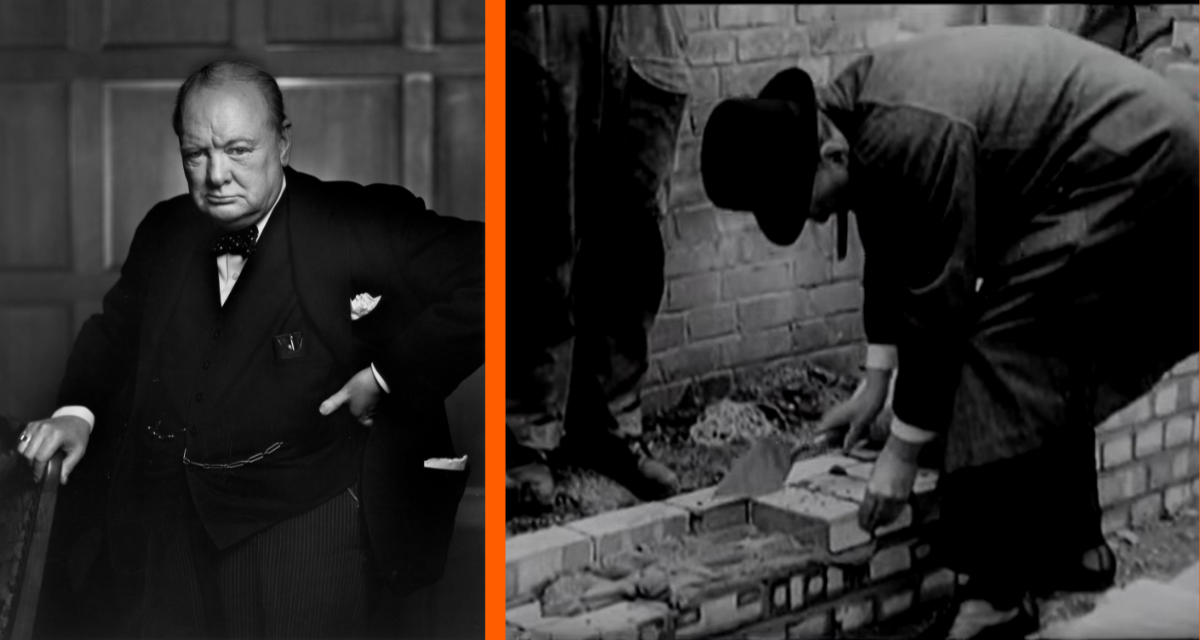
Winston Churchill battled his depression by staying busy, laying ‘200 bricks’ every day
Winston Churchill, former prime minister of the United Kingdom, referred to his depression and dark moods as the “Black Dog.” He never hid his struggle, and those close to him knew about it.
In a personal letter to his wife, Clementine, Churchill wrote:
“Alice [Guest] interested me a great deal in her talk about her doctor in Germany, who completely cured her depression. I think this man might be useful to me—if my Black Dog returns. He seems quite away from me now. It is such a relief. All the colours came back into the picture. Brightest of all your dear face—my Darling.”
Churchill turned to physical activity to help subdue the “Black Dog,” including painting. Another pursuit that helped him was bricklaying.
Churchill becomes a bricklayer
His passion for bricklaying took center stage at his family’s estate, Chartwell, where he constructed many new additions. His daughter, Mary, wrote:
“While my father was constructing the red-brick walls which now surround the garden, he had the delightful idea of building a little one-roomed cottage in the line of the wall for Sarah and me: it was meant for us both, but Sarah, who had started at boarding school in 1927, outgrew its pleasures fairly soon, and this charming dwelling became known as the Marycot.”
Churchill became such a prolific bricklayer that he officially joined the Amalgamated Union of Building Trades Workers in 1928 while serving as Chancellor of the Exchequer, according to The New York Times.
Churchill also wrote in September 1928 about his bricklaying at Chartwell: “I have had a delightful month building a cottage and dictating a book: 200 bricks and 2000 words a day.”
He continued bricklaying through the 1950s, according to the International Churchill Society.
Winston Churchill fought his depression with bricks. He'd lay them for hours at his country home in Kent. He joined the bricklayers' union. And in 1921 he wrote about why it worked. It took psychology another 75 years to catch up.He called his depression the "Black Dog." It… https://t.co/QfAsWvT9KB— Anish Moonka (@anishmoonka) May 5, 2026
Churchill’s mental health theory
In December 1921, Churchill wrote an essay for The Strand Magazine titled “Painting as a Pastime.” Churchill also used painting as a way to cope with depression, and he created more than 570 paintings during his lifetime.
He fully explained his theory on restoring the mind through activity in this excerpt:
“Many remedies are suggested for the avoidance of worry and mental overstrain by persons who, over prolonged periods, have to bear exceptional responsibilities and discharge duties upon a very large scale. Some advise exercise, and others, repose. Some counsel travel, and others, retreat. Some praise solitude, and others, gaiety. No doubt all these may play their part according to the individual temperament. But the element which is constant and common in all of them is Change. Change is the master key. A man can wear out a particular part of his mind by continually using it and tiring it, just in the same way as he can wear out the elbows of his coat. There is, however, this difference between the living cells of the brain and inanimate articles: one cannot mend the frayed elbows of a coat by rubbing the sleeves or shoulders; but the tired parts of the mind can be rested and strengthened, not merely by rest, but by using other parts.”
The modern-day phrase “depression hates a moving target” was certainly something Churchill would have subscribed to.
The post Winston Churchill battled his depression by staying busy, laying ‘200 bricks’ every day appeared first on Upworthy.








 New Posts (Home)
 ChatBox
 Popular Posts
  Game Zone
 Top PodCasts