reactormag.com
Two Plot-Friendly Approaches to Generation Ships
Books
Science Fiction
Two Plot-Friendly Approaches to Generation Ships
When it comes to governing a generation ship, do you prefer the Watsonian or Doylist strategy?
By James Davis Nicoll
|
Published on May 11, 2026
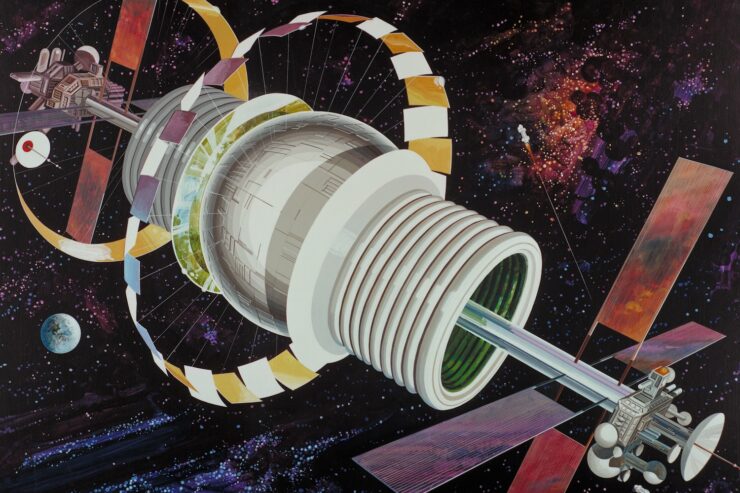
Art by Rick Guidice (Credit: ARC / NASA)
Comment
1
Share New
Share
Art by Rick Guidice (Credit: ARC / NASA)
You may not worry about the best way to govern generation ships, but I do1. Because I often read SF novels about generation ships (and have written about various approaches to telling stories set on generation ships over the years)—as you may not. But if this is your territory, read on.
Generation ships, by definition, take enough time to get from one star system to another that whole generations will live and die during the voyage. Will their governing systems keep on working over such extended voyages?
Human history teaches us (or at least some of us) that governments and their societies can fail catastrophically. Thus the marked lack of Hittites on the UN Security Council, not to mention the absence of the Harappans in the G8. Societal collapse can be devastating; there are estimates that populations fell by half or more in the regions affected by the Late Bronze Age Collapse. That’s on Earth, where people can at least count on the air to be breathable2 and where possible refugia are just a desperate march or sail away.
Generation ships traverse barren gulfs. No resources, no refuge. They are more isolated than any previous human culture. Societal collapse will probably ensure extinction.
So: I recently realized that there are at least two ways in which authors can configure plot-friendly settings. One is Watsonian (from the perspective of the characters). One is Doylist (from the perspective of the author).
Watsonian
While the motivation for boarding a generation ship can vary wildly from “what a cool thing to do!” to “those men with the bayonets were very insistent I get on board,” likely most people on generation ships want to live long and happy (at least, as happy as possible under the circumstances) lives. They hope the vessel and their descendants will reach their destination. They will want to live under a government that maximizes happiness and sustainability, one that will be able to weather foreseen and unforeseen challenges.
The goal here is not to have a perfect government. Rather, it is to have one whose failure modes are not collapses, because a collapse is a death sentence. Failing that, you probably want a government whose average intervals between collapses is at least twice as long as the duration of the journey3.
There are at least two ways to tackle the problem. The first is to embrace some novel, idealistic approach crafted with great thought to suit the unprecedented situation. The second is to turn to history to see if this is a solved problem4. Mix and combine to taste.
Wait, no. There is a third solution, which is ignore the issue and hope for the best. Good luck with that.
As previously stated, I have thought about this a lot. My conclusion is that the best form of government under these circumstances is the sort that doesn’t suddenly implode, whereas the worst is the sort that does. The rest is mere detail.
Doylist
It is a truth universally acknowledged that the worst enemy of a protagonist is likely to be their author. The primary goal for an author is an interesting story. “Interesting story” and “protagonist’s happiness and well-being” are sets that do overlap… but not by much. In fact, they overlap so little you might need a powerful visual assistive device to spot the overlap.
From the author’s point of view, the best form of government for a generation ship is the one that facilitates the story they want to tell.
Does the author want to highlight the ability of a government based on Society of Friends protocols to deal with trying circumstances? In that case, expect a government in which Quakers or Quaker analogs calmly discuss things until they reach a consensus5.
Does the author want a state of tension between officers and mutinous crew to complicate first contact with intelligent carnivorous plants? Expect high-handed command staff little interested in feedback from the rank and file.
Does the author want the protagonist to discover that everything they know is wrong, and that the ship is not the whole universe? Expect government by ignorant, doctrinaire fools.
Does the author want to force on the three protagonists the need to visit ship section after ship section in weekly episodes, questing for the knowledge needed to prevent the semi-derelict ship from flying into a star? Expect a total lack of government, thanks to an ill-timed catastrophe.
Does the author want to write cozy mysteries? Then the government will be largely functional and onstage just enough to sufficiently establish that there is a desirable normalcy which the protagonist’s keen insight can restore.
Synthesis
While Watsonian and Doylist reasoning may seem unrelated or even opposed, they are united by the author’s need to avoid breaking the reader’s suspension of disbelief. Humans being humans, the ship’s government seems certain to make some bad decisions. Those bad decisions need to be ones that readers will believe those characters and societies could plausibly make under their particular circumstances. Otherwise, readers and reviewers will mutter phrases like “idiot plot” and “Dorothy Heydt’s Eight Deadly Words.”
How best to do that? Well, that is for each individual author to solve. Tackling problems like the above are why authors are paid the big bucks6.[end-mark]
No, people don’t usually sit next to me on the train. Why do you ask? ︎Unless we’re talking Iceland from June 1783 to February 1784, in which case you, the Icelander of the past, are SOL. ︎My reasoning is that it’s very unlikely that even the most habitable of exoplanets will allow the travellers to disembark as soon as they arrive. Therefore, the generation ship may have to be home for some time after they arrive. Extended pre-collapse period necessary. At least there will probably be some resources in the new system on which the colonists can draw. Best outcome: the generation ship can make sustainable orbital habitats. ︎For some reason, characters who embark on generation ships all seem to share the quality of never having read or viewed any work set on a generation ship. Hence they often repeat mistakes seen in previous generation ship stories. ︎I own many SF novels extoling the virtues of libertarianism. I cannot think of one that is set on a generation ship. I wonder why… ︎Most authors are not, in fact, paid the big bucks. ︎The post Two Plot-Friendly Approaches to Generation Ships appeared first on Reactor.








 New Posts (Home)
 ChatBox
 Popular Posts
  Game Zone
 Top PodCasts