www.optimistdaily.com
Earth Prize 2026 part I: teenage teams tackling big global problems
BY THE OPTIMIST DAILY EDITORIAL TEAM
Every year, The Earth Prize asks teenagers across the world the same question: what environmental problem would you solve, and how? Every year, the answers come from young people who live closest to the problem. After five years and more than 21,000 students across 169 countries, that’s less a pattern than a design principle. The people who know the problem best tend to build the best fix.
This year, seven regional winners share $100,000 in prize funding, each team receiving $12,500 to develop their idea into something deployable. A global winner will be chosen by public vote on May 29. Here are four of them (including one team we’ve already introduced).
Ireland: a plastic that cleans up after other plastics
3 phases of biodegradation in soil, which releases the enzyme into the environment and further breaks down microplastics.
Arya Satheesh, 18, hit a basic limitation while monitoring water quality: she could detect microplastics in the water, but there was nothing to take them out. That gap became her project.
Eco Purge is a plant-based plastic embedded with enzymes that release gradually as the material breaks down. As those enzymes spread into the surrounding environment, they continue degrading other microplastics in soil, fresh water, and salt water. Most solutions try to prevent plastic from entering the environment in the first place. Eco Purge is designed for what’s already there.
Arya has collaborated with researchers at University College Dublin, ATU Letterkenny, and BiOrbic Bioeconomy Research Centre, and plans to scale the technology toward packaging and compost bags.
“Plastic pollution doesn’t just disappear, it breaks into tiny pieces that stay in our environment,” Arya said. “This is just the beginning.”
Kenya: an exhaust filter built from maize, coconut shells, and algae
3D-prototype model.
For Fredrick Njoroge Kariuki, this wasn’t an engineering problem first. It was a health problem. He has bronchitis, and growing up in Naivasha, the air pollution around him made it worse.
He and Miron Onsarigo, both 17, built HewaSafi (Swahili for “clean air”), a multi-stage vehicle exhaust filter made from maize cobs, coconut shells, agricultural waste, disposed batteries, and algae. It captures more than 90 percent of particulate matter and reduces both CO2 and carbon monoxide emissions. The design targets matatus (shared minibuses) and boda bodas (motorcycle taxis), the vehicles that carry most people in African cities and account for a significant share of urban air pollution.
It’s also cheap to make and genuinely hard to steal. Conventional exhaust systems get stripped for their valuable components; HewaSafi’s materials have no street value.
“I didn’t choose this problem, it chose me,” Fredrick said. Miron added, “Back home in Kisumu, seeing people get sick from vehicle fumes was just normal. But normal didn’t feel right to me.”
The team has completed pilot tests with a local matatu association and is building a product family with installment payment options so drivers can afford it.
Gaza: rubble into bricks
Prototype of the bricks.
We covered Tala and Farah Mousa earlier this month, when their project had earned them a spot among the top 35 Earth Prize finalists. They’ve since been named the Middle East regional winners — the first from Palestine in the competition’s five-year history.
Build Hope Palestine processes debris from damaged buildings into non-load-bearing blocks for garden beds, pavements, and partitions. The method is designed to work anywhere: crush and sieve rubble, mix with locally available binders like clay, ash, or glass powder, mould, and dry. No heavy machinery, no specialised infrastructure.
Their next goal is to bring 100 young people into hands-on workshops, producing at least 200 blocks and equipping participants to teach the process onward.
“The view from our tent window is what keeps us motivated,” Tala said. “It’s designed to be replicated by communities without heavy machinery or specialised infrastructure, and turn what was once destruction into a starting point for hope.”
India: tamarind powder that pulls microplastics out with a magnet
Demonstration – Adding the tamarind-based powder to water (dyed green for visibility).
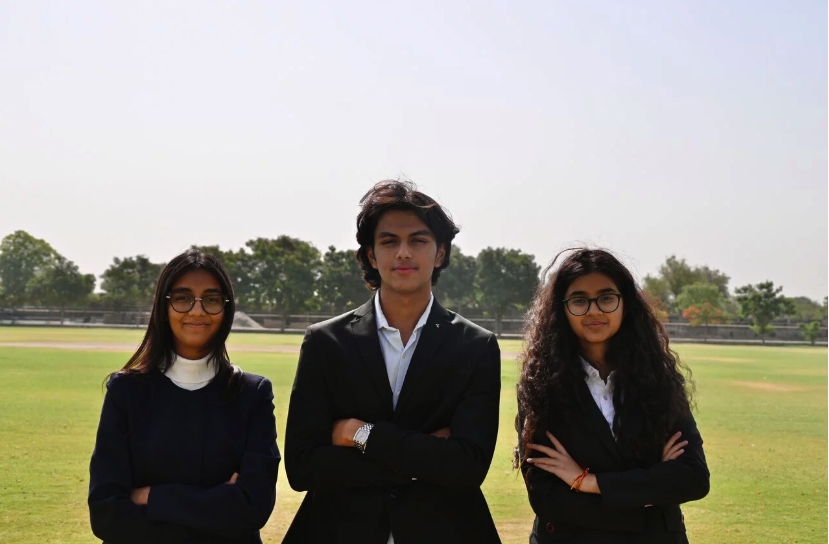
Vivaan Chhawchharia, Ariana Agarwal, and Avyana Mehta, all 16, came up with their idea after visiting a rural community and watching a child drink from a shared container with no filtration. More than 2.2 billion people globally lack access to safely managed drinking water and rely on exactly these kinds of containers.
Plas-Stick is a biodegradable powder made from waste tamarind seeds. Added to water, it attracts microplastics and clumps them into visible masses that can be pulled out with a handheld magnet. No electricity required. The team has already reached more than 8,000 students and teachers and worked with researchers at IIT Guwahati. Their prize funding goes toward decentralized production hubs across rural India.
“Plas-Stick was designed to be simple, affordable and accessible,” the team said. “This support allows us to take it beyond pilot schools and scale it to many more communities that need it most.”
Part II covers the three remaining regional winners from Oceania and Southeast Asia, North America, and Central and South America.
Did this solution stand out? Share it with a friend or support our mission by becoming an Emissary.The post Earth Prize 2026 part I: teenage teams tackling big global problems first appeared on The Optimist Daily: Making Solutions the News.








 New Posts (Home)
 ChatBox
 Popular Posts
  Game Zone
 Top PodCasts