www.upworthy.com
A seemingly innocent painting of a farmer and family member caused outrage in 1930
One of the most iconic American images is American Gothic, a 1930 painting by Grant Wood of a farmer holding a pitchfork, standing next to his annoyed daughter (or wife). It’s been parodied everywhere from Homer and Marge standing in the pose on The Simpsons, to advertisements for Nicole Ritchie and Paris Hilton’s The Simple Life (2003 to 2007), to Magenta and Riff Raff recreating the painting in The Rocky Horror Picture Show (1975).
To modern eyes, the painting appears to be a traditional depiction of a couple living on the farm. It’s as wholesome as America gets. However, when it was first hung in the Art Institute of Chicago, it was a cultural Rorschach test that offended rural Americans and delighted city slickers. “We should fear Grant Wood. Every artist and every school of artists should be afraid of him, for his devastating satire,” writer Gertrude Stein said of the painting.
Why was American Gothic so controversial?
With American Gothic, context is everything. The painting was released on the precipice of the Great Depression at a time when the Dust Bowl was killing American agriculture. It was also after a great migration when Americans left farms in droves for city life. Rural Americans were mocked for their simpler, conservative ways, with cultural voices such as H.L. Mencken referring to rural Americans as “booboisie.”
The painting showed a dour, joyless couple wearing simple clothing and was painted in a style that could be called medieval—no doubt, a comment on their traditional ways. After the painting caught the public’s attention, an Iowa farmer’s wife phoned Wood and didn’t hold back. “She claimed she wished to come over and smash his head for depicting her countrymen as grim Bible-thumpers,” Art History School host Paul Priestley said, according to Open Culture.
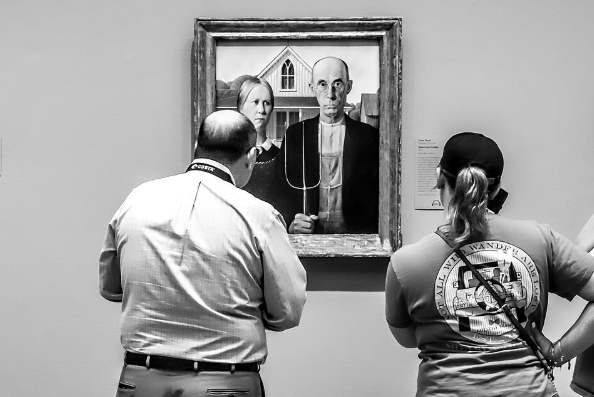
Museum patrons looking at American Gothic. Credit: Kevin Dooley/Wikimedia Commons
The artist’s background also plays a big role in how the painting is interpreted. Wood grew up in Cedar Rapids, Iowa, but often traveled to Europe to study Impressionism. This meant that he had one foot in the world of Bohemian Europe and another as an Iowa farm boy.
Wood would never admit that his painting was anything but an expression of genuine affection for its subjects. Wood “said he painted American Gothic to extol rural American values, real people in their well-ordered world: an image of reassurance during the onset of the Great Depression,” Priestly continues.
The home that inspired American Gothic. Credit: Ser Amantio di Nicolao/Wikimedia Commons
How American Gothic’s meaning changed over time
“American Gothic” was born at the beginning of the Great Depression, and its meaning would evolve over the difficult period. By the end of the decade, working people of the Midwest had begun to be seen as noble by city dwellers, who embraced folk music and workers’ rights. Further, mocking the “yokels” who were devastated by a natural disaster felt rather cruel.
The painting’s meaning evolved “because over the course of the thirties in the context of the depression and throughout World War II, it changed from being that satirical image to a national symbol of stability, order, prosperity, virtue and wholesomeness,” Steven Biel, historian and author of American Gothic: A Life of America’s Most Famous Painting, told Pop Entertainment.
Great pieces of art can mean different things to different people and evolve with the times. For many, in 2026, American Gothic is seen as simple American iconography and little more than a template for satire. But those who intend to tap into its cultural cache should first understand that it has undergone an incredible cultural arc: it redeemed those it intended to mock while softening the hearts of its jaded first audience. That’s something that the farmer’s wife (or daughter?) probably couldn’t even scoff at.
The post A seemingly innocent painting of a farmer and family member caused outrage in 1930 appeared first on Upworthy.








 New Posts (Home)
 ChatBox
 Popular Posts
  Game Zone
 Top PodCasts