www.thecollector.com
How the “Civil Rights Era” Reshaped the Legal Landscape of the United States
America was founded on the premise of freedom and human rights for all. In the face of a constitution that promised equality, many in America have continually fought to exercise these rights. Numerous marginalized groups have fought for their civil rights in America over the centuries, especially after the conclusion of the Civil War.
In addition to African Americans, women and those of varying races, religions, and preferences have been forced to seek legal help to defend their rights. Congressional legislation has made slow but evident progress in protecting American equality, most notably during the “Civil Rights Era” of the 1960s, and continues to have a lasting impact on modern lives.
Early Civil Rights Actions
The Reconstruction Era witnessed significant progress in the realm of civil rights, marked by the election of the first Black members of Congress, as depicted in this Currier & Ives print. Source: Library of Congress
The tenets of the United States promise its citizens rights to political, social, and other freedoms, along with the right to be treated equally. These ideas can be summarized under the term “civil rights.” While civil rights apply to all citizens, certain groups have had to fight to receive and exercise these rights.
Perhaps most notably, African American citizens fought for these freedoms, especially after the conclusion of the Civil War and the banning of slavery in the United States. Congress first took action in this area in 1866, when the first “Civil Rights Act” was passed. “An Act to protect all Persons in the United States in their Civil Rights and furnish the Means of their Vindication” was introduced by Illinois senator Lyman Trumbull. The purpose of this act was to strengthen the application of the Thirteenth Amendment to the Constitution, which outlawed slavery.
The 1866 act declared all persons in the US to be citizens, regardless of race or color, and guaranteed the rights to make contracts, sue in a court of law, serve as a witness in court, and own property. The bill was vetoed by President Andrew Johnson, but Congress overrode his veto, and the language became law.
An 1871 act strengthened the 1866 act, allowing for action in federal court for the interference with an individual’s civil rights. Further expansion in 1875, sponsored by Senator Charles Sumner of Massachusetts, guaranteed all citizens access to accommodations, theaters, schools, churches, and cemeteries regardless of race or color. The bill also refers to the free ability to serve on a jury regardless of race.
Moving Backward
Marines in Saipan during World War II, 1944. Source: National Archives/Wikimedia Commons
Unfortunately, the progress in the civil rights arena made by Congress during the Reconstruction Era was quashed in 1883, when the 1875 Act was overturned. The reversal by the US Supreme Court cited that the lawmaking was an unconstitutional exercise of Congress’s authority. Despite ongoing efforts to further Reconstruction and promote equality throughout the country, little progress was made in the way of Civil Rights legislation after the repeal of the 1875 law.
As the United States confronted fascism in the Second World War, the American people were also forced to consider equality and democracy in their own country. Jim Crow laws were still in place in many locations throughout the country, yet more than a million African Americans served with distinction in World War II, willing to lay down their life for a country that saw them as less than their compatriots of other ethnicities.
Women were also starting to demand more equality in society, launching the start of the feminist movement in the late 40s. In 1945, the US Congress considered a civil rights bill for the first time in 70 years. This legislation was unable to advance, but the movement was not extinguished. A civil rights bill was introduced every year for the next 12 years before legislation moved forward.
The Eisenhower Justice Department Steps In
President Dwight D. Eisenhower helped move through the first civil rights legislation in decades. Source: Eisenhower Presidential Library/Wikimedia Commons
In 1957, President Dwight D. Eisenhower’s Department of Justice submitted a proposal for civil rights legislation and forwarded it to Congress. This bill was approved, resulting in the Civil Rights Act of 1957. This act established a Civil Rights Section within the Department of Justice. It largely focused on voting rights, allowing federal prosecutors to intervene with court injunctions to protect against interference with voting. In addition, a Civil Rights Commission was established, which had the authority to investigate discriminatory practices. While the final bill was weakened due to a lack of support among Congress’s Southern Democrats, it was forward action, the first legislation of its kind since Reconstruction.
Landmark Legislation: The 1960s
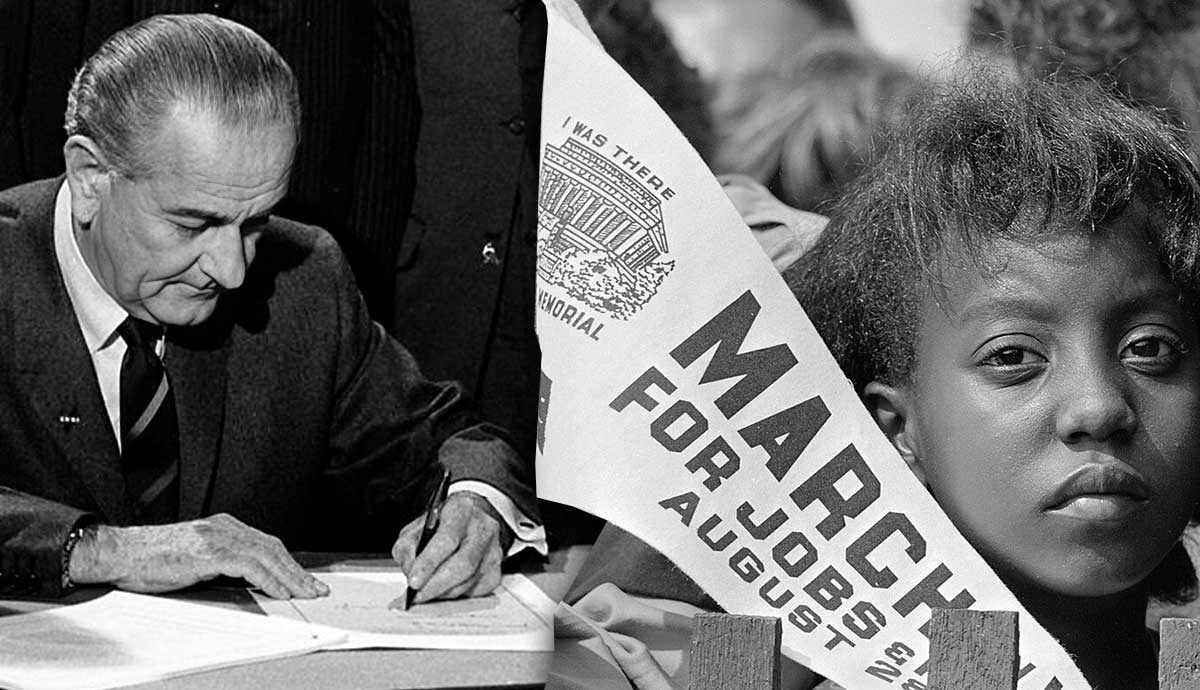
12-year-old Edith Lee Payne of Detroit, Michigan, holds a banner at the March on Washington in 1963. Source: Wikimedia Commons
America was on a trajectory to continue the progress made by Eisenhower’s bill. In 1960, an act was passed that expanded the 1957 bill, requiring election officials to make voter registration records available to the Department of Justice. The longest filibuster in Senate history, lasting over 43 hours, impeded the movement of the bill, but in the end, it passed with some edits.
Civil rights became a primary focus of the country as the 1960s progressed. America saw what is now referred to as the “Civil Rights Era.” Figures like Martin Luther King Jr, Malcolm X, and Thurgood Marshall made their mark on America, forcing the conversation America had long tried to suppress into the spotlight. Events such as the Montgomery Bus Boycott and the March on Washington promoted discourse and action. In 1963, the Equal Pay Act was passed, a civil rights measure that helped protect the rights of women in the workplace.
The signing of the Civil Rights Act of 1964, with President Johnson at the table in the East Room of the White House. Source: LBJ Library/Wikimedia Commons
However, the major boon for civil rights legislation took place in 1964 with the passing of the Civil Rights Act of 1964, now considered a landmark piece of law. This bill banned discrimination based on race, color, religion, sex, or national origin within the United States in relation to employment, public accommodations, and receiving federal funding. The act, introduced by John F. Kennedy before his assassination and signed into law by his successor, Lyndon Johnson, created the Equal Employment Opportunity Commission to enforce the new law.
In 1965, the act was followed up with the Voting Rights Act of 1965. One noticeable flaw of the 1964 Civil Rights Act was that it failed to address voting rights. Even after the Eisenhower administration’s work in 1957, there were several legal and illegal measures being used throughout the country to prevent Black citizens from voting.
President John F. Kennedy addresses the nation regarding civil rights matters, June 1963. Source: John F Kennedy Presidential Library & Museum/Wikimedia Commons
Rounding out the essential civil rights legislation of the 1960s was the Fair Housing Act of 1968, which addressed fair housing practices. It outlawed discrimination in relation to housing and was paired with the Architectural Barriers Act, also in 1968, to further improve housing accessibility to another frequently underrepresented group: people with disabilities.
Continuing the Fight
President Lyndon B. Johnson signing civil rights legislation in 1968. Source: Library of Congress/Wikimedia Commons
Throughout the remainder of the 20th century, several laws related to civil rights advanced, including the Equal Educational Opportunities Act (1974), the Pregnancy Discrimination Act (1975), the Age Discrimination in Employment Act (1967, amended in 1975), and the Americans with Disabilities Act (1990). In 1991, another Civil Rights Act was passed. This act amended the 1964 act, strengthening the original law and how it is applied in the workplace. It clarifies the definition of discrimination in the workplace and suggests appropriate remedies for such situations.
Furthering Future Rights?
Civil rights are still a concern in modern America. Source: Wikimedia Commons
Though tremendous progress has been made since the humble beginnings of civil rights legislation, concerns still exist. The country is still struggling to fulfill promises of equality for all, and new challenges have arisen. In some situations, it appears that the country has eroded its protections, with divisive rhetoric largely contributing to this trend. In recent years and moving into 2025, migrants, refugees, and LGBTQI+ communities were targets of disproportionate discrimination, and people of color continue to remain marginalized on the federal legal level. Reproductive rights were restricted in 2022, with the Supreme Court’s reversal of Roe v. Wade and subsequent abortion bans in several states.
Efforts to expand civil rights for US citizens are ongoing. Source: Wikimedia Commons
Despite the frustrations that these political and legal actions have presented, numerous groups and organizations remain committed to advancing civil rights legislation. There are efforts underway to expand the language of the Civil Rights Act of 1964 to include and protect more classes of citizens. The true application of equality and civil rights for all American citizens does not seem to be a reality anytime soon, but a hope for the future.








 New Posts (Home)
 ChatBox
 Popular Posts
  Game Zone
 Top PodCasts