www.thecollector.com
Why the Battle of Manila in World War II Was Such a Destructive Urban Conflict
Manila was considered one of the most cosmopolitan cities in Asia before the Second World War. In 1945, after several years of Japanese occupation, Manila suffered a terrible fate when it was faced with a combination of Japanese cruelty and American firepower. By the time the Americans and their Filipino allies gained control of the city, it was completely devastated and would take years to rebuild. The battle was one of the most devastating instances of urban warfare during WWII.
Manila Under Japanese Occupation
Bombing of Manila by Japanese aircraft, 1941. Source: John Tewell, Flickr
One day after Japanese aircraft bombed Pearl Harbor, the Japanese began launching air raids over major sites throughout the Philippines. Tokyo aimed to conquer the Philippines, set up a puppet regime, and seize control of natural resources throughout the islands. This was part of Japan’s plan to create the so-called “Greater East Asia Co-prosperity Sphere,” a euphemism for its Asian empire. After landing tens of thousands of men across the archipelago, Japanese forces seized Manila on January 2, 1942. They subsequently defeated the rest of the Allied garrisons on the islands within a couple of months.
Japan’s military administration of the Philippines was headquartered in Manila, making it the center of power for Japan in the Philippines. For the rest of the war, Japan garrisoned Manila with a mixture of army and navy units to keep order. Members of the Kempetai, Japan’s secret police, worked with local collaborators to hunt down anyone deemed a threat to the Japanese. Citizens of Allied countries were locked up in prisons or internment camps like Santo Tomas, along with American POWs captured during the initial seizure of the islands. Even though Japan granted the Philippines “independence,” it maintained control and employed vicious methods of repression.
Filipinos were used to fighting outside occupiers; they had spent years fighting against Spanish and American imperialism. Now, they sought to work with Americans who escaped the fall of Bataan to fight Japan from the shadows. In addition to spy rings in the city, a group of guerrilla fighters called Hunters ROTC operated near the city and attacked Japanese targets. They waited patiently for the US military to return.
American Landing on Luzon and Advance to Manila
American troops landing at the Lingayen Gulf, 1945. Source: National WWII Museum
When General Douglas MacArthur arrived in Australia in 1942 after fleeing the Philippines, he vowed that he would return at the head of an army to liberate the islands. In 1944, he landed on Leyte with the US Sixth Army. Once Japan was defeated there and on Mindoro island, MacArthur’s command, called Southwest Pacific Area Command (SWPA), prepared for the invasion of Luzon. General Walter Krueger’s Sixth Army, initially consisting of the I Corps (6th and 43rd Infantry Divisions) and the XIV Corps (37th and 40th Infantry Divisions), was assigned to land on a stretch of beaches on the Lingayen Gulf in northern Luzon. Afterwards, they would strike south and east to defeat Japanese forces. One of the priority objectives for the Sixth Army was retaking Manila.
On January 9, 1945, the Sixth Army landed at the Lingayen Gulf and proceeded to move inland. Japanese General Tomoyuki Yamashita, commander of the 14th Area Army, had three groups of troops defending the whole island: the Shobu, Shimbu, and Kembo groups. He sought to concentrate his forces in the north of the island and ordered his men to fight a delaying action. Under pressure from American forces and Filipino guerillas, Japanese infantry and armored units withdrew to the center of the island.
General Oscar Griswold’s XIV Corps pushed south from the beaches towards Clark Field, the largest airfield in the Philippines. By the end of the month, they seized it from the Kembo group and advanced to the northern outskirts of the city to link up with American forces that had landed south of Manila.
Japanese Defenses and the Start of the Battle
1st Cavalry Division column advancing on Manila, 1945. Source: Warfare History Network
General Yamashita became concerned that Japanese forces in the Manila area would be cut off by the American advance. When paratroopers of the 11th Airborne Division landed south of Manila, Yamashita ordered the Shimbu Group commander, General Shizuo Yokoyama, to destroy infrastructure and weapons dumps in the city and retreat east. Yokoyama complied, but Rear Admiral Sanji Iwabuchi announced he would remain in the city with over 16,000 sailors and marines to defend the city. Three army engineer battalions remained in the city and joined preparations to defend it.
Admiral Iwabuchi’s Manila Naval Defense Force had eight army and navy battalions in the city and its outskirts. Much of the garrison consisted of crews of sunken ships and did not have training for an urban battle. They did have large stockpiles of weapons and engineering equipment. Multiple lines of defense were dug north and south of the city and buildings were turned into fortresses. Iwabuchi hoped to make the battle as costly as possible for the Americans.
From the north, the 37th Infantry and newly arrived 1st Cavalry Division pushed south on MacArthur’s personal orders. General Joseph Swing’s 11th Airborne Division transferred from the Eighth Army and joined the Sixth Army’s advance. They began to break through the southern Japanese defenses. Griswold’s forces pushed south and liberated the Bilibid and Santo Tomas prison camps by early February. They were joined by Filipino guerilla units including Hunter’s ROTC. By this point, three American divisions with nearly 40,000 men surrounded the city. Iwabuchi’s garrison was cut off.
Crossing the Pasig River and Capturing Nichols Field
US troops preparing to cross the Pasig River, 1945. Source: US National Archives
General Griswold’s GIs found themselves facing tougher resistance as they continued deeper into the city. Despite having successfully liberated two prison camps, the Americans still had a long way to go. Japanese defenses north of the Pasig River were meant to be a trip wire but were formidable nonetheless. When American forces secured the north bank by February 6, MacArthur declared total victory prematurely. The 37th Infantry and 1st Cavalry Divisions still had to enter the main areas of the city.
When troops of the 148th and 129th Infantry Regiments attempted to cross the Pasig in small boats, they found themselves under heavy fire from Japanese sailors on Provisor Island. Within a couple of days, they managed to seize the island and create a foothold on the south bank, but resistance was fierce. Admiral Iwabuchi had concentrated elements of five battalions south of the river and Japanese fortifications were strong. The 37th Division pushed slowly southward while the 1st Cavalry Division carried out an envelopment maneuver around the city to meet the paratroopers from the south.
The 11th Airborne Division was not tasked with entering Manila proper. Instead, it was ordered to drive the garrison out of Nichols Field. The 187th and 188th Glider Infantry Regiments advanced along the runways and overran the dug-in defenders. The Japanese had so many naval guns at the airfield that one company commander radioed to his superiors “Tell Halsey to stop looking for the Jap Fleet. It’s dug in on Nichols Field.” By February 12, the Airborne had secured the airfield.
Street Fighting and Clearing Intramuros
GIs patrolling the outskirts of Intramuros in Manila, 1945. Source: Army Times
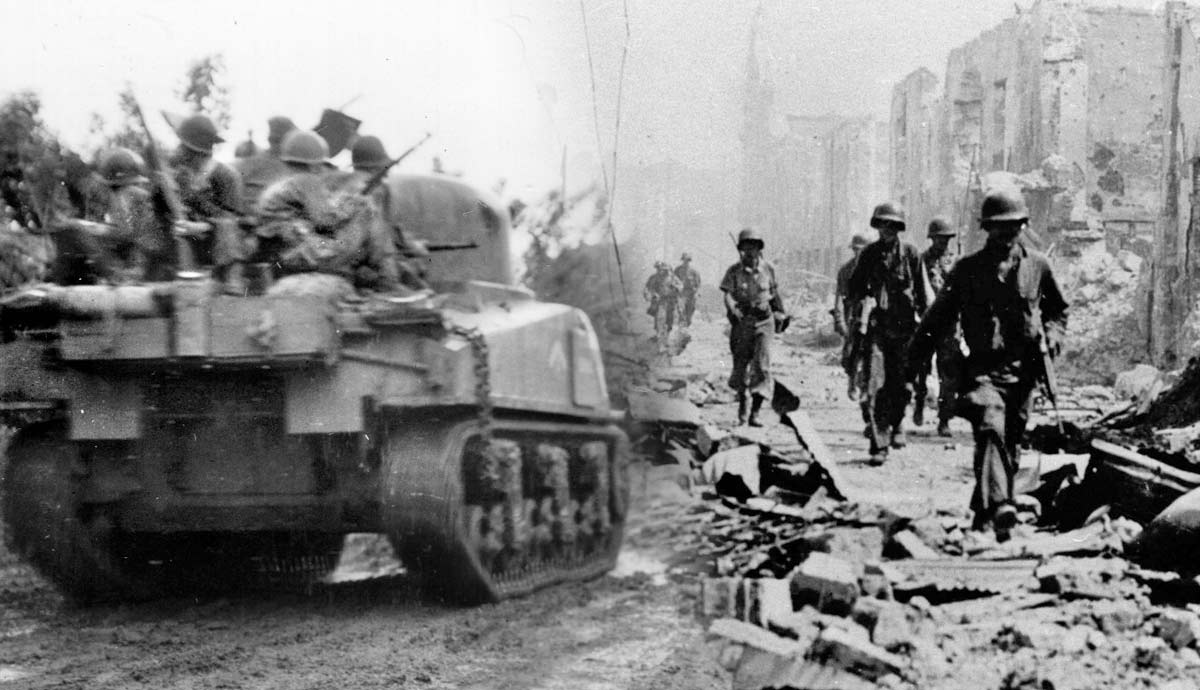
The area south of the river witnessed brutal house-to-house fighting. Japanese forces, surrounded without hope of relief, were determined to fight to the death. They set ambushes for advancing American troops and forced the Americans to turn to heavy firepower. MacArthur restricted the use of air power but consented to artillery and mortars being used in areas with a heavy Japanese presence. American forces destroyed every Japanese position they could with tanks, artillery, mortars, and flamethrowers. The fighting resembled battles in Europe such as Aachen and Berlin.
By February 17 and 18, General Griswold’s forces secured the Rizal Baseball Stadium and the Philippine General Hospital, both of which were major Japanese strongpoints. Reinforced by 1st Cavalry Division troopers, the 37th Infantry Division managed to keep the Japanese pinned in Manila’s old Walled City, known as the Intramuros district. Admiral Iwabuchi unsuccessfully attempted to break out of his encirclement on February 18, leaving 6,000 men trapped in the pocket.
On February 23, American artillery pounded Japanese positions in Intramuros. For the next three days, American troops moved into the district, battling Japanese on every corner. When it became clear that the Japanese were defeated, Admiral Iwabuchi and his subordinates committed suicide. American forces secured major government buildings, including MacArthur’s headquarters from before the war, and ended the battle on March 3 by capturing the rest of the district. For the rest of March, American troops and Filipino guerrillas patrolled the rubble for Japanese stragglers before turning north and east to finish off the rest of Yamashita’s forces.
The Manila Massacre
Filipino refugees after their liberation by American forces in Manila, 1945. Source: Naval History and Heritage Command
Amidst the heavy fighting between American/Filipino and Japanese forces, the civilian population of Manila paid a horrible price during the destruction of their city. Of all the Allied cities fought over in WWII, Manila was one of the most heavily damaged, on par with Warsaw. It is estimated that over 100,000 Manileros died during the battle, mostly due to Japanese actions but also due to American firepower. The scale of Japan’s atrocities in the city ranks among the worst war crimes committed by any party during WWII.
Japanese forces had long believed that Filipinos were overwhelmingly hostile to their presence and that they passed information to the Americans. This environment of distrust was compounded by Japanese racism towards non-Japanese. Throughout the battle, Japanese forces gangraped and murdered Filipino civilians in the areas they controlled. In Fort Santiago, Manila Cathedral, and other prominent locations in the city, civilians were gunned down, bayoneted, or beheaded by the Japanese. There is evidence that Japanese officers commanded their men to commit atrocities by claiming every Filipino in the battle zone was a guerilla. For these atrocities, General Yamashita was sentenced to execution by hanging by an American military court after the war.
While American forces did not commit atrocities like these, their firepower devastated entire neighborhoods and killed thousands of civilians in the process. Despite efforts by MacArthur to restrict American firepower, the formidable Japanese defenses meant that the use of heavy weapons was inevitable. As a result, Manila was one of the most destroyed cities on Earth and a textbook case of urbicide. The reconstruction of the city took several years, and while Manila is now a thriving and dynamic city, the legacy of its destruction remains apparent.








 New Posts (Home)
 ChatBox
 Popular Posts
  Game Zone
 Top PodCasts