www.dailywire.com
The Hidden Message Inside America’s New WWI Memorial
This article is part of Upstream, The Daily Wire’s new home for culture and lifestyle. Real human insight and human stories — from our featured writers to you.
***
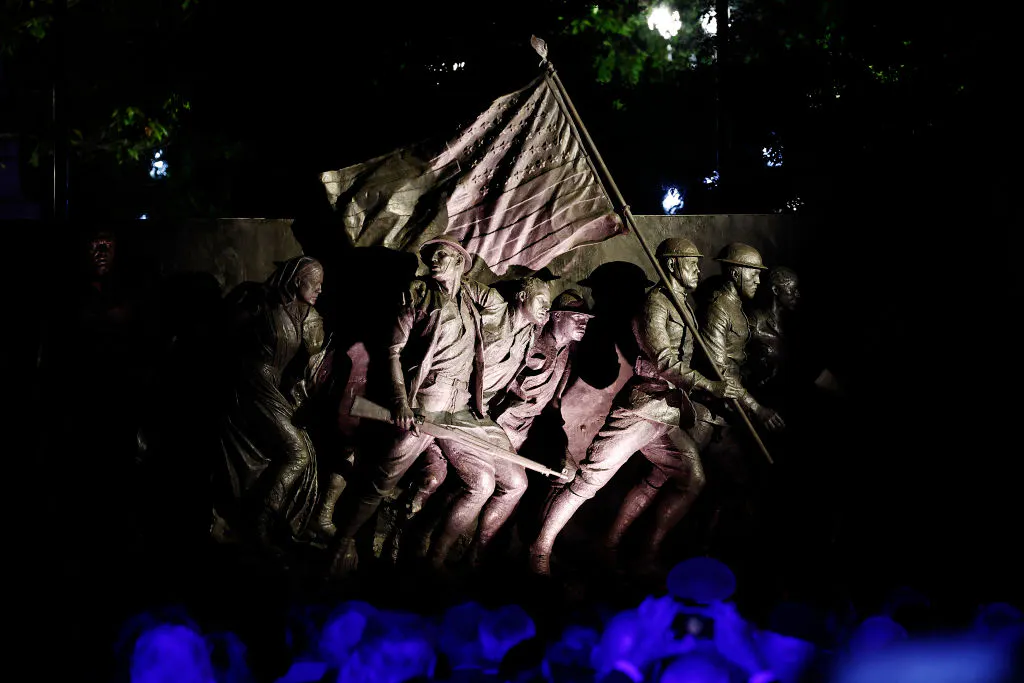
There are many famous memorials within walking distance of each other in our nation’s capital, but perhaps none so imposing as the World War I Memorial just steps from the White House. Its 60-foot bronze sculpture known as “A Soldier’s Journey,” installed in 2024, honors the 116,000 men and women who died in the war and uses 38 figures in its depiction of the hero’s journey, beginning and ending with the relationship between a soldier and his daughter. For Memorial Day, The Daily Wire spoke with Sabin Howard, the master sculptor behind the art. We talked about the beauty of the Western artistic canon, the value in memorial artwork, and why our history is something to remember, not reject.
The Daily Wire: Tell us about getting veterans to pose for you as models. What was that process like?
Sabin Howard: There’s something that distinguishes this memorial from the rest of the memorials that are out there, and I really wanted to show our humanity. My whole process of making art is so reliant on looking at real people. I spent an average of 650 hours per figure. That whole time you’re looking at the person, and you’re diagramming what you see in real life and translating it into art. And I’m using a system of translation that is objective truths and sacred truths.
When you look at art and when you depict a human being, that human being needs to be — I’m searching for the word — created. It’s almost like as an artist you’re creating the vision of that human being in the sculptural form. And we’re made in God’s image, so you have to use a voice that comes from the canons of Western civilization, of proportion and anatomy and design, that were used for almost 2,000 years — and then thrown out.
Courtesy of Sabin Howard
There’s no way I could have made that monument if I didn’t have a really, really good knowledge of what had preceded me in the figurative art world for the last 2,000 years. Every single figure comes from a source of an artist that has preceded me, and then I use that as a launching point to then evolve it into something that would be modern and contemporary.
What can I learn from looking at the Baroque period with Bernini? It’s highly dramatic and like an opera. And what about the structure of Michelangelo? And what about the emotionalism of Rodin? Because I looked at that, I was able then to compose things that are very unique because I would have a starting point. I didn’t go and try to reinvent the wheel. I looked at what had happened in Western civilization, and I took that and I evolved it into a contemporary mindset. And that was by making the figures more kinetic, more action-packed, breaking past the boundary of the frame. And that goes to the art form of today, which is movies. So that sculpture is an evolution of Western civilization. I made a bronze “movie” that the visitor comes and looks at.
Courtesy of Sabin Howard
The Daily Wire: You’ve created something visually complex and compelling. Why was it important to create a sculpture in this style rather than, say, some abstract shapes?
Howard: A large segment of our society is not into art, right? They’re not art aficionados. So you need to make something that will capture their attention in a chemical, visceral way. And so by going to the idea of a bronze movie, you’re doing something that’s very dynamic, kinetic, and emotional. It has a life when people look at it. I saw busload after busload of eighth graders and high school kids, and they’re really captured by it because they’re excited by it, by how it looks. The visuals are exciting to them.
We got a problem, though, because figurative art today is not exciting. If you do something that’s esoteric and static and quiet, it’s not going to emotionalize the viewer. You got to capture the viewer’s attention. And so I was thinking, how do I design this so I can capture the viewer’s attention and get them engaged? That was it.
People want to see what we look like. They want to know, what did it look like to be in World War I? That’s what I did.
The Daily Wire: Like you were saying, there’s a little bit of a contemporary element. Viewers can picture themselves in that scenario. It doesn’t feel as far removed.
Howard: Yes. That’s exactly it. It’s perfect words that you use, “It doesn’t feel that far removed.” You can relate to it, and you can see yourself in the sculpture because it’s not like gods. It’s very much real people because we sculpted real people.
Photo by Shannon Finney/Getty Images
The Daily Wire: Why is it important to have things like the World War I Memorial, this sculpture, pieces of art that are specifically about our veterans or people who have died in combat? What is the value of honoring them in that way, through art?
Howard: Two things. Each of us is not an isolated incidence in time. Our DNA strings way back into history. And then if you have children, it goes forward. So we are stewards of our history, and we, in the present moment, must think about how are we going to play that into the future.
I’m very averse to tearing down the past and saying, “Oh, it’s old, it’s archaeological, it’s history.” No, it’s our story. Stories unify cultures and countries. And that’s why the Left is so interested in destroying history and destroying values and Western civilization: because then it’s like we’re starting fresh from zero and you have to reinvent everything rather than build off of our heritage of what we’ve been given.
History explains to us our virtues and our ideals because we’ve seen men and women who have done things of great courage and stepped into places where we don’t know what will happen. Stepping into the void, I call it. Those soldiers and all history, everything that we honor — these are men and women that have stepped in the void. It’s limbic space, and it’s a space where our faith grows.
This is actually what all memorials are about. It shows the virtue and ideals of our predecessors. How can we learn from history so we don’t repeat the same mistakes? And we move forward with greater consciousness.








 New Posts (Home)
 ChatBox
 Popular Posts
  Game Zone
 Top PodCasts