reactormag.com
The Chosen of Aslan: Narnia’s Talking Animals
Books
SFF Bestiary
The Chosen of Aslan: Narnia’s Talking Animals
Deep in a wardrobe, four English children meet a large cast of mythological creatures and talking animals…
By Judith Tarr
|
Published on May 26, 2026
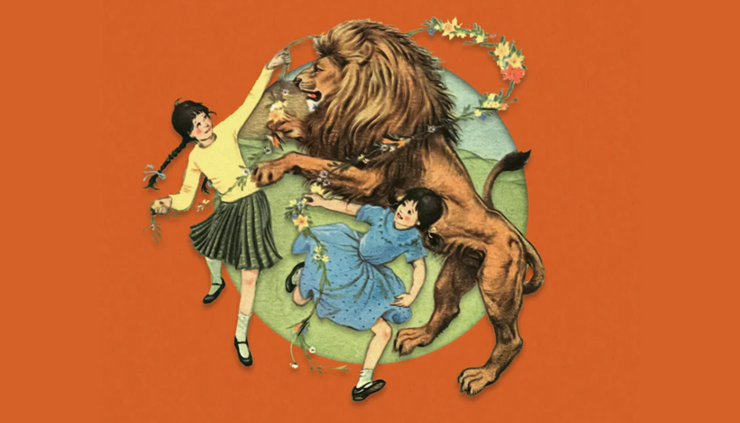
The Lion, the Witch, and the Wardrobe illustration by Pauline Baynes
Comment
0
Share New
Share
The Lion, the Witch, and the Wardrobe illustration by Pauline Baynes
I came to Narnia as an adult. The Inkling of my childhood was Tolkien. In college I read Charles Williams—he’s the least known now, but in some ways the most complex and beautifully weird of all. With those two behind me, I found C.S. Lewis’ series, explicitly written for children and also explicit in its allegorical underpinnings, rather too simplistic to be satisfying.
And yet it stayed with me. It’s derivative, its voice is often condescending, and there is the Problem of Susan. Still. It has its own power.
Much of that is borrowed, but like Lewis (and Tolkien) I am a medievalist. In the Middle Ages, originality was not a virtue. The real genius was the author who, in a famous image, stood tall on the shoulders of the giants who came before. The greater the homage, the stronger the work.
Lewis’ Talking Animals owe a great deal to everything from the classical and medieval beast fable to The Wind in the Willows. They have, for him, a very specific purpose. In 1953, halfway through the Narnia series, he published a poem titled “Impenitence,” in which he said,
Why! they all cry out to be used as symbols,Masks for Man, cartoons, parodies by Nature Formed to reveal us
Each to each, not fiercely but in her gentlestVein of household laughter.
And he is proud of it. He wants to do it. He doesn’t care what the critics say.
Or so he says. It’s hard to be an academic who also writes fiction, especially fantasy fiction, and particularly if it’s for children. One risks being regarded as Not Serious.
Over seventy years later, Lewis’ academic works aren’t nearly as beloved, or even known, as these books he wrote for children. They speak to something deep in us. Literally, in the case of his Talking Animals.
The original beginning of the series, The Lion, the Witch, and the Wardrobe (1950), introduces us to the world inside Uncle Digory’s wardrobe. It’s a world under siege, locked in ice and snow—forever winter, but never Christmas. Four children from our world, who have been sent away to the country in the middle of a terrible war, are called to save that world, and restore it to its green and pleasant self. They do this with the help of a large cast of mythological creatures and Talking Animals.
Who those animals are, where they come from, how they got there, wouldn’t be made clear to readers for a few years. Other volumes would be published first, with the exception of The Last Battle, which appeared in 1956, though it was completed before the origin story, The Magician’s Nephew (1955). There at last, Lewis spelled out exactly how Narnia was created, where the White Witch came from, and what the Talking Animals were and why.
Narnia’s animals for the most part are the same as ours—from the viewpoint of an Englishman born at the beginning of the twentieth century. They’re a lower order of creation than humans, without speech or understanding. But some of them have been lifted up by Narnia’s creator, who himself takes the form of a huge Lion.
When Aslan sings the dark and empty world into existence, he selects a pair from a number of species. The largest ones, such as elephants, he sizes down somewhat. The smaller ones—mice, rabbits, beavers, badgers—he sizes up, sometimes considerably. Hence, the mighty and indomitable Reepicheep, who is many times the size of an ordinary mouse.
These animals are his chosen. He grants them the power of speech and human levels of discernment. Like the children of Adam, which is what Aslan calls humans, they have a higher purpose. They ally with humans to serve and protect their world.
This gift is not irrevocable. If they turn to evil, they lose the gift. They return to their original state, without speech or understanding.
Loss of speech is a terrible thing in Narnia. It harks back to a profound Christian concept: In the beginning was the Word. Which, in the case of Narnia, was sung. It’s song that brings the world into existence, sung by the greatest of all the Talking Beasts, the creator himself, Aslan the Lion.
In The Last Battle, when Aslan submits himself to the final sacrifice, he’s robbed of all his dignity and strength and power. And, inevitably, his ability to speak. Speech is fundamental, and to lose it is in some ways worse than death.
I would rather live in Middle-earth than in Narnia. It’s so much bigger and deeper and higher. But the longer I live with Lewis’ series, the more it grows on me. It stays in my memory, and shows me new faces of itself with each rereading. I can see why it’s survived as long as it has, and been loved so much.
Greta Gerwig is working now on a film of The Magician’s Nephew, to be released next year—and from what I can gather, it’s the first of the full series, released in chronological rather than publication order. I’ll be there for it. I am so looking forward to the Creation of Narnia, the transformation of the cart horse into the glorious Fledge, and I hope she gives us the spectacle of Jadis, all seven feet of her, roaring down a London street on the roof of a hansom cab. That alone will be worth the price of admission.[end-mark]
The post The Chosen of Aslan: Narnia’s Talking Animals appeared first on Reactor.








 New Posts (Home)
 ChatBox
 Popular Posts
  Game Zone
 Top PodCasts