reactormag.com
Life Among the Giant Bugs: The Forgotten Planet by Murray Leinster
Books
Front Lines and Frontiers
Life Among the Giant Bugs: The Forgotten Planet by Murray Leinster
Giant spiders! Deadly fungus and killer spores! A massive ant army! This book has it all.
By Alan Brown
|
Published on May 26, 2026
Comment
0
Share New
Share
In this bi-weekly series reviewing classic science fiction and fantasy books, Alan Brown looks at the front lines and frontiers of the field; books about soldiers and spacers, scientists and engineers, explorers and adventurers. Stories full of what Shakespeare used to refer to as “alarums and excursions”: battles, chases, clashes, and the stuff of excitement.
One of the joys of this column is getting to explore used bookstores and discover old classics that I missed in my youth. A few weeks ago, I discovered a good one: The Forgotten Planet, by one of my favorite all-time science fiction authors, Murray Leinster. To this day, I remain amazed that one man could have had so many ideas relating to so many different fields, and over a fifty-year career produced classic tales about the earliest days of space travel, first contact with aliens, exploration of hostile environments, and even managed to make tales about a roving public health doctor interesting. This book is made up of three parts, the first two parts, “The Mad Planet” and “The Red Dust,” having appeared in Amazing Stories in the 1920s (different sources list different dates), and the third part, “Nightmare Planet,” published in 1953, with the combined novel coming out the following year. The copy I used for this review is a Carroll and Graf paperback from their Masters of Science Fiction series, printed in 1990.
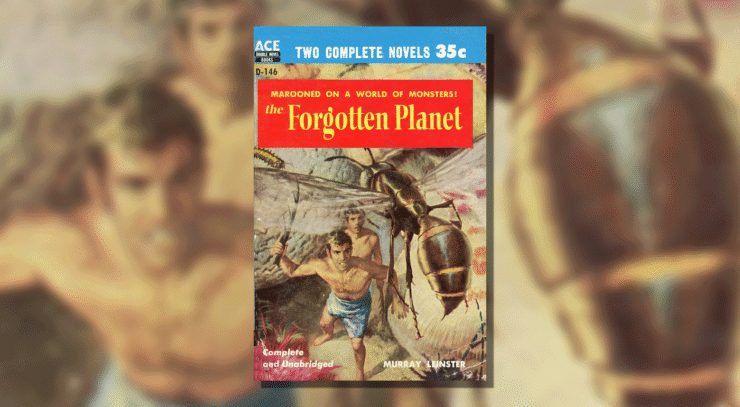
The book is a gripping tale of descendants of the crew of a wrecked spaceship struggling to survive on a planet only partially seeded with Earth life, where toxic plants and giant arthropods pose a constant threat.
About the Author
Murray Leinster was the pen name of William Fitzgerald Jenkins (1896-1975), a leading American science fiction writer active from World War I into the 1960s, who wrote groundbreaking stories in a wide range of sub-genres, including first contact, time travel, alternate history, and medical SF. I previously reviewed the collection First Contacts: The Essential Murray Leinster, the collection Med Ship, three books on humanity’s initial steps into space (Space Platform and Space Tug, reviewed together, and City on the Moon), and two books about Time Tunnels, one an original, and one tied to the TV show—you can find that review here. You can access some of Leinster’s works to read for free on Project Gutenberg, including The Forgotten Planet.
Problematic Attitudes Toward “Savagery”
One issue I had with The Forgotten Planet was with Leinster’s depiction of his human characters, and particularly his use of the word “savages” to describe them. That term, savage, has been used for centuries by people to describe those who are seen as less civilized or more primitive than themselves. The idea that civilized people are innately superior to those in more primitive conditions was used as an excuse for some of the worst excesses of colonization, oppression, and even genocide (you can find a Wikipedia article on the topic here).
While the protagonist, Burl, is shown as being a bit cleverer than his fellow tribespeople, they are depicted in a distinctly unflattering manner. Their goals are basic and described as being limited to filling their stomachs, preserving their lives, and perpetuating their species. They have no weapons, and few tools, using only rocks to crush things and the rough edge of giant grasshopper legs to saw things. They have lost the ability to make fire. They have no ambition or imagination, are timid and selfish, and react instead of thinking strategically. I myself can’t believe that, in such a hostile environment, human abilities and drives would have fallen so far. I would argue that with all the challenges they faced, the survivors of the original crash and their offspring would have become even more clever and creative in facing the constant threats of the planet, not sunken into apathetic lethargy.
What I do see that would have threatened their survival was the danger of inbreeding. The crew of a spaceship would probably not have a population large enough to ensure sufficient genetic diversity, and prevent disorders and recessive traits. That issue, more than any loss of ambition and creativity, would have threatened the long-term survival of the humans.
The Forgotten Planet
The prologue was my favorite part of the book, tracing humanity’s move out into the stars and encountering many habitable worlds, but worlds devoid of life (I’m not convinced that worlds without life would conveniently have an environment so well suited to it, as there is a synergistic relationship between life and the environment, but it is a reasonable starting premise). Leinster describes how humanity forms an Ecological Preparation Service dedicated to bringing life to these barren worlds via a centuries-long program of visits by seed ships. The first ships would bring microbes, bacteria, spores, and plankton. The next would bring both aquatic and land plants, a variety of fish for the seas, and insect life for the land. The species were limited to primitive animals that required no parental care upon hatching. But before this as-yet unnamed planet could receive additional seed ships, a file card was lost (a rather amusing anachronism to contemplate).
So, there were no higher forms of life seeded, and the primitive plants and arthropods evolved to fill environmental niches that birds, reptiles, and mammals fill on Earth. The preface tells us that into this stunted environment a human ship fell, the starship Icarus, (appropriately named after the legendary wing-maker who flew too close to the sun and fell to his death). And so, our story opens with survivors of that ill-fated vessel struggling in a world filled with familiar creatures that had evolved into strange and dangerous forms.
The protagonist, Burl, is a member of a small tribe with only a few strong adult members, with the majority being children or the elderly, too weak to contribute much. The lowlands of the world are constantly shrouded with clouds, and neither Burl nor anyone from his tribe has ever seen the sun. The flora is primarily made up of fungus, giant mushrooms, toadstools, and cabbages. There are fish in the waters, but only insects and other arthropods on land, many which have evolved to large sizes. Butterflies and moths have yards-wide wings, and what garments the tribe have are cut from those wings. Burl has an idea, and we meet him as he scavenges the horn from the corpse of a giant beetle, with the idea he can use it the way the beetle did, to kill prey. There is a woman near his age in the tribe, Saya, and he has a vague idea that he can impress her by gathering more food than one person can eat. Burl decides to stab a fish, and stands on a giant fungus shelf near a river. He gets his fish, but the fungus breaks off, and he is soon being transported aboard the floating fungus on an inadvertent voyage of discovery, far from his tribe.
Burl encounters a giant spider, and then another, and only survives because they battle each other. He flees from giant ants, and being alone, has to devise new ways to survive. He uses a dismembered beetle’s leg as a club. A forest fire breaks out, and Burl flees the flames along with the other creatures. He runs from an army of ants, each big enough to be a threat on its own, and unstoppable in large numbers. He finds a wounded moth, decks himself out with clothes torn from its wings, and finds a longer fragment of an insect shell to use as a spear. Emboldened by his successes, he kills a spider. When he finds his tribe again, they look at Burl with new-found respect.
The middle of the book is filled with Burl’s adventures as the leader of his tribe as they learn not just to survive, but to dominate their environment to an extent they previously did not think possible. There are setbacks, but they make steady progress until a new threat arises. There is a new kind of puffball fungus moving into their region, which releases red spores that contain deadly poisons. So, the tribe must begin a long journey, moving away from concentrations of the red puffballs to find a new and safer home. That home ends up being a plateau that rises above the constant mists of the lowlands, allowing them to finally see the sun, sky, and stars. The flora and fauna on the plateau are not nearly as hostile as those that populate the teeming lowlands they came from. And happily, they find another type of creature on the plateau, an old friend of humanity. The book ends on an even more positive note, as they are rediscovered by a visiting starship, and are able to rejoin humanity. Their planet becomes not only the source of many unique commodities for interstellar trade, but also a hunting ground for those rich enough to afford the trip.
Leinster does a great job imagining and evoking this strange world. In an Author’s Note at the end of the book, he cites the many sources he used in researching arthropod and insect life, and that research pays off in the realism of the many action scenes in the book. You might quibble about how quickly arthropods evolved to such large sizes, and the plausibility of invertebrates becoming so large, but the book would be much less exciting if they stayed their normal size.
In the older parts of the book, Leinster makes the decision not to use dialogue. This makes the story feel a bit stilted and expository, but at least we are saved from what might have been the phonetically spelled pidgin that authors from that era put in the mouths of their primitive characters.
Especially in the earlier sections, the tone of the book is very dark, and even depressing. While authors tend to create fiction by developing characters and then throwing problems at them, in this case Leinster almost goes too far. I began to dislike the book in the middle, but pushed ahead and was rewarded with a lighter tone toward the ending, as the tribe became more successful and found their way to less threatening environments.
Final Thoughts
I remain constantly amazed at the scope of Murray Leinster’s imagination. While his contemporaries early in his career were pumping out lurid adventure stories with preposterous backdrops, he was imagining a massive, complex program to seed other planets, and diving deep into research on insects and other arthropods to give his imaginary world a grounding in real science. And while The Forgotten Planet has its problems with outdated tropes and a depressing tone early on, it is a gripping tale of survival that keeps the reader turning pages.
Now, I’d enjoy hearing from you. That includes any thoughts you have on The Forgotten Planet, any thoughts on Murray Leinster and his other works, and any recommendations for other science fiction narratives that use insects as antagonists.[end-mark]
The post Life Among the Giant Bugs: <i>The Forgotten Planet</i> by Murray Leinster appeared first on Reactor.








 New Posts (Home)
 ChatBox
 Popular Posts
  Game Zone
 Top PodCasts