www.dailywire.com
Stop Tolerating Civil Terrorists Masquerading As First Amendment Warriors
This piece is part of MI x DW, a collaboration that brings Daily Wire readers exclusive commentary and research from the Manhattan Institute’s world-class team of scholars.
***
States are cracking down on illegal demonstrations, and radicals are panicking. Earlier this year, Utah enacted HB 331, which took several steps to enhance criminal penalties for crimes currently classified as misdemeanors. Arizona is close to sending a similar bill to the governor’s desk. These bills draw on a concept called “civil terrorism,” which I coined in early 2025 and have fleshed out since then, including in model legislation developed alongside my colleagues at the Manhattan Institute.
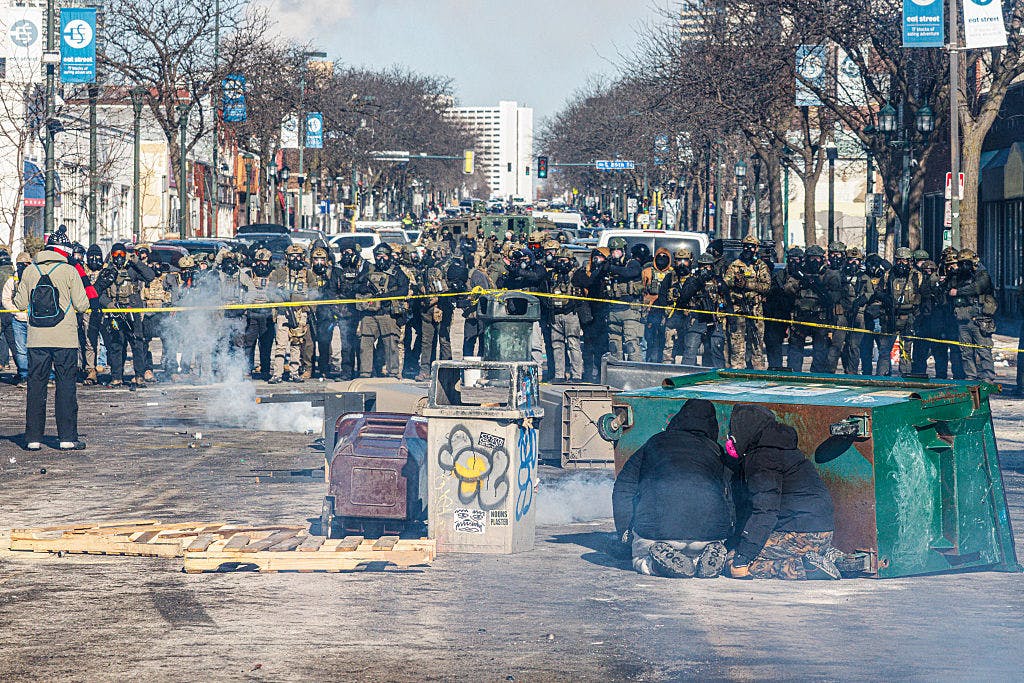
Civil terrorism refers to the weaponization of “minor” crimes to intimidate or coerce law-abiding citizens into taking a political position. The best way to understand it is to consider its most common manifestation. Radical groups block a road en masse, chanting about their environmentalist, economic, or geopolitical views. They communicate to trapped drivers that no trip to the airport, their jobs, or their families will be spared from the threat of future disruption until some policy changes are made. Rather than persuading their fellow citizens to support the change, they threaten to make life miserable until enough people cry uncle and acquiesce.
That is not how we communicate or settle political questions in our democratic system. We have robust First Amendment rights that allow us to channel strong, offensive, or controversial opinions into peaceable arguments — including in public spaces. But the First Amendment has never allowed people to shut down all other elements of American life so that some group can express itself with maximal ruthless effectiveness. We have laws that prohibit disorderly conduct, vandalism, trespassing, and more. And if those laws fail to deter repeat offenders or treat the minor crime of road-blocking by one person — a nuisance, not a menace — the same as road-blocking by 15 people, they should be updated. That is what civil terrorism laws do.
Most Americans grasp this intuitively and recognize that civil terrorism laws present no First Amendment problem. Yet some organizations and media outlets seem invested in pretending otherwise. A recent attempted hit piece against me and the Manhattan Institute in WIRED made some classic moves in trying to argue that civil terrorism laws are somehow violations of the First Amendment’s speech protections. It made some classic errors and employed some recurring misdirection, which is worth addressing.
The piece’s subheader is self-refuting. It says that civil terrorism laws would “increase[e] penalties for minor crimes committed while people engage in constitutionally protected free speech.” If people are committing minor crimes, however, the fact that they are engaged in some expressive behavior is constitutionally irrelevant. There is no get-out-of-jail-free card for yelling about a political issue while you do something illegal.
What is a “minor” crime, anyway? Just because something is classified as a misdemeanor now does not make it inherently unimportant — certainly not deserving of First Amendment protection, as if it were almost legal. Civil terrorists exploit the fact that some crimes are treated with kid gloves and hardly prosecuted. They violate precisely those laws in creatively destructive ways, knowing that they will face minimal consequences and can return to breaking the law repeatedly.
Their sympathizers, like the author of the WIRED article, often emphasize that such lawbreaking is “nonviolent.” That’s a red herring. Many laws prohibit nonviolent actions because “violent” and “illegal” are not synonyms. Our laws protect against behaviors that erode the social fabric, such as subjecting thousands of people to needless traffic to make a political point. Americans have an interest in clean, functional, orderly public spaces, which is why vandalism can be prohibited — and treated as a serious crime when its message threatens further disruption or even violence.
Click here for more Manhattan Institute content.
Another common criticism is that civil terrorism stigmatizes protest by labeling some demonstrators as terrorists. But these laws don’t label individuals “terrorists” as a pejorative or put them on a list. Civil terrorism simply describes the application of terrorist logic through less-violent means: We will continue to make your life miserable until you adopt our political position. Doing that with guns and bombs is violent terrorism. Doing it with other unlawful actions is still dangerous. More importantly, highlighting the logic of terrorism at play alerts lawmakers and our fellow citizens that the disruptions won’t stop if we ignore them. To the contrary, civil terrorists regularly vow to “escalate.” Our policy response has to be a crackdown, rather than a backdown.
Fretting about the invocation of terrorism or emphasizing the irrelevant (and arguable) element of nonviolence is a good sign that these critics don’t have much to go on. Frivolous First Amendment arguments attempting to extend constitutional protection to obviously illegal behavior shows that beyond all doubt. States have every right to ensure that their streets aren’t surrendered to radicals who only care about the Constitution when they can wield it in bad faith against law-abiding Americans. The movement to put civil terrorists in prison, investigate their organizers, and ensure that public spaces belong to the public again is gaining steam — and it is taking flak because it is over the target.
***
Tal Fortgang is a legal policy fellow at the Manhattan Institute.








 New Posts (Home)
 ChatBox
 Popular Posts
  Game Zone
 Top PodCasts