flashbak.com
Daido Moriyama’s NYC ’71: The Essence of Street Photography
“My approach is very simple—there is no artistry, I just shoot freely… My photos are often out of focus, rough, streaky, warped etc. But if you think about it, a normal human being will in one day receive an infinite number of images, and some are focused upon, other are barely seen out of the corners of one’s eye.”
– Daido Moriyama
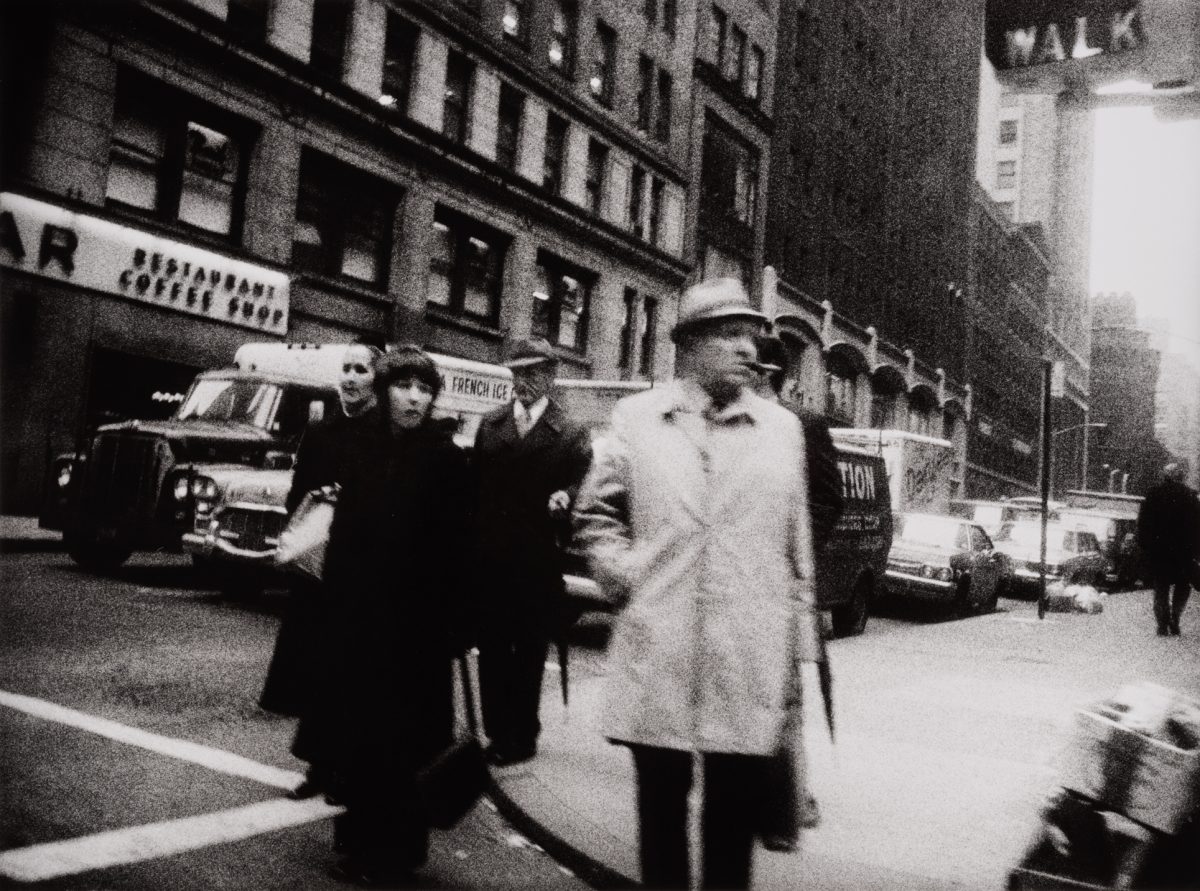
In 1971, Japanese photographer Daido Moriyama took a trip with the illustrator and painter Tadanori Yokoo to New York City for the first time.
The city was home to two artists Moriyama loved: Andy Warhol and William Klein. For him, NYC was “the world itself”, a world “filled with a vague scent of mescaline, while the smell of Andy Warhol is billowing out of every street”. New York was “a far but familiar place on the other side, or in other words, ‘another country.’”
He stayed at the Chelsea Hotel, visited the Museum of Modern Art Photography Study Center and spent some time looking at pictures taken by Weegee. And he shot one hundred rolls of film with a half-frame camera, giving 70 images per roll.
The Joy of Imperfection
The images are Are-Bure-Boke (粗-ぶれ-ボケ), a Japanese photographic aesthetic that translates to “rough, blurred, and out-of-focus”. What we call ‘shot‘.
Emerging from the postwar avant-garde scene, the style rejected technical perfection in favour of capturing raw, emotional, and authentic moments.
Back in Japan, Moriyama published a portfolio of the New York images in Asahi Camera magazine (April 1926 until July 2020 and was invited to show the work at Shimizu Gallery in Tokyo in 1974. At the exhibition he brought in a photocopier and assembled images. One version became Another Country in New York, named after the 1962 novel Another Country by James Baldwin.
His work appeared in the book, ’71 – NY. It includes a facsimile and English translation of a letter from Moriyama, an interview with the photographer, and passages from Baldwin’s book.
1. ‘Are’ (Grainy)
This term refers to the presence of visible grain or ‘noise’ in photographs. Instead of striving for the pristine clarity and fine grain of film often associated with traditional photography, Moriyama embraces the texture and imperfections created by grain. Grain is the visible texture created through the random arrangement of silver halide crystals on photographic film which can be fine or coarse.
2. ‘Bure’ (Blurry)
Embracing blur as an artistic choice, Moriyama’s work often features subjects that are intentionally out of focus. This blurriness adds a dreamlike quality to his images, encouraging viewers to engage more with the emotions and atmosphere of a scene rather than just its details. Blur in photography can occur for different reasons, for example moving the camera when making an exposure or photographing something fast moving at a slower shutter speed.
3. ‘Boke’ (Out of focus)
‘Boke’ takes the intentional blurriness a step further. This technique can create a sense of mystery and intrigue, inviting viewers to interpret the image in their own unique ways. To photograph something out of focus, a photographer can be selective with what is in focus by changing the ‘depth of field’ or they can shoot entirely out of focus by choosing no focal point at all.
– Photographers Gallery
Daido Moriyama
Born in 1938 in Osaka, Japan, Daido Moriyama studied photography before moving to Tokyo in 1961. To begin with, he worked as an assistant to Eikoh Hosoe, a Japanese photographer and filmmaker best known for his portrait series of the novelist Yukio Mishima.
In the early 1960s Moriyama began working on his own projects, photographing human foetuses in formaldehyde (Pantomime); the U.S. military base Yokosuka; fetishism (Provoke magazine); and streets, highways, and road culture in Japan (the photobook Kariudo). He sees the photobooks as a way to “see what I’m drawn to or thinking about, how I feel about it, and what I do and don’t want to do. It’s a process by which I have to articulate my relationship to photography and prove it.”
He told an interviewer for Bomb that for him, “everything was in the city. Cities are galleries, museums, libraries, movies, and theatres. I perceive cities to be all of these things, and that’s why I photograph them. They are alive with a breakneck momentum, with a vitality like an incredible creature or monster.”
“When I press the shutter, many aspects inside of me collaborate. I collaborate with the city, and then there’s the subject being photographed. And furthermore, the viewer collaborates. A photograph arises out of so many interactions.”
– Daido Moriyama
“…black-and- white photography has an erotic edge for me, in a broad sense. Color doesn’t have that same erotic charge. It doesn’t have so much to do with what is being photographed; in any black-and-white image there is some variety of eroticism.If I am out wandering and I see photographs hung on the walls of a restaurant, say, if they are black and white, I get a rush! It’s really a visceral response. I haven’t yet seen a color photograph that has given me shivers.”
– Daido Moriyamavia, via aperture
“For every single photo I take, some fragment of my memory has probably made its way in there. Then the viewer also projects his or her own memory onto it. Sometimes the photograph has more impact on the beholder than the taker. To be clear, I believe the three elements of documentation [記録 kiroku], memory [記憶 kioku], and commemoration [記念 kinen] are the basis of photography.”
– Daido Moriyamavia, via bomb
Via: Reflex Amsterdam
The post Daido Moriyama’s NYC ’71: The Essence of Street Photography appeared first on Flashbak.








 New Posts (Home)
 ChatBox
 Popular Posts
  Game Zone
 Top PodCasts