www.dailysignal.com
We Owe American Security to Those Boys on the Beaches of Normandy
Editor’s note: This is a lightly edited transcript of today’s video from Daily Signal Senior Contributor Victor Davis Hanson. Subscribe to our YouTube channel to see more of his videos.
Hello, this is Victor Davis Hanson for the Daily Signal.
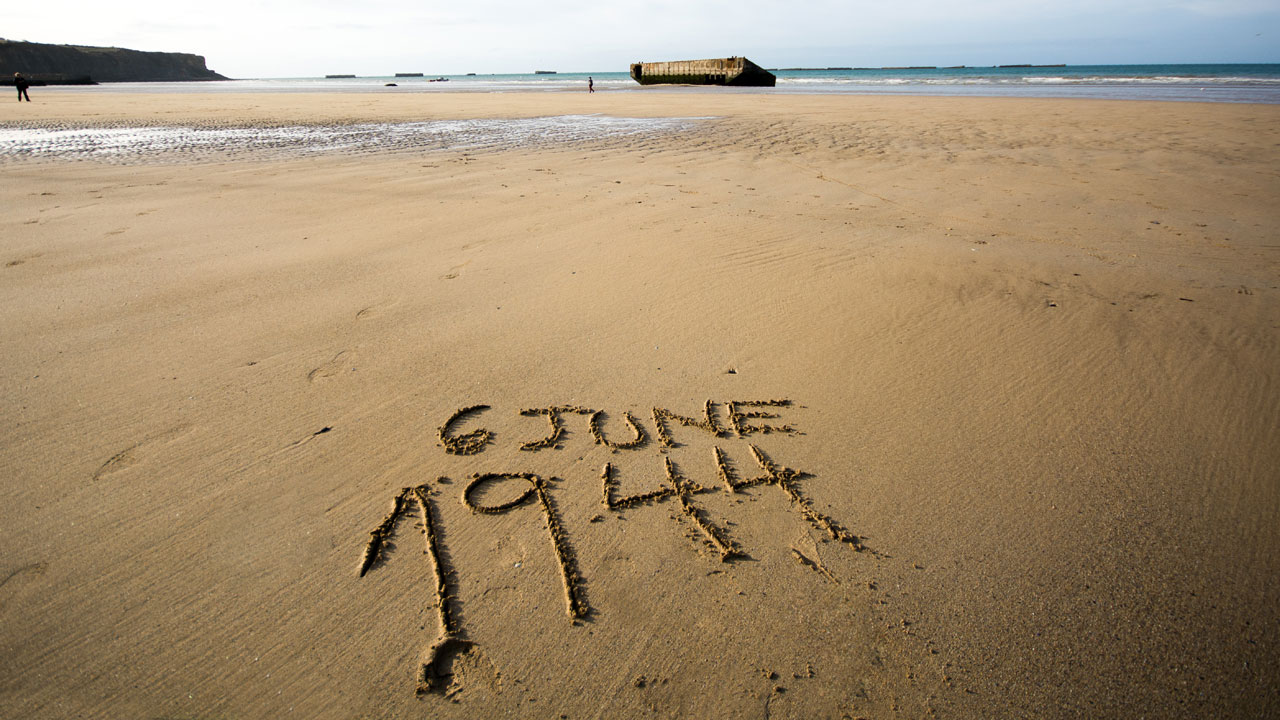
This past week was June 6, 2026. That’s the 82nd anniversary of the D-Day landings in World War II that took place on June 6, 1944. It was the largest amphibious invasion since Xerxes’ invasion of Greece. It might have been much larger, even.
Some 300,000 British, Canadian, and American troops landed on five beaches in Normandy. Probably about 150,000 on land and over 160,000 various naval personnel and airborne personnel. On that single day, more than 10,000 British, American, and Canadian troops were wounded or missing or killed. Forty-four hundred we know Americans, 4,400 were dead among all Allied armies.
Probably most of those were Americans.
What was the strategy behind it? The Russians had been pressuring us for a second front. Remember that [Joseph] Stalin had been in league with [Adolf] Hitler since August 23, 1939, and that devilish, diabolical relationship had benefited both sides until Hitler turned on Stalin on June 22, 1941.
And then Stalin all of a sudden became our friend and wanted help. At war’s end, it is true the Russian, Soviet Red Army killed three out of four German soldiers. That’s where most of the bloodletting was. Twenty million Russians died on the Eastern Front, probably 3 million to 5 million Germans. We don’t really know the exact totals of Germans were killed there.
But Stalin felt that if the United States had a second front—that is, if they landed on the beaches of France—then Germany would have a two-front war. That was the strategy. The problem was that the United States, once Hitler declared war on us and we then declared war back on December 11, just a few days after Pearl Harbor, we were in no position to fight a European war.
Our army was the 19th largest in the world. The Portuguese had a bigger army than we did. We were in rapid mobilization and rearming. The British knew that. The Russians knew that. But the problem was we were very confident that we, to end wars, would go straight to Berlin. No fooling around in peripheral theaters.
So George Marshall, the Army chief of staff, demanded that in 1942 or early ’43 we land on the beaches of France and go straight to Berlin. We were not capable of doing that. To do that, you had to have absolute air superiority. We did not have that. You would have had to have absolute naval superiority. In ’42, we did not quite have that.
More important, we didn’t have veteran troops. The people who were stationed in France on D-Day turned out to be some of the most vicious infantry and Panzer divisions in World War II: the Panzer Lehr Division, the Das Reich Division. They had a lurid history—Second and Third Panzer divisions in Russia—of committing atrocities but also being very well equipped with Panther and Tiger tanks, close air support, very deadly.
So we were not up to that. The thinking was we had landed 2 million troops in World War I on the beaches of France and the ports of France, and we thought we didn’t lose more than 50 in transit, so we said we’ll just do the same thing and go right to the German border. But of course, France wasn’t occupied in World War I. It was in World War II.
So we had to get on the beaches and then form an army and then not be pushed off as the British had been in Dunkirk. Churchill was against the idea because he said, “We were surrounded at Dunkirk and we had to evacuate more than 300,000 troops. We almost lost our entire army. It’s very dangerous to have an amphibious landing against crack veteran German troops.”
Nonetheless, we decided then to hit the periphery of the German Third Reich. So we, in November 1942, landed in North Africa; the next summer in Sicily and Italy; and we gained enormous experience in amphibious landings. So some of those commanders, many of those troops, were the veterans that helped school us, along with the British, who had been fighting the Germans much longer, to land on D-Day.
So the idea was we were going to have five beaches. Gold and Sword would be the British, Juno would be the Canadian, and we would have two, the Americans, Utah and Omaha Beach. It’s not the closest route from England across the channel to France. It would have been better to land at Calais.
But of course, the Germans were expecting that, and they had fortified it heavily. Normandy was a huge beach, 50 miles long. It gave us chances to spread out. We would not be confined to a peninsula and cut off. It was pretty good ground for armor. And the idea was we could take off to Paris, and we might be there in a week or two.
It was a great success and in some ways a failure. The first day, the British and Canadian beaches were very lightly defended in comparison with the Americans, who had high cliffs, and the wind had blown the Americans off course. The seas were rougher. Many of our tanks that were supposedly floatable sank.
We didn’t have the ability to knock out the German artillery and machine guns on the first day, and more than half the casualties and fatalities on the entire D-Day were at Omaha Beach. Nonetheless, in a series of waves, pretty young kids that had no prior battle experience, 18 and 19, charged right off the beach, right across it, and eventually up over the seawall and captured Germans.
And by the end of the day, they had in their possession Utah and Omaha Beach, and the British and the Canadians had made a successful landing. Part of our luck was that Erwin Rommel, who had the tactical command under Gerd von Rundstedt of the German defenses, was not allowed to release the Panzer or the armor divisions.
Hitler alone could make that decision, and we had a lot of very successful decoy operations, intelligence operations, to fool the Germans into thinking we were going to Calais. As a result, he did not release enough German armor to push us off.
However, we really didn’t break out from June 6 all the way to the end of July. We found, the Americans in particular, that the land on the other side of the beaches was what we call hedgerow or bocage, thick, dense brush with one-acre, tiny little fields, perfect cover for German machine gunners and mortar teams, and that took a lot of casualties.
By the time we, six to eight weeks later, finally got all of the armies united and we had reached the major cities of Caen and Saint-Lô, and we were ready to break out, we had lost about 80,000 casualties.
And we only broke out because finally the U.S. Army Air Force had to come in and bomb the German army with heavy B-24 and B-17 bombers and blast a corridor.
And of course, one of the tragedies of the entire campaign was that George S. Patton, the most gifted of all American generals in the field, had been under discipline for slapping two soldiers. On two occasions he slapped soldiers who he felt were dogging it. One was sick; one was suffering from shell shock, and he was reprimanded.
And for one year he was relieved of active command in the field, and he was stationed in Britain as a decoy. The Germans thought wherever he went, the actual invasion would occur, and he stayed in England, and so they didn’t commit fully their troops to Normandy, thinking Patton would go to Calais.
But there was an irony to it. The ground commander on D-Day, the overall commander was Dwight Eisenhower, in charge of naval, air, and land, but the ground commander was Bernard Montgomery. He was not a thruster. He was not an aggressive commander. He was brilliant on defense, as El Alamein had shown.
But we didn’t have a George Patton. Had we had a George Patton in the month of June and the month of July, I think we could have lessened casualties. When he was finally deployed with the Third Army, he broke out at Falaise Gap, so to speak, and for a month he was traveling at 50 miles an hour eastward toward Germany.
Finally, what was the notion about after D-Day occurred? It became iconic because it was emblematic of fresh troops, as I said, up against some crack Germans. There were a lot of Soviet prisoners who were given a chance to fight and save their lives, and they were not reliable troops.
But very quickly, in the weeks after D-Day, some of the best German divisions were on their way into Normandy. And what was quite stunning was the Americans fought extremely well, just as well as the British and sometimes better. They ground down the Germans. They had superior air superiority and naval support.
And I’ll leave you with this tidbit. It’s maybe an unfair comparison, but the distance from Omaha Beach to Berlin was a little more than 600 miles. On June 6, 1944, the Russian army was about 650 to 700 miles from Berlin.
And it had not moved since 1941. You could make the argument that the Americans had to land on the beach, had to be supplied 100% by amphibious landings on the beach or the Mulberry artificial harbors. They waited at least two months before Cherbourg, Brest, and some of the ports that had been mined and defended and blown up were usable.
And yet the Americans got just outside Berlin at the Elbe River about the same time the Soviets did.
It was a stunning achievement to land on June 6, 1944, and to be across the Rhine and receive the surrender of all Western troops in the German army on May 9 and 10, less than a year later.
So we were in Western Europe for less than a year, and we had fought in North Africa. We had fought in Sicily. We had fought in Italy. We had fought in the Pacific. We had alone defeated Japan with the help of the British.
And so people keep saying the Red Army won World War II. The Red Army did one thing. It destroyed German soldiers in land warfare. It did not have a strategic bombing campaign. It did not have a naval campaign. It did not fight the Italians. It did not fight the Japanese until the last two years of the war.
So the American achievement we should all remember today was quite stunning, and we all are the inheritors of a free and prosperous and secure United States in part because of those young kids who went out of the landing craft, charged at Omaha Beach, and suffered in some cases 90% casualties of their company.
We publish a variety of perspectives. Nothing written here is to be construed as representing the views of the Daily Signal.








 New Posts (Home)
 ChatBox
 Popular Posts
  Game Zone
 Top PodCasts