www.upworthy.com
Why Major League Baseball cancelled all games in June 1944 to support the allied invasion of Normandy
During World War II, Major League Baseball (MLB) surprisingly did not shutter despite many players enlisting in the armed forces. According to the American Veterans Center, over 500 major league players and over 2,000 minor league players went into service.
Their dedication to their country was evident. However, keeping MLB operating during WWII was an important decision.
According to the National WWII Museum, in 1940, baseball was the most popular sport in the United States. The decision to keep it going during wartime was made between the MLB Commissioner Kenesaw Landis and President Franklin D. Roosevelt.
Roosevelt keeps baseball operating
Following the attack on Pearl Harbor on December 7, 1941, the future of MLB continuing to operate was up in the air. On January 14, 1942, Landis wrote a letter to President Roosevelt asking for his guidance on keeping the league operating. The American public was also polled for its opinion on whether the MLB should continue during the war or stop. The results showed that 67 percent of Americans voted to keep it going, per the National WWII Museum.
On January 15, 1942, Roosevelt gave Landis a response via his now infamous “Green Light Letter.” President Roosevelt responded: “I honestly feel that it would be best for the country to keep baseball going.”
It was settled. Baseball would continue to keep Americans at home entertained and morale high. As Jeff Obermeyer wrote for Society for American Baseball Research, keeping baseball operating was a “play to patriotism and morale, tying baseball fandom (and therefore attendance) to what it meant to be an American.”
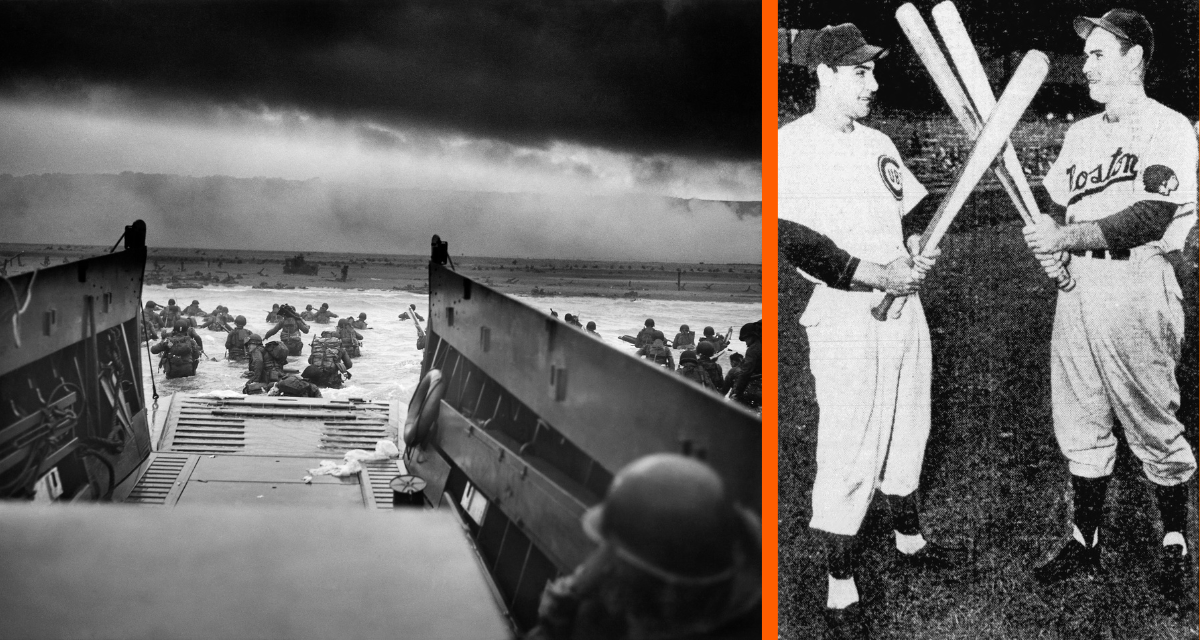
Major leaguers Ted Williams, Stan Musial, Hank Greenberg, Bob Feller, and Joe DiMaggio all served during WWII, per the National WWII Museum. But there was one important day during World War II that all MLB games were stopped: D-Day, June 6, 1944. (Future National Baseball Hall of Famer Yogi Berra also famously served at D-Day.)
MLB stopped on D-Day
The Allied troops stormed the beaches of Normandy, France, on June 6, 1944. Known as D-day, the invasion involved nearly 160,000 American troops and their allies, according to the National World War II Museum.
Known as operation OVERLORD, the attack was meant to bring a “quick end to the war.” As Smithsonian Magazine notes, “News of the invasion wouldn’t reach the United States shores until 3:32 a.m. EST, when General Eisenhower’s Order of the Day, a message recorded for the troops going into the invasion, was read over American radio stations. President Roosevelt himself wasn’t briefed of the invasion’s status until a mere 30 minutes before the American public found out—he remained on the phone with generals until 9 a.m., then met with the press at 4 p.m..”
In reverence, League Commissioner Landis decided to halt all scheduled games set for that day so fans and family members with service members could listen to radio updates.
“The reaction of many Americans, whenever they found out what was happening that day, was to attend religious services,” Keith Huxen, the Samuel Zemurray Stone senior director of research and history at the National World War II Museum, told Smithsonian Magazine. “Churches and synagogues were reportedly packed across the country.”
Although D-Day did not end World War II, it was referred to as the “beginning of the end.” The Allied troops suffered over 10,300 total casualties (killed, wounded, or missing).
“The D-Day invasion gave the Allies the success they needed to initiate the campaigns that would lead to the liberation of occupied Europe,” notes the National World War II Museum.
The MLB would continue to operate following the invasion. However, on July 10, 1945, the MLB All-Star Game was also canceled during World War II as part of the war effort.
The post Why Major League Baseball cancelled all games in June 1944 to support the allied invasion of Normandy appeared first on Upworthy.








 New Posts (Home)
 ChatBox
 Popular Posts
  Game Zone
 Top PodCasts