reactormag.com
Poetry From the Plague Pit: The Early Stories of Clive Barker and Joel Lane
Featured Essays
queer SFF
Poetry From the Plague Pit: The Early Stories of Clive Barker and Joel Lane
At the height of Thatcherism and the AIDS crisis, two queer British horror writers began carving out their unique visions…
By Matthew Cheney
|
Published on June 11, 2026
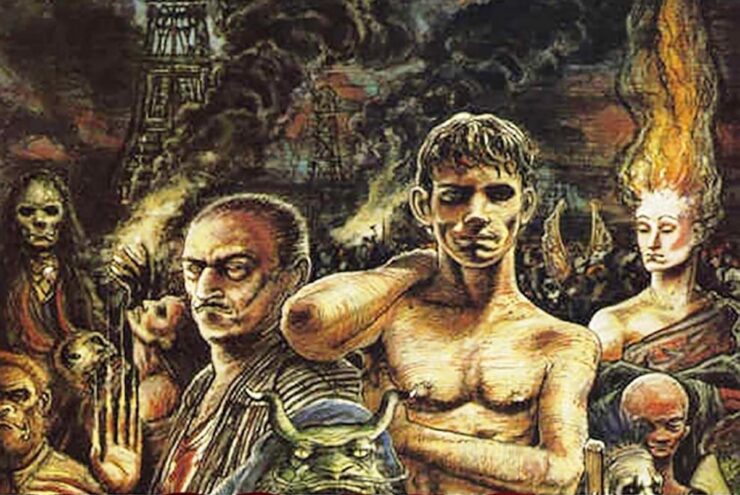
Books of Blood Vol 1 cover art by Clive Barker
Comment
0
Share New
Share
Books of Blood Vol 1 cover art by Clive Barker
In 1984, the fifth year of Margaret Thatcher’s reign as Prime Minister of the United Kingdom, two English men published their first short stories. Born October 5, 1952, Clive Barker started writing stories in 1981 as a change of pace from his primary creative activity at the time: writing, directing, designing, and occasionally acting in plays. Completely ignorant of the world of publishing, Barker did not know that short story collections are not considered a money-making prospect by publishers, especially not by unknown writers, and especially not when they arrive, unsolicited, as 600-page manuscripts. Luck was on Barker’s side, though, and in 1984 his stories appeared in three volumes titled Clive Barker’s Books of Blood.
Joel Lane was born October 2, 1963 and had a more conventional literary debut. His first story, “The God of Clay,” appeared in Dark Horizons, a small-press magazine of the British Fantasy Society, and he would not publish his first collection until 1994, when Egerton Press released The Earth Wire and Other Stories.
These completely different debuts would lead to completely different careers, and yet Clive Barker and Joel Lane stand as emblems for much of the best of British genre fiction over the last forty-plus years, and both, in their own quite different ways, stretched the limits of horror both in terms of content and technique. That they were both born in the month of Halloween is coincidental, though fun for any writer of weird and dark fiction; that they were both living as queer men in Margaret Thatcher’s Britain when their first stories were published suggests much more about what and how they wrote in those years.
Joel Lane died suddenly in 2013, a few weeks after his collection Where Furnaces Burn won the World Fantasy Award. (He at least got to outlive Margaret Thatcher by six months.) Clive Barker is still alive and reportedly working, but health problems have prevented him from publishing any new fiction for many years. With contemporary politics taking a conservative turn, including fierce attacks on queer and trans people, now feels like a good time to look back on the early years of Barker and Lane’s careers. The stories they wrote decades ago still resonate, and those resonances suggest myriad ways the art of horror can bring clarity to our emotions, philosophies, and desires in times of trouble and fear.
On July 3, 1981, when Barker was starting work on his Books of Blood stories, The New York Times published a report on page A20 headlined “RARE CANCER SEEN IN 41 HOMOSEXUALS.” In April 1984, scientists announced that they had isolated the retrovirus that caused AIDS, which two years later would be permanently named HIV: the human immunodeficiency virus. By the end of the year, there were 108 reported AIDS cases and 46 deaths in the UK, significantly fewer than in the United States, but the numbers rose quickly.
Barker has said that his editor at Sphere didn’t want him to include one story in the book: “In the Hills, the Cities,” a tale of two men in a failing relationship who travel to central Europe and happen upon an old ritual where competing towns bind all their citizens together in the form of colossus figures and then attack each other. The story is one of Barker’s most original and astonishing; it won the British Fantasy Award and remains one of his most highly regarded works, prized by critics and fans alike. In Clive Barker: The Dark Fantastic (2002), Douglas E. Winter notes that the first draft of the story featured a heterosexual couple, but one of Barker’s friends pointed out to him that something of a homosexual undercurrent remained, and Barker brought the undercurrent to the surface in revision. Ordinarily at that time, this would not have been a good career move. An unknown writer of strange, often violent short stories was already going to be considered a gamble by any publisher. Adding in sexually active queer characters would be perceived as something of a book marketer’s nightmare in the early 1980s. But Barker stubbornly stuck to his vision.
According to Winter’s biography, “Sphere published Clive Barker’s Books of Blood in March 1984, without any advertising, promotion, or expectations.” At first, it seemed that the books would take some time to each sell out of their ten-thousand-copy first printing. “But within months, propelled by entirely by word of mouth and an occasional review, these stories, originally published for a small niche audience, rose from the shadows and into the mainstream to become one of the true publishing phenomena of the 1980s.” Winter attributes this to Barker’s talent meeting the literary moment. Since the paperback triumphs of Rosemary’s Baby by Ira Levin, The Other by Thomas Tryon, The Exorcist by William Peter Blatty, Jaws by Peter Benchley, and the first books of Stephen King in the 1970s, horror was hot—but by 1984 the market was becoming oversaturated with low-quality work retreading familiar ideas and scenarios in mediocre (at best) prose. Barker offered energetic writing, imaginative imagery, invigorating angles on old plots, and, as with “In the Hills, the Cities,” some utterly original visions of weirdness and horror. His sheer originality within a genre that was aching for it is certainly the primary reason for Barker’s improbable success, but the fact that some of his characters happen to be queer should not be lost—in an era where white, heterosexual conservative political dominance remained strong but not new, a yearning arose (especially among young people) for any vision that could confront the cruelties delivered by a sadistic political order while also recognizing the world’s diversities of humanity.
Mick and Judd in Barker’s story are not models of romantic bliss. (This is far from a story of queer joy!) Mick is a dance teacher who has come to perceive his journalist boyfriend, Judd, to be boring and arrogant; at home, Judd’s rightwing politics didn’t especially bother Mick, but now, outside of their familiar environment, it’s much harder to overlook Judd’s intolerance and xenophobia, although the extent to which this is Mick’s perception, heightened by Judd’s lack of interest in the churches that spark Mick’s curiosity, is unclear. Barker gives us a glimpse into Judd’s point of view, and we learn that Judd has begun to think of Mick as a shallow queen: “There was just no other word for him,” he thinks. “His mind was no deeper than his looks; he was a well-groomed nobody.”
Mick and Judd do not find their way to reconciliation, new partners, or a conventional happy ending. They are destroyed by madness and gravity, punished not for their homosexuality but for their obliviousness to the dangers around them and, ultimately, their inability to get out of the way. Their sexuality is irrelevant to the old rituals and forces that determine their fate. At the end of the story, Barker, knowingly or not, echoes the famous conclusion of Anton Chekhov’s story “Gusev,” which follows the dead Gusev’s body as it is tossed into the ocean and falls past fish, then is played with by a shark, until in the last paragraph the narration draws our attention to clouds, sky, sunlight, and unnameable colors on the ocean’s water. Barker is more explicit with his meaning (more expressionistic than impressionistic) but the point of view is the same, like a camera zooming out to reveal the larger scheme of things: a dead body taken over by birds, foxes, flies, butterflies, wasps, maggots in a cycle of life and death. Names and opinions now have no more consequence or meaning than an exhaled breath caught in a breeze. The cycle of life and death continues with the rising and falling of the sun: “Darkness, light, darkness, light. He interrupted neither with his name.”
“In the Hills, the Cities” is an early story, probably written before the horrors of AIDS had become apparent in Britain. (The first person publicly acknowledged as dying from an AIDS-related illness in the UK, Terrence Higgins, died on July 4, 1982, and it wasn’t for another year that diagnosed cases hit the double digits.) It isn’t until the sixth of the Books of Blood (somewhat confusingly, in the US, the stories in this collection were originally packaged along with the short novel Cabal and published under that title), written while Barker was working on his first novel, The Damnation Game, and published in the summer of 1985, that we get a story where AIDS feels like an unavoidable reference, even if it goes unnamed. “The Life of Death” is the story of a woman, Elaine, who has recently recovered from serious surgery for a life-threatening illness (something like ovarian cancer) and one day discovers a derelict church that catches her interest. The church is being prepared for demolition. She inquires of a strange, bow-tied man what is going on and he mentions a sealed tomb. Soon, the tomb is unsealed, and Elaine sneaks in, discovering well-preserved bodies in a plague pit. She becomes a carrier of the plague, though apparently immune to it—but her friends are dying.
Anyone reading “The Life of Death” in 1985 would likely have thought of AIDS, which was frequently spoken of in terms of plague and divine retribution. Anyone who has had cause to pay attention to mortality can sympathize as Elaine seeks a philosophy to corral her emotions: the elation of surviving her illness, the residual fear lurking in her, and the anxiety born of knowing that whatever plans she makes, whatever hopes and dreams she indulges, are all fragile, all speculative, all able to be undone in a day. Romanticizing death drains fear of its power, turns the feared thing into the desired thing, and Elaine often succeeds at this psychological maneuver, but at crucial moments she must admit it is fantasy. When she descends into the plague pit, she must reckon with the physical remnants of death, utter materiality absent any art or glamour. No romance here, only corpses tossed on each other in panic and desperation, preserved by the sealed tomb but now rotting anew with a fresh influx of air.
Elaine will regain her sense that death is romantic, but once again the story will show her to be mistaken. Following her experience of the plague pit and after her friends start getting sick and dying, she must preserve some shreds of sanity somehow, and so death becomes a great attraction, something she anthropomorphizes and imbues with romantic power.The story is sympathetic to Elaine, but also shows that her romance with death leads her to errors of judgment, and while her own end has a certain “Gusev”-like transcendence to it, it is not the death she thought she was on her way toward, but rather something altogether more mundane. The story’s final moments reveal that the figure she thinks is the embodiment of Death is no such thing, and Elaine’s end is hardly more elegant than being tossed into a plague pit. “Does it matter, though?” the story seems to be asking us. Death is death, a release into the universe. Elaine is a bit disappointed in herself, but, once she realizes what is happening and rises above it all on her way to escaping the body and its imperfect flesh, she seems no more or less content than she would have been had she perceived the real danger she faced.
The endings of “In the Hills, the Cities” and “The Life of Death” may make us think of the daring point-of-view shift at the end of “Gusev,” but that is the only meaningful connection between Barker’s stories and Chekhov’s. Barker’s stories are more in the tradition of well-made tales by writers such as Guy de Maupassant and O. Henry. Joel Lane, on the other hand, was one of the most Chekhovian writers of horror and weird fiction, at least in the structures of his stories. In her history of Russian literature, Thaïs Lindstrom wrote: “It has been said that a Chekhov story is like a tortoise — all middle. The ending, never stated, is implicit in the frustration, nostalgia, loneliness, pretension, or despair of the story’s one brief moment selected from a life to illuminate it in its entirety.” Though Chekhov’s name appears nowhere in Lane’s collected nonfiction, and I have not noticed it in any interview with him, nonetheless, he brought to weird fiction (his preferred term for what he wrote) exactly the sensibility Lindstrom describes.
Lane’s stories tend to be significantly shorter than Barker’s, more loosely plotted, less full of incident, less explicit, less conclusive. Reading one quickly, it’s easy to get to the end and think, “Is that it?” In contrast, throughout The Books of Blood Barker is careful to give readers gripping beginnings, incident-rich middles, and endings that tie up most of the loose threads. This more conventionally pleasurable approach to storytelling is part of the reason Barker’s work is vastly better known and more widely appreciated than Joel Lane’s. For all their differences, though, both writers found techniques for representing and working through the calamities of life as queer men in the 1980s and 1990s. They proved themselves masters of their approaches, and our luck as readers is that we can appreciate both and suffer no requirement to choose between them.
Barker has long loved monster stories, using them to propose the idea that the creatures most rejected by the world are the most interesting and often the most sympathetic, an idea that would find its fullest early expression in his short novel Cabal and the film based on it, Nightbreed. It’s a concept that echoes throughout The Books of Blood, perhaps most clearly in “The Skins of the Fathers,” a story playing on tropes of the Western genre, where wondrous mutants are persecuted by American hicks. Barker’s monsters may do monstrous things, but it is rarely because of some immutable essence; rather, they are shaped into monstrosity by the misunderstanding, prejudice, oppression, and rejection they experience.
While equally concerned with social forces, Lane’s approach is quite different. The contrast between the two writers is perhaps best described as the difference between a poet and a dramatist. Barker came to fiction from the theatre and his career has been rich with theatricality. Lane published books of his poetry and in 1993 won an Eric Gregory Award, given annually since 1960 by the Society of Authors for collections by poets under the age of 30. The creatures in Lane’s fiction are more mysterious than the creatures in Barker’s work—often ethereal, sometimes more glimpsed than seen. Even when perceived completely, Lane’s monsters rarely offer clear meaning or import.
In his 1989 story “Albert Ross” (included in The Earth Wire), the title character is a young man who discovers that he is growing wings. He seeks help from the story’s point of view character, a healer named Lochran. There is no explanation of the wings, nor any great consequence except pain and ostracization for Ross. His attitude toward the wings is strangely blasé — they’re just one more burden he has to bear, and maybe not the worst. Just as we know nothing of the origin of the wings, we learn little of either character’s background. We know Ross lives at home with his parents, that his father is struggling as a spot-welder always threatened with losing his job, that his mother is consumed with anxiety, that neither parent pays much attention to him. About Lochran, we know even less. Why does Ross think Lochran is “a faith healer” and how did he find out about him? What other people exist in Lochran’s life? What are his desires, dreams, motivations? These are the sorts of details a more traditional (and theatrical) writer like Barker would provide, but they are not questions that interest Lane in this story. Instead of the standard details of character and event, we must think about resonances, atmosphere, implications. Stories such as “Albert Ross,” like many poems, thrive on juxtapositions, on the rhythms of images set one beside the other, on the subtle accumulation of sensation, and on the reader’s own imagination.
Like the supernatural elements of many of Lane’s tales, Albert Ross’s wings serve as a kind of metaphor without a clear referent, unsettling our reading practices by denying the other half of the equation, unmooring meaning. But they aren’t a random weird element. At the most basic level, they serve a narrative purpose by bringing Ross and Lochran together in an intimate way that develops through the story and leads to conflict. (Lochran’s hands are as symbolically resonant in the narrative as Ross’s wings.) Unlike a more overtly dramatic story, the conflict is a quiet one between the two men, and it is not the result of their actions but rather their circumstances. Ross wants more from Lochran—wants love—but, enamored of Ross as he is, Lochran is a generation or so older, and he is wise enough to recognize that what Ross wants and what he needs are opposed. Neither man has anything to apologize for; they are trapped in a simple twist of fate.
The ending is in some ways more conclusive than in many of Lane’s stories. Lochran’s time with Ross is over. (“He felt like an accessory. There was no organizing principle within him.”) Ross at least has some sense of definition: he is the boy with wings, the boy with needs. What does Lochran have, what does he need? He doesn’t know. And so, in his own unwingéd way, he takes flight.
The next story in The Earth Wire is “The Clearing,” one of four stories original to the collection, and a rare science fictional story from Lane. It is set in a near future where a contagious cancer-like disease is killing people in great numbers. The shell of civilization remains, but the citizenry feels defeated. Youth gangs roam in search of goods and amusement. “The Clearing” tells the story of Martin, whose best friend has just died of the cancer, and who feels, like so many of Lane’s protagonists, adrift. His flat gets broken into by a couple of youths, and he catches them at it and asks why they are taking things. “Scarcity of resources,” they say, repeating a phrase anyone might have heard on the evening news during the Thatcher years.
Lane’s stories tend toward bleakness, but “The Clearing” is among the bleakest. It unites a feeling of doom, loss, and anomie common to both Thatcherism and the AIDS crisis. The lack of any obviously queer characters in the story makes it a kind of thought experiment hypothesizing what a world might look like if all of British society were to suffer the oppressions imposed on marginalized people by rightwing cruelty and an uncontained pandemic. Early in the story we read: “A couple of years ago, the hospitalization of cancer victims had been made compulsory. That had been the turning point, Martin supposed: when a popular fear had been made into law.” Lane could be writing about the anti-gay 1988 law Section 28 there, but also of the push by various politicians and pundits to quarantine AIDS patients. The experience of many HIV+ patients, though, is reflected in a comment by Phil’s friend’s widow. “You know,” she tells Martin when he visits, “people say that they’re actually killing everyone who goes in [to the hospital]. Since they’re all going to die anyway. It’s a waste of resources to take care of them.” (Any number of tabloids in the 1980s could have run opinion columns arguing that care for AIDS patients was a waste of resources.) The story’s title refers to an urban redevelopment project to clear away the empty houses of the dead and make the future seem appealing, but the phrase resonates with various meanings through the story: clearing away and emptying out, certainly, but also with the sense of bringing clarity, making clear.
What is clear for Martin by the conclusion is the need for community. Social ties between people have been shattered by fear and loss. The story ends with Martin joining a crowd on a mysterious walk to an empty parking garage, a place of gathering, where strangers can at least be together. The imagery is like an inversion and echo of moments from Barker’s “The Life of Death”—these characters who have seen so many corpses have gathered haphazardly to remember their humanity together. “What this gathering voiced was only a wordless protest against silence, a shared regret that mourning was impossible.”
“The Clearing” has a similar premise to another of Lane’s stories published in 1994, “The Pain Barrier,” reprinted in his astonishing 2006 collection of stories, The Lost District. In “The Pain Barrier,” England and perhaps other parts of the world have suffered some sort of contamination that has brought about a new blood disease, “thin blood”. The country seems to be under martial law; there is a passing reference to the militia being indistinguishable from the roving gangs. The main character here is Lee, a man recently released from prison, where he was serving time for possessing drugs and illegal films. He is thin blooded, likely doomed. At a club, he sees a younger man he recognizes as an actor in some of those films, Tony. They chat and Tony eventually takes Lee to an abandoned building where, Lee soon realizes, one of the films was shot. They talk about the films, which seem to have mixed sex and violence, with Lee curious about what was real and what wasn’t. “The pain was real,” Tony says. “Even if the rest was fake. That’s why I went on with it.”
Tony is smart and thoughtful (he talks about the German critical theorist Walter Benjamin, author of “The Work of Art in the Age of Mechanical Reproduction”), but he is, he says, an exile. He had sought community, but found exploitation. Having escaped the world of the films, he no longer has the protection of the director who took him in, but he is something of a fugitive, banned, unable to get official work. Lee and Tony undress and have sex. Tony’s body is strangely scarred (rather like Albert Ross’s when he first meets Lochran). They lie together and fall asleep. In the morning, Lee wakes to discover their bodies have begun to merge; he pulls himself free and leaves, abandoning Tony, heading back to the hostel where he can get a transfusion to keep death at bay a little longer.
AIDS is mentioned directly in one of Lane’s earlier stories, “Power Cut,” first published in 1991 and reprinted in his 2009 collection The Terrible Changes. That story is a rather obvious fable, the tale of a closeted gay politician, a hypocritical “family values” conservative who picks up a young man at a bar who turns out to know exactly who he is and delivers him into a strange fate. It’s a surprisingly obvious story for Lane, and its weaknesses point to Clive Barker’s strengths, because it is the kind of story Barker might be tempted to tell (think of “Human Remains” from the third volume of The Books of Blood, or “The Inhuman Condition” from the fourth), but he would have developed it more, given us richer character details, complicated the circumstances. It doesn’t work well because it’s not the sort of story Lane was best at telling, any more than Barker would be successful with an indirect, impressionistic story.
AIDS was not an overt topic in The Books of Blood, but Barker would go on to write of characters dealing with it in novels such as Imajica (1991) and Sacrament (1996), the latter of which has a gay protagonist and movingly depicts the effect of the disease on communities. It was published just as a new cocktail of drugs became widely available as the first effective treatment for HIV.
In addition to being queer men born in England in the month of October, Clive Barker and Joel Lane share something else—a mentor. Ramsey Campbell, one of the most acclaimed of all horror writers, supported and nurtured them both at important moments in their careers. In perceptive essays about Campbell’s writing (collected posthumously in This Spectacular Darkness from Tartarus Press) Lane repeatedly pointed out Campbell’s facility with moving between different styles of horror and weird fiction, mixing and melding as needed. Discussing what he calls “existential horror” (horror of human nature and mortality) versus “ontological horror” (horror of the alienness of reality), he writes that the “distinctive achievement of Ramsey Campbell has been to weave together the two traditions in a powerful exploration of what the genre can tell us about the modern world.” While both Lane’s writing of horror and Barker’s are in many ways more limited in scope than Campbell’s, the older writer’s protean example kept Lane from falling too far into the trap of traditionalist horror that arose in the ’80s and ’90s, and which he described in the introduction to The Terrible Changes: “No violence! No sex! No ‘bad’ language!” Despite the lyrical and poetic nature of his own work, he resisted such censorious calls to quiet, cozy horror. “Making weird fiction harmless and polite didn’t seem to me a particularly creative approach.”
There, perhaps, is what most unites the work of Clive Barker and Joel Lane: In their very different ways, they show us how to keep weird fiction weird and horror horrific—how to use the harmful and impolite qualities of the genre toward creative, transgressive, artistic, and innovative ends.[end-mark]
The post Poetry From the Plague Pit: The Early Stories of Clive Barker and Joel Lane appeared first on Reactor.








 New Posts (Home)
 ChatBox
 Popular Posts
  Game Zone
 Top PodCasts