www.newsbusters.org
Morning Joe’s Persian Rug Merchants: Ethnic Stereotyping Unthinkable for Protected Groups
On today’s Morning Joe, Ed Luce of the Financial Times dusted off a hoary ethnic stereotype to explain Iranian negotiating tactics:
“They are famously known worldwide, not just as Iranians, but as Persians through history, as very tough hagglers and negotiators.”
The imagery was unmistakable: Persian carpet merchants in the bazaar, haggling relentlessly, playing mind games, feinting and walking away, always ready to yank the deal at the last second.
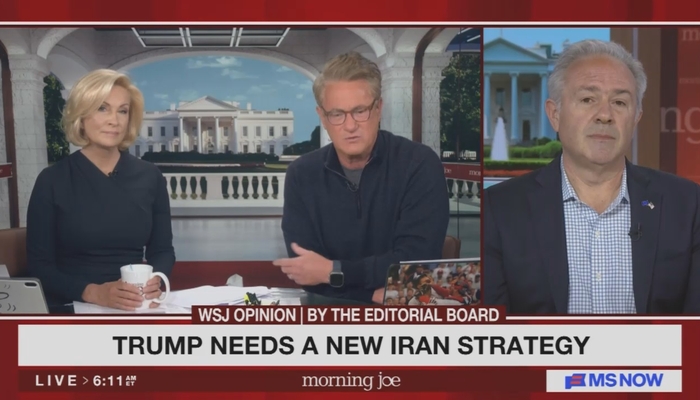
The panel ran with the stereotype, invoking the Iranians “pulling the rug” out from under American presidents — from Carter to Trump — at least four times. Check the screencap for Joe Scarborough doing his "pulling the rug" move -- which he accompanied with a related sound.
In France, this archetype even has a name: "marchand de tapis"— literally, a rug merchant — a longstanding pejorative for a pushy, unscrupulous haggler. I heard it countless times during my years in France—always in a disparaging sense.
This is the same media that treats any negative generalization about protected identity groups as a potentially career-ending sin. Imagine a Morning Joe guest describing black negotiators as “street hustlers," Jewish diplomats as notoriously “tough bargainers” with hidden backchannels, or gay counterparts as drama queens who thrive on mind games. The outrage machine would go into overdrive: panels, apologies, firings, the works.
Morning Joe: Persians Are 'Tough Hagglers' Who 'Pull the Rug' pic.twitter.com/vkrSe3ajlt
— Mark Finkelstein (@markfinkelstein) June 11, 2026
But Persians/Iranians? Knowing chuckles all around. The 19th-century Orientalist painting "The Carpet Merchant" by Jean-Léon Gérôme would have made the perfect backdrop.
To be clear, none of this is a defense of the Iranian regime. The theocratic government has a long record of bad-faith negotiations, hostage diplomacy, nuclear deception, and backing terrorism. The regime deserves the sharpest scrutiny — based on its ideology and actions, not recycled ethnic tropes about “Persians through history.”
The real story is MS NOW’s blatant double standard. Stereotyping is only verboten when it targets approved groups. When it serves the preferred Trump-is-Carter narrative, the old marchand de tapis slur gets a polite pass on national television.
Here's the transcript.
MS NOW
Morning Joe
6/11/26
6:08 am EDT
JOE SCARBOROUGH: You know, Mika, like we said yesterday, the president has been way too eager for a deal, and he's paid for it. The Wall Street Journal editorial page has a new piece out this morning, and it's called, "Trump Needs a New Iran Strategy."
MIKA BRZEZINSKI: Yeah. It goes on to say, "Iran's large strike on Kuwait's airport was not a big deal, Mr. Trump said, a mere tit for tat. He said the same for Iran's Sunday strike on Israel, urging it not to reply since the missiles didn't hurt anybody. That logic leads to trouble. Only by a miracle did two U.S. pilots survive after an Iranian drone struck and burned inside their Apache helicopter near the Strait of Hormuz on Monday. Yet Mr. Trump's early reaction was to say that this too wasn't a big deal."
SCARBOROUGH: An attack on an Apache helicopter.
MIKA: "Mr. Trump won't wanna hear it, but he has been dancing to Iran's tune. He will have to break from it or go down as losing the war politically despite the early military gains. Mr. Trump still hopes for a diplomatic breakthrough, but even the press's favorite unnamed Pakistani officials are now downbeat. As long as Iran believes Mr. Trump is stuck with no alternative, it will squeeze him in the talks and in Hormuz. The president's choice now is to alter the facts on the ground or leave the conflict in a worse position than Mr. Bush did in Iraq."
SCARBOROUGH: And they had talk about in this op-ed about what George W. Bush did at the end in '07 with the surge, and how it made a difference, and said he's going to have to figure out militarily how to open up the Strait and keep the Strait open. Also, he may want to go in and do a joint operation with the Israelis to seize their nuclear material. Very risky move, the Wall Street Journal editorial says. But sitting back and waiting for the Iranians to negotiate, and on the Iranians' goodwill, Ed Luce, always leads to trouble.
You, of course, as everybody knows, you wrote the biography of Dr. Brzezinski that got you inside the Carter White House during those torturous days where Chris Matthews has said time and time again on this show, we would be told there was going to be a deal, we got excited, we did everything we thought that would line up the deal to get the hostages home, and then the Iranians would [makes pulling gesture] pull the rug out from under us. And he said they did it time and time again.
This is what they do. They just play U.S. presidents, and if those U.S. presidents look like they need a deal, that's when things get really tough, because that's when the Iranians clamp down.
ED LUCE: Yeah, I mean, they — they are famously known worldwide, and not just as Iranians, but as Persians through history, as very tough hagglers and negotiators. And they play for time, and they feint, and they walk off, and they play mind games with the people they're negotiating with.
Carter did discover this to his lasting cost several times during that 1980 presidency campaign with Reagan. It looked like a deal to release the hostages was about to happen really four or five times, and that would have changed, transformed the mood on the campaign trail, and then Iran pulled the rug.
And it turns out, you know, Iran really needed weapons because Iraq, Saddam Hussein's Iraq, had just invaded Iran. Iran really needed weapons, so that was finally the leverage Carter had been seeking to get those hostages out. And they kept going right up to the brink of a deal, and lots of public positive statements from the White House, and then Iran would pull the rug.
Now there's a theory — you know, why that might have been happening in terms of the Reagan campaign's backchannel communications with the Iranians. But this has been going on for forty-seven years at least.
I mean, U.S. presidents — with patience and time and a strategy and a theory of the case like Barack Obama had with the 2015 nuclear deal, might get somewhere. But if you're in a hurry, Iran's got more time.
SCARBOROUGH: Yeah, they've got more time and they will walk away. As David Ignatius told us yesterday, you have to let the Iranians know that you're willing to walk away, that you either don't want the rug or you don't want the nuclear deal. You've got to be willing to do that. They weren't.
This headline, Willie, I'm just noticing this headline — we have seen a headline in Financial Times for Ed Luce's article that somehow manages to insult supporters of both of the gentlemen in that headline.
Trump supporters going, "How dare you compare us to Jimmy Carter?" And Jimmy Carter supporters saying, "How dare you compare such a good man to Donald Trump?" But there it is.
And what, you know, the common denominator, you know, Iran. If you depend on the goodwill of Iran's negotiators, and if they see a weakness, man, they know how to leverage that and they will exploit it.
MIKA: We've had this experience.
SCARBOROUGH: And Jimmy Carter had an election in 1980 that he was trying to make everything just right for, and the Iranians wouldn't do it. And now you have Donald Trump, they know he has some midterms to worry about, so they are not worried about making a deal right now.








 New Posts (Home)
 ChatBox
 Popular Posts
  Game Zone
 Top PodCasts