reactormag.com
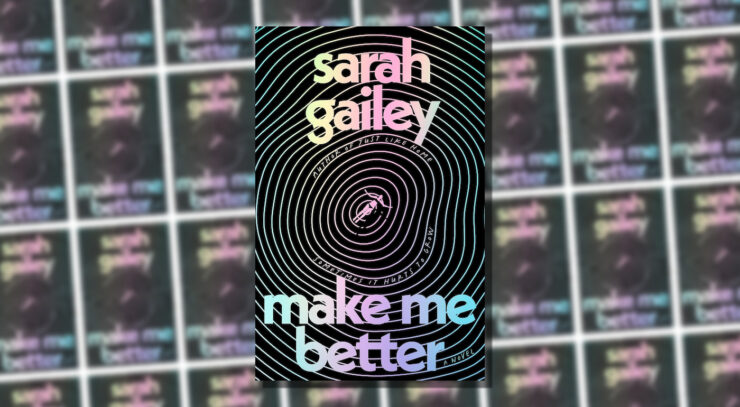
This Is Not Idyllic: Make Me Better by Sarah Gailey
Books
book reviews
This Is Not Idyllic: Make Me Better by Sarah Gailey
Is this a murder cult?
By Tobias Carroll
|
Published on June 15, 2026
Comment
0
Share New
Share
Is this a murder cult? It’s a question that can come up a lot when encountering a story in which a character seeks psychological relief in the arms, literal or metaphorical, of a reclusive group that promises a better life. The film Midsommar is one good example of this; watching it, you spend much of the film waiting for the other shoe to drop, for the smiling Scandinavians to reveal a lust for blood. Yellowjackets season two featured a New Age organization that gave off cult vibes, albeit not murdery ones. Vladimir Sorokin’s Ice Trilogy involves a cult that makes frequent use of meteoric hammers.
Alternately, stories involving a character seeking solace with a group promising relief tend to fall into one of two categories: inspirational works and cult dramas. Some of that is a matter of perspective, of course: Plenty of people find happiness through embracing the tenets of a specific belief system. But if you find yourself reading a novel by an author with a penchant for the uncanny where a group claims to have all the answers, it’s a safe bet that something is about to go very wrong. The question that comes to mind when reading Sarah Gailey’s Make Me Better, then, is: What?
It begins with an arrival. A woman named Celia arrives by boat at an island called Kindred Cove to witness their annual Salt Festival. The event is said to have therapeutic properties; attendance is strictly limited, and the islanders can’t stop gushing about how the experience of being on the island transforms the lives of the people who go through it.
Celia has her reasons for wanting to travel there. As Gailey reveals through a series of flashbacks, Celia is restless. She’s been trying to conceive a child, and has experienced several miscarriages thus far. She works as a lifestyle influencer; there’s a passing reference to her home containing products from network marketing companies. She’s also profoundly lonely, and learned of Kindred Cove through a friend named Adelaide, who told Celia about her own roots on the island and traveled there six months earlier. Celia wants what many people seek: a community, a sense of belonging, a family.
Buy the Book
Make Me Better
Sarah Gailey
Buy Book
Make Me Better
Sarah Gailey
Buy this book from:
AmazonBarnes and NobleiBooksIndieBoundTarget
For much of the Salt Festival, Celia is under the supervision of Kindred Cove resident Easy. It wouldn’t be inaccurate to say that Easy knows more than she’s telling Celia, but that could be true of any situation in which one person has more information than another—like, say, when one of them is a longtime resident of a given community. Some of Easy’s rhetoric does tap into a vein of what could be called the menacing therapeutic, however:
“You fell, and then you got back up, and now look at you. Walking on your own two feet. I’ll bet that five minutes ago, when you were flat on your back you thought you’d never be moving forward again. Do you know what I see when I look at you now?”
Easy’s answer to the question she poses to Celia: “You’ll figure it out. I know you will.” If that sounds a little sketchy, phrasing summoned up by someone who’s trying to keep someone else’s spirits up but doesn’t quite know how to do so, that’s probably because it is. Earlier in the book, Easy tells Celia, “You never have to be all alone again, Celia. I’ve got you. I’ll show you everything.” Again, this probably should be setting off alarm bells—but what kind?
Celia’s journey to the island is not the only plot thread Gailey incorporates into this narrative. A parallel plotline set several months earlier focuses on Adelaide’s return to Kindred Cove, and shows the reader some of the same characters we’ve met earlier in a new light. Adelaide is no newcomer to this society, after all, though her time away from the island has led to some estrangement from her peers there. Her reasons for wanting to stay away have a familiar ring; she’d felt stifled by certain elements of the society, whose methods of living in harmony with the environment can lead to some feelings of alienation.
Gradually, Gailey introduces some details that seem designed to disquiet. A selection of discarded objects could hint at violent acts in the recent past, but it’s also possible that the presence of blood was due to Kindred Cove’s practice of eschewing shoes on the island. Several characters refer to feeding the reef; that also sounds ominous, but feeding coral is something that people can do. Maybe this is all a wacky misunderstanding. Maybe it’s Celia who’s the threat. Then again, Kindred Cove is home to a building called the Old House, and the presence of capital letters there also foreshadows something ominous.
Reading Make Me Better gives a sense of Gailey experimenting with how they handle pacing for this book. It’s not difficult to imagine a novella-length work telling just Celia’s story (or just Adelaide’s, for that matter). Some of the other flashbacks provide insights into Kindred Cove’s origins and to the peculiar environmental circumstances that surround it. The aforementioned reef is not the only curiosity there, and eventually Gailey reveals both how the outside world views Kindred Cove beyond its status as a healing destination and its role as the source for artisanal salt.
Gailey does something else noteworthy here, and it wasn’t something I had expected. Besides the feeling that something is wrong on this island, they also casually suggest that Make Me Better might be set in the near future, rather than the present or recent past. It’s a subtle thing, but the effect is unmooring; much as Celia finds herself in a place where she doesn’t quite understand how things work, so too does the reader discover that one of their preconceptions might not apply at all.
It’s elements like this that make Make Me Better come together in a way that elevates it from some of its peers in the “is something amiss in this isolated community” narrative world. In telling the story of Celia’s desperate search for healing, no matter what the cost might be, Gailey takes several risks. The result is a slow-building sense of dread, a cautionary tale as chamber epic.[end-mark]
Make Me Better is published by Tor Books.Read an excerpt.
The post This Is Not Idyllic: <i>Make Me Better</i> by Sarah Gailey appeared first on Reactor.








 New Posts (Home)
 ChatBox
 Popular Posts
  Game Zone
 Top PodCasts