reactormag.com
Read an Excerpt From To Drown a Witch by Lindsey Olsson
Excerpts
Young Adult
Read an Excerpt From To Drown a Witch by Lindsey Olsson
A criminal and a royal guard are drawn into the hunt for a dangerous witch—and an unexpected romance.
By Lindsey Olsson
|
Published on June 16, 2026
Comment
0
Share New
Share
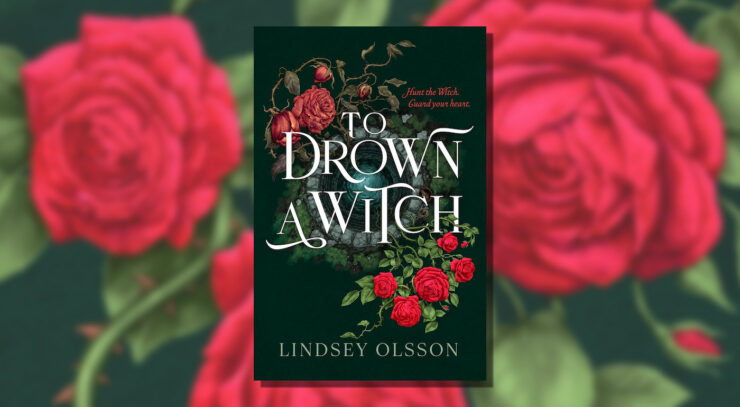
We’re thrilled to share an excerpt from To Drown a Witch by Lindsey Olsson, a young adult romantasy publishing with G.P. Putnam’s Sons Books for Young Readers on July 14th.
In Gadore, the Witch is feared above all else. Reborn into each generation, she is the only person with magic running innately through her veins, able to wield that magic with a single thought.So when guards across the city begin to drop dead, gruesomely murdered by violent and vicious magic, everyone knows the Witch has returned—and no one will be safe until she’s killed.Toran is the Prince’s Crown, the most highly skilled fighter in the King’s Guard. Tasked with the responsibility of leading the hunt for the Witch, Toran tries to focus on his assignment to forget the ghosts of his past. And after he learns of Nes, a thief with an uncanny ability to sniff out magic, he forcibly recruits her into joining his hunt.As the two face deadly magic and otherworldly threats, their mutual dislike soon turns to something more electric, and they find themselves drawn to each other in ways they’d never imagined. But the Witch is always a step ahead of them, and with bodies piling up, secrets threaten to come to light—secrets that could destroy everything from the fragile trust between them to the very city of Gadore itself.
Buy the Book
To Drown a Witch
Lindsey Olsson
Buy Book
To Drown a Witch
Lindsey Olsson
Buy this book from:
AmazonBarnes and NobleiBooksIndieBoundTarget
BeforeThe Witch
The trees have their eyes on me.
I can feel them on my back, on the hood over my head, on my careful feet as I step over the twigs and bits of brush littering the forest floor. I leave my clothes at the base of a tall, majestic evergreen. I know they will still be there when I return. No one ever crosses this forest path. It’s why I take it.
Still, my gaze creeps over my shoulder, eyes skittering to shadows, searching for movement. There have been many a night when my eyes deceive me, crafting movement where there is none.
But not tonight. I am alone. No soul dares delve this far into the forest, not with creatures of warning on the prowl. And yet, I itch with the need to check again and again. I cannot be caught.
Not with magic.
No one knows where magic came from. They say it found a home in the trees. They say the trees reached their long limbs into the air and allowed the magic to fall upon their leaves. The magic took to the trees just as quickly, seeping in through their many veins and cascading through their grooves. They say magic is what keeps trees alive, why they live through each tumultuous season. They say it’s why trees stand tall, grow taller, and reach higher than anyone else. Magic is the trees’ best friend.
It is not mine.
I was four when I learned about the trees. About the dangerous magic residing within them.
I was five when I learned I was just like them, a husk for magic to hide in. And six when I learned to hide.
Magic is not my friend. It is my fear. My shame. I keep it locked away.
But no living thing can spend its life in a cage. It pulses, beats, thrashes against me.
It wants out.
Out. Out. Out.
Magic is a living thing I cannot kill. It does not die.
But I can die. And I know magic will be the death of me one day.
The ache in my veins tells me when it’s at the edge. When a vicious spectacle of otherworldly power might burst from me. So I come to the river.
When I submerge, the brackish water is frigid. The magic inside me coils tight, fighting against the coming expulsion. It knows this is different from if I were to willingly use it. It can sense I have no purpose to give it, none but to leave me.
I grit my teeth and pluck at the coil.
Above, the trees watch me, judge me. They revere magic, but I am not as strong as them.
The magic resists my pull, so I give it a sharp yank and a piece breaks free. I spread it through my veins, weighing the heaviness of it in my blood. This portion, though small, is enough for today. It should be enough to last me before I need to return and repeat this ritual.
I spread my limbs—arms, legs, fingers, toes, and neck—until I am a star in the water. The current lingers around me, playing with the space I’ve taken, eager to take me away. It can take something else.
I push the bit of magic from my veins. It tingles, burns, and skates through my skin. Once it is on the surface—dancing, teasing me with promises of virtue—I let go.
The magic rebels.
Ice forms in an instant, floating in chunks around my head, then bubbles and bursts, as if boiling without heat. The fish at my feet freeze, die, and keep on swimming. Reeds grow so strong and fast they push rocks out of their way.
I wait for everything to settle. For the current to sweep the magic out to sea. When it does, I break the surface and sigh.
Water sloshing at my ankles, I climb back up the bank of the river. Though the air is bitter with cold, I don’t shiver.
I feel the trees’ glares on me as surely as I feel the haunting laughter knocking against my lungs. I turn my back, shoving the remaining magic down deep within me until my insides are still. I am not like the trees. I did not call the magic to me.
Only I know the true danger of magic. The world thinks they know. But they’ve forgotten. One day magic will see fit to remind them.
Once dry, I dress and gather my things. The forest is heavy around me, but I feel lighter.
My footsteps make imprints in the dirt leading away from the river. I leave the woods behind, making my way back to my friends, to my family. Back to the people who would execute me if they knew—
I am the Witch they hunt.
Part IThe Strangers
“And so, after all that time, the Goddess met a stranger on the road. Upon their greeting, her exquisite face bore no smile, for it was then that wrath was born.”
—The lost holy book of Nephele: Great Goddess of All, Book II, Section IV, Lines 31–32
1Nes
You are irreplaceable.
That was what Nes Deivana had been told. It was meant as a compliment. A lure to make her feel special, to make her feel like she had a home in this Goddess-forsaken city.
But she knew better. Nes might not always know what she was, but she did know what she wasn’t. And that was irreplaceable. She intended to prove it. It had taken months, but, at last, she’d done it.
Marnie Sorphel didn’t look like much, but to Nes, the timid, wide-eyed girl meant everything.
Nes strolled through the Valley, the main market in the Ditch, with one hand tight around Marnie’s wrist and the other against the silver flask at her hip. Despite the hour, the oil lamps lining the street lit the way for shoppers, criminals, guards, and wanderers alike.
The Ditch was one of six city sectors in Gadore. Though it had the same ocean-blue rooftops as other sectors, the Ditch gave the impression of an overflowing mouth. Ramshackle hovels, beams dark with the wood of the Foxvin Forest and splattered with the blood of forgotten fights, were squeezed between the once white buildings like food stuck between teeth.
Beside her, Marnie gawked at the tables lining the market. But Nes knew it wasn’t the vendors selling crystals on gold chains, thumb-sized bottles of tonics, and ornate pocket watches who caught Marnie’s eye.
Scattered among the tables of typical wares were the vendors selling far more fantastical goods. Things imbued with magic.
To their right, a man showed his customer how a silver thread, finer than a single strand of hair, would not break no matter how hard he yanked on the ends. On a table to their left, a crate full of snakes—snakes that had been fed a steady diet of diluted magic—hissed and coiled and slithered over one another, flickering in and out of visibility. And, laid out on a table ahead, a woman sold rows of extra fingers, claiming they would seamlessly attach to a person’s hand in place of any they’d lost.
“What pretty young girls,” the woman called out. “I sell pearls that’ll weave into your ears, too. Make you look like the rich folk up in the Ring.”
Nes gritted her teeth. Just because her face spoke of innocence didn’t mean her heart answered in turn.
She grabbed the edge of Marnie’s hood and yanked it down over the girl’s face. Turning to the vendor, she spat, “Keep your junk and your assumptions to yourself.”
The woman’s eyes narrowed to slits. “No need to be rude, girly.”
Nes tilted her hip so the flask sitting there caught the light enough for the woman to see the snarling dog etched on the metal. “Careful,” she hissed. “Or Phineas might find a reason to remove more than your table from this street.”
Jaw tight with unspoken rage, the woman lowered her head and stepped away. Nes lifted her chin. She’d learned years ago never to walk the Ditch with her head down.
But Marnie—it was best if Marnie kept her head down.
As part of a large family, Marnie was desperate to earn a few extra gadots. And if there was one thing you didn’t show in the Ditch, it was desperation. Pure luck had allowed Nes to find Marnie before some other rapacious soul.
“This way,” Nes said, ushering Marnie far from the conniving vendors. The sooner she got the girl to Phineas, the sooner she could be free of this place.
As always, the smell of death, decay, and fornication lingered like overcooked stew. But there was something else. A scent that did not belong. Winter had snuck under Gadore’s door last week, curling up like an unwelcome cat. Yet it was a spring breeze—the budding of new blooms coupled with the promise of warmth—that drowned out the usual Ditch smells.
Nes dug her feet into the dirt and craned her neck, searching for the source of the pleasant spring scent. But it was Marnie who found it first.
“Oh no.”
The words fell from the girl’s mouth as if she hadn’t meant to let them out. Barely a few feet away, cupped in a limp hand, was the magic.
Pure magic.
Bright green, with hundreds of tiny threads twisting together like moss, it could have only come from one place. The forest beyond the city wall, torn straight off the bark of a tree.
Nes’s heart stumbled at the face of the dead. The boy was young. No more than fifteen. In death, only the whites of his eyes were visible. A waterfall of dried blood ran from the boy’s lips, covering his chin and neck. The dark of the new moon allowed Nes to just barely make out the soft green glow of pure magic inside the boy’s mouth.
The dead boy’s shirt had been torn open, revealing what looked like claw marks marring the skin over where his heart had beat. The boy had made them himself, a last desperate attempt to get the magic out. But once magic took hold of your heart, there was no hope.
The residents of the Ditch could dabble with the stars, but the magic never let them forget they were playing with fire. For pure magic killed. Every time.
Nes did not shy from the body. She couldn’t stop the evil of the world, but she could stare it down. To her surprise, Marnie did not look away, either. Maybe the girl was stronger than she thought.
“For magic’s end,” Nes whispered. The phrase was both a curse and a prayer. For her, the prayer always won out.
Marnie stepped closer to the corpse, her mouth hollow. In one hand, the boy still held the green threads of the pure magic, and in the other, the pulping, bloody mass that was once his tongue. Marnie bent down, a hand reaching for the magic.
“Don’t touch it.” Nes grabbed Marnie and yanked her upright. “Do you want to die? If the guards find you with that, you’ll be drowned as the Witch for sure.”
There had been three Witch drownings this week alone. An unusually high number, even for a country as paranoid about the Witch as Orlonea. Neither Nes nor Marnie could give the King’s Guard reason to suspect them.
Marnie gnawed on her chapped bottom lip. “But shouldn’t we—”
“No,” Nes said. “Leave him.”
The boy wasn’t magic’s first victim. Nor would he be its last.
Nes pulled open the door to the gambling den, the tambourines on the inside rattling.
On the surface, the Siren’s Hair was like any other gambling den scattered throughout the Ditch. The green felt atop each table was stained with splotches and dark rings from pissed-away drinks, while the legs on the stools clustered around the tables were scuffed and scraped. The Siren’s Hair had seen better days.
But that was the point. As the only legal business Phineas Wraw had his name on, it wouldn’t do well for the lowly Ditch den to be gleaming with signs of her boss’s true wealth.
“It is only a matter of time,” Phineas once told her, “before suspicion becomes certainty.”
For the better part of two years, the Siren’s Hair—specifically the tiny room she shared with Suri on the second floor—had been her home. A shitty, sew-your-pockets-shut home, but home nevertheless.
Suri had made the place more like home than anything else—despite all of Nes’s efforts to avoid her. A runaway bride from Brevna, Suri had somehow found a place in Nes’s life, and, much to her own surprise, Nes liked her in it.
But that wouldn’t matter for long. Once Nes freed her father, they’d have to flee, and she wouldn’t be able to return to Gadore. She had to stay focused on what mattered. This was it. Marnie was her last job.
She pulled Marnie into the den’s kitchen. The space was a cacophony of sound. Spoons clattered at different pitches against the insides of pots. Knives hit cutting boards in various rhythms.
There were two doors in the kitchen. The first led out back to the dumpstreet. A long, thin space that stretched across the backs of every Ditch business. Appropriately named, as it was a place people tended to dump their trash—and sometimes bodies—until the plows came at midnight to sweep it all away.
The second door led to a fully stocked pantry. But it was what waited inside the pantry that made her palms sweat.
She threw open the pantry door and, skirting bags of onions and potatoes, found the third door. The one that concealed a staircase down.
“Ready?” she asked Marnie.
The girl shook beneath her cloak, her knees and elbows no more than tree branches shuddering against a strong wind. “He’ll pay me a hundred gadots a week?”
“As long as you do as Phineas asks.”
Marnie swallowed. “Then yes.”
Pulling her flask from her belt, Nes took a short swig before descending the hidden steps. The light from the lanterns lining the stairs bloomed bright and vibrant against the dirt-carved walls. At the bottom of the steps, they pushed through another door.
The space laid out before them was wide and cavernous. Unlike the kitchen above, the brawlhouse was nearly empty. The cleaners had mopped up the blood from the previous night’s fights, and the bartender had finished taking stock of the liquor. Only a few men stood in the center of the room. And in the center of the group stood Minot—Phineas’s second.
Keeping clear of the other men, she eyed Minot. Why Phineas had chosen this scrawny boy of barely sixteen to be his second, she would never understand.
Nes knew each and every one of the men lining up in front of Minot, all of them brawlers she’d found and brought here. Not one hassled Minot, their heads bowed as they stepped forward to accept a silver flask. A flask identical to the one currently at her hip.
She knew what waited inside each flask. Magic. Not the pure stuff scraped off tree bark like that in the hand of the dead boy outside the Valley, but diluted magic.
When mixed with seawater, magic became tame enough to ingest. To consume pure magic was to condemn yourself to death. But consuming diluted magic could give you a unique magical advantage. And the people of the Ditch yearned for any sort of advantage.
That was the truth of Gadore: Magic was the drug of choice. With Phineas as Gadore’s underlord, magic ran rampant in the belly of the city and infested the streets—slinking in shops, billowing within bars, and gushing out of gambling dens like the Siren’s Hair.
Underground brawlhouses were a common source of entertainment in the Ditch. But none compared to Phineas’s—where the fighters were anything but ordinary and the fights were unpredictable clashes of magic.
She watched one of the brawlers, his fingers clumsy as he unscrewed the top of his flask. She’d brought him in a year ago after discovering diluted magic gave him the ability to throw people across the room without laying a finger on them.
Minot approached her, one flask left in his hand. “Ah, Nes, so nice of you to join us.” His eyes latched on to Marnie, the girl still huddled close to the steps. He grinned, suddenly looking a lot less like a young boy and more like a true threat. “And it looks like you’ve brought Phineas another wayward soul to sink his claws into.”
She didn’t have a retort. I don’t have a choice sounded whiny. Even if it was true.
“He here?” She wanted to get this over with before the pits opened again.
One of Minot’s long fingers tapped the outside of the last flask, his nail clinking against the metal as he continued to stare at Marnie.
“Minot,” she said when he didn’t answer. There was an edge to her tone, one she normally tried to keep at bay when in the brawlhouse. But her manners were about as wrought as her patience.
“Nes.”
She gestured to the only other door in the underground. “Is he in there?”
“He’s not to be disturbed.”
She tried to sidestep Minot but was blocked. A laugh bubbled up her throat before she clamped down on it and shoved him out of her way.
Minot’s eyes widened. “Nes, you can’t. He’s not—”
“—to be disturbed.” She gripped the door handle and shot Minot a disparaging look over her shoulder. “You said that. But he and I, we’re overdue for a talk.”
She threw open the door and stepped inside. The light of the brawl-house floor rushed the tiny office space, illuminating a square, fairly nicked desk with a single chair on either side. Both chairs sat unoccupied.
“Where—”
“Hello, hound.”
Nes flinched as if the dark itself had slapped her across the face.
She whirled, turning just as Phineas Wraw emerged from behind the door.
Phineas was slim in the same way a suit was sleek, his nose as sharp as his eyes. And though he was gloriously attractive, she prided herself on not falling for him. His beauty had always felt feigned to her, like it was something he’d collected over time rather than inherited.
His hair, kept long, was a deep red today and flowed down over one shoulder. He stroked it like a pet as he watched her out of eyes of brightest amber.
“What brings my prized hound home?” Phineas asked. His lips, nearly as deep a red as his hair, puckered softly as he spoke.
Hound. She hated that nickname.
In Gadore, Phineas held power like the clouds held rain. Only Phineas never let his fall.
People whispered about the infamous lord of the Ditch and how he came to power. How he swept into the city on the back of a Barrenborn, desert amphiptere some fifty years ago, blowing sand into the cracks of all the cobblestone streets, and how, not a week later, he had a finger on the pulse of the entire city.
Preposterous rumors, all of them. And not because the amphipteres had gone extinct more than five hundred years ago—relegated to long-lost history along with other mythical beings like the shape-shifting Xell. No, it wasn’t how Phineas’s story was wrapped up in legends that gave her pause. In the two years she’d spent working for Phineas, she had been unable to figure out how one man gained, kept, and hid such vast power.
“Tonight marks two years,” she said as Phineas slid by her to the other side of the desk. He sat down in his chair and set his hands on the desk’s surface among the numerous knickknacks displayed. “It’s time.”
Patience was a virtue. But she was done being patient. And done being virtuous—if she ever had been. Now it was time for Phineas to pay up.
Phineas’s brow furrowed like a cat’s tail. “Time?”
She bristled. “Time for you to hold up your end of the deal. Time to get my father out of the Walled Prison.”
She knew he’d broken prisoners out before. It was why she’d agreed to the deal.
Phineas shook his head. “Surely not.”
“Don’t play dumb. That was our deal. A year of service in exchange for passage into the city and another year as payment for breaking my father out.”
Traffic in and out of the city was strictly monitored by the King’s Guard—anyone coming through the Northern or Southern Gates were required to show proper identification, their information recorded. Without any of her own, she’d had no choice but to rely on Phineas to smuggle her into the city.
She’d been so desperate back then, so foolish, she hadn’t even asked what his price would be. Everything in Gadore had a price. It was all a matter of how you paid. And now she’d finally paid hers.
“Oh, my little hound.” Phineas twirled a lock of red hair around one finger, looking at her with what appeared to be pity in his eyes.
She wasn’t fooled. Phineas didn’t pity anyone. The pity was just a mask to hide his next move. She wanted to reach for the knife she kept in her boot—wanted to carve those malicious brows from his head—but resisted.
“You misunderstood.”
“I did not.”
“Our deal was not contingent on the passing of time, but on the number of recruits you brought me. And, I’m sorry to say, your performance has been less than satisfactory.”
“You want more dogs?” she asked, recalling the dozen men who’d crowded Minot and then the dozen more magic users she’d smelled on her walk here. “I can get you more right now.”
Phineas kept magic users like noblemen kept exotic pets. He hoarded men who, after consuming diluted magic, displayed abilities he deemed useful. He called them his recruits, but everyone with a hand in his business knew what they really were: his dogs. Dogs she had painstakingly stalked then collected for him.
Phineas sighed, gaze on one of the small jars atop his desk. When he tapped a finger against the glass, the stone inside the jar began to float. “You know full well I can’t have just anyone. I need those who will be good in a fight.” He looked up at her. “I want the special ones.”
I want you.
He didn’t say it, but she heard the words from his mouth all the same. And she knew—had suspected it for a while now. It didn’t matter how much time passed or how many dogs she brought him. It would never be enough.
The first time they met he’d asked her one question. What can you do for me?
She’d offered to run errands, to wait tables, to wash dishes. But Phineas declined it all.
What can you do for me that no one else can?
So she’d told him.
Everyone had the same reaction to consuming pure magic, but with diluted magic, their reactions were all different. And it was her reaction Phineas prized above all others.
In a city whose underbelly thrived on magic, she was the one person who could find it. Tucked in people’s boots, stuffed between slices of bread, even already consumed and running through someone’s veins. It didn’t matter the form or how many layers stood between her and the magic, she could always sniff it out.
She was his magical bloodhound.
For two years, she wandered the streets of Gadore, using her ability to seek out those who had willingly ingested diluted magic. That was the easy part. From there, she had to learn how they reacted to magic. Then she’d relay the information to Phineas, who determined whether or not the person’s reaction was something he wanted in his collection of fighters. If he wanted them, it was her responsibility to bring them in—kicking and screaming if she had to. With her at his side, the profits in Phineas’s brawlhouse had grown exponentially.
Irreplaceable, he’d called her. Because of that, he wouldn’t let go of her leash. Not without a suitable replacement.
“Marnie,” she called, “you can come in now.”
The door creaked as it opened, and Marnie, hood still covering her face, stepped inside the already cramped room.
“Phineas Wraw, meet Marnie Sorphel.”
Marnie removed her hood and inclined her head to Phineas, a blush coloring her cheekbones. Phineas stared at the girl, the tip of his tongue tapping the corner of his lips, before returning his gaze to Nes.
“Why is she here?” he drawled.
“For a demonstration.” Nes held out a hand. “Minot,” she said. Minot sneered at her but plopped the last flask in her outstretched hand.
She unscrewed the top and handed it to Marnie, trying not to think of what she was bringing into the girl’s life. “Only a little bit,” she reminded her. Marnie nodded. Nes removed her own flask from her belt, lifting it toward Marnie’s. “Bottoms up.”
Together they took a swig. The liquid inside burned a path down her throat, and she watched Marnie grimace as she swallowed. Nes stowed her own flask before setting Marnie’s on Phineas’s desk.
Phineas raised a brow, not in interest but in boredom. Nes clenched her jaw. She would make him see Marnie’s value.
“We made a deal, Phineas,” she said. “I work for you, and in exchange, you’ll break my father out of prison. You say you need a bloodhound. Well, I’ve found you my replacement.”
She nodded to Marnie.
The girl undid her cloak, revealing the dress she wore underneath. The dress itself was plain, save for the deep V that dipped well below her breasts and showed off the smooth skin of the girl’s sternum.
Marnie reached for Nes’s hand.
As the two clasped hands, the dim room filled with light. Bright and green, the exact color of the pure magic they’d seen earlier, it streamed from a spot between Marnie’s breasts. After a moment, Marnie let go of her hand and the light went out.
Nes plucked the jar with the gravity-defying stone off of Phineas’s desk and tossed it to Marnie. The girl caught it. Again, that green light burst from her chest. The light went out only when Marnie set the jar back on the desk, effectively cutting off her connection to the magic in it.
“See?” Nes said. Marnie’s reaction to diluted magic—her glow—could find Phineas new dogs. “Marnie is willing to identify magic users for you. She can replace me.”
Phineas exhaled. “No.”
Disbelief sputtered out of her. “What?”
When Phineas deigned to look at her again, his gaze was possessive, unrelenting. “I said no. This girl cannot replace you. No one can. As I’ve told you before, my dear hound, you are irreplaceable.”
Her heart tightened until it froze. Frost spread across her entire chest.
Phineas continued. “I thought you were smarter than this. I can’t have a torch bursting to life every time we find someone using magic. The light would send a direct signal to every guard on patrol. This girl is nothing more than a poor imitation of you.”
He was right about one thing. She was smarter than this.
She had been a fool to think he would keep his word. She would not be so foolish again.
Nes stared into the amber of her boss’s eyes and recognized the intent staring back at her. He thought he owned her.
No one owned her. No one.
Gadore was now as familiar to her as the freckles on her face. She could navigate the city with obstacles in her path or without any senses. She would find a way to free her father.
Fingers splayed on the wood, Nes leaned over the desk until she was eye to eye with Phineas. “Find your own damned dogs,” she spat. “I’m through being your bitch.”
Then she did something she’d never dared do in the two years she’d worked for Phineas. She turned her back on him.
“Nes?”
It was the use of her name that made her pause.
“Aren’t you forgetting something?”
She turned.
“You leave, there’s nothing stopping me from turning you in.”
For a second, she saw herself at the bottom of the Witch’s Well, slowly sinking, slowly drowning. It wouldn’t matter if she was innocent. Everyone knew once you were named as the possible Witch, your days were limited. It was every woman’s greatest fear.
But she refused to let Phineas see such fear in her. He didn’t deserve it. And he didn’t deserve her.
“Try it,” she said. She’d spent two years in his employ. She wasn’t the only one who had made the mistake of trusting the other. “And see what’s left of your business when you do.”
This time, when she turned, he didn’t call her back.
Excerpted from To Drown a Witch, copyright © 2026 by Lindsey Olsson.
The post Read an Excerpt From <i>To Drown a Witch</i> by Lindsey Olsson appeared first on Reactor.








 New Posts (Home)
 ChatBox
 Popular Posts
  Game Zone
 Top PodCasts