reactormag.com
Disclosure Day Puts Religion and Aliens in a Blender, With Mixed Results
Featured Essays
Disclosure Day
Disclosure Day Puts Religion and Aliens in a Blender, With Mixed Results
Ah, the beautiful oblivion of Vague Movie Catholicism
By Leah Schnelbach
|
Published on June 17, 2026
Credit: Universal Pictures
Comment
0
Share New
Share
Credit: Universal Pictures
Disclosure Day could have just been a movie about aliens. Spielberg’s previous films Close Encounters of the Third Kind, E.T., and War of the Worlds each use religious allusions and imagery to tell their stories, and he and screenwriter David Koepp have once again woven a conversation about religion and faith into this newest outing.
Unlike those films, however, I don’t think Disclosure Day explore these ideas as well as it needs to, and I’d like to parse through why—spoilers are going to be fully disclosed here, so hop in your inexplicable craft and fly away if you haven’t seen the film yet.
First, we have two very different responses to an experience that is coded as divine. As a 20-year-old college student, Daniel Kellner (Josh O’Connor) has a conversion experience of a sort, and can suddenly, inexplicably, understand math in a way that seem synaesthesiac. He can look at equations and understand them, and, later, understand an alien language that translates itself into mathematics and English in his head, simultaneously. He quickly comes to understand that mathematics is the underlying language of the universe. But this knowledge is too much for him, it alienates him from people, he loses all of his friends, and comes to realize that he can’t remember a lot of his childhood. His gift divides him from humanity—until he meets Jane (Eve Hewson), who is the first person who understands him.
Meanwhile, Margaret Fairchild (Emily Blunt), has an encounter with an uncanny cardinal, and can suddenly speak different languages with absolute fluency—but without realizing she’s doing it. It’s soon revealed that she can also look into people’s eyes and know intimate details about their lives, and cut though their own mental chatter to understand what’s most important to them. As my beloved colleague Emmet pointed out in their review, her gift merges empathy with telepathy—when Margaret sees into peoples’ minds, she understands whatever is troubling them, and says their true intentions back to them in a way that clarifies problems and solutions pretty much instantaneously.
These “gifts” are extremely gendered, obviously, as are the characters’ reactions to them. Daniel used his gift to become a hacker, sold his brain to the highest bidder after a stint in prison, and now wants to disclose the truth without really thinking through the chaos it might cause. He’s had to live with the knowledge of aliens and it ruined his life—now he’ll inflict it on everyone else on Earth, consent or no. Margaret loves her gift (at least at first) even though it frightens her and gives her a headache; she chooses to float through much of the film dispensing wisdom and reminding people of their loved ones. Where someone like Scanlon would exploit this sudden advantage, it never seems to occur to Margaret to “use” her new power, or to withhold the knowledge these people need, and she responds to everyone with compassion even when it overwhelms her.
Both of these abilities can be seen in religious terms. Daniel’s is kind of a mystical knowledge that cuts through all the distractions of reality, like Neo seeing the Matrix. Margaret’s gift can be seen as glossolalia, or speaking in tongues, a miracle that was visited upon the followers of Jesus on the Day of Pentecost in the Book of Acts. In that story, the Holy Spirit descends on people and allows them to speak languages they can’t possibly know, which, if I remember correctly, was taken as a sign that Jesus’ followers were holy, but also, more practically, that they could spread their Gospel more easily because the Spirit allowed them to transcend language barriers. In the modern era, speaking in tongues or glossolalia is practiced by certain Christian denominations—people are “taken up by the Spirit” and speak in a way that might not make logical sense, but is seen as a direct communication with the divine. (Other religions practice it, too, but the imagery of Disclosure Day is resolutely Christian for some reason—we’ll get into that—so I’m only using this example.)
Speaking in tongues also kind of undoes the tragedy of the Tower of Babel. In case you’ve forgotten the story: in Genesis Chapter 11, pretty soon after the Flood receded, humans worked together to build a massive city and tower. They were able to work together well because they all had one common language. This made God nervous, but rather than hitting the reset button with another flood, God responded by giving people lots of different languages and scattering them across the Earth.
It’s never clear how the aliens’ gifts to Margaret and Danny actually work, and, crucially, they are not asked if they want these gifts. They receive them as helpless children—which is one of the problems with the movie, because Disclosure Day is really about choice and consent, but never digs into those ideas enough to do anything with them.
Which brings us to Jane, the character who becomes the site of religious conversations in the film.
Jane is Daniel’s girlfriend, and they’ve only known each other a few months, which almost excuses the fact that all of their conversations are exposition dumps. Almost. After Daniel rescues her from the shadowy Wardex organization, she takes them to the St. Clare of the Dawn monastery to hide out, which is how Daniel learns that she was in training to be a nun a few years ago. The script attempts to cut off questions by having Jane say that she doesn’t tell anyone about her time as a nun because they’ll think it’s weird, but Daniel seems shocked that she has religious beliefs at all. He even asks if she left the nunnery because she lost her faith, which implies that this topic hasn’t come up at all. She replies that she lost her “calling”, and he has no further questions, even though most people would ask the follow-up of: “and what’s the difference between ‘faith’ and a ‘calling’, exactly?”
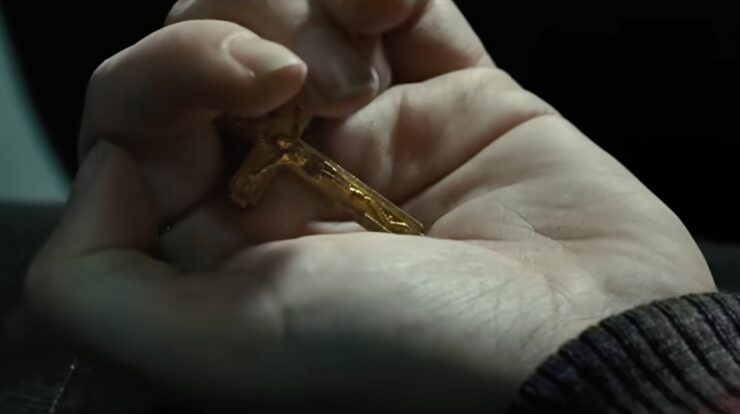
His ignorance of her religious beliefs raises other questions, because we soon learn that Jane wears a large, gold, ornate crucifix around her neck. Not a small Dana Scully-style cross, not a tiny little saint medal, but a large, gold, ornate crucifix. Like, Dominic Torretto would wear this thing. Now, if her former Mother Superior, Sister Maura (Elizabeth Marvel), gave her that crucifix right before the two of them go on the run again, cool. But if she’s been wearing that the whole time she and Daniel have been dating, how has he not noticed it???
The movie uses Jane’s status as a nun-in-training to tee up all of its conversations about religion, but it makes some really weird choices about them. Again, I’m only harping on this because they brought it up. Koepp and Spielberg chose to make this movie a conversation between religious faith, belief in aliens, and whether the general populace has a right to know truths about their universe, but they don’t really give the conversations enough time to play out. Faced with the truth about aliens, Jane immediately says that people have been “raised to believe in God” and that this will shatter that belief. “People have been raised to believe in a supreme being, and now you want to show us actual supreme beings? …the world can’t handle both.”
Well, but, not everyone on this Earth has been raised to believe in a Supreme Being. And not everyone defines “Supreme Being” the same way! It’s clear that this is a personal issue for Jane—she was already questioning her faith enough to leave a nunnery, she’s embarked on a secular life, she’s in a new relationship with a troubled guy, and now she’s just found out that her whole conception of reality might be wrong. That’s a lot! But she’s applying her own crisis to everyone, and the film doesn’t give her character enough time and space to explore that. And by using a Catholic character to stand in for people of any faith, the film straitjackets its own spiritual discussion.
The film takes its questions about consent and choice to the furthest extreme by including multiple scenes of torture—and these ideas are wound inextricably into a discussion of faith and spirituality through the film’s treatment of Jane. We see Daniel wield the alien MacGuffin in the movie’s opening scene, but he’s obviously winging it. His old boss/current adversary Noah Scanlon (Colin Firth) knows how to use it, and the measured way he talks Daniel through the scene implies that the MacGuffin might blow everyone up. So we know the device is powerful, but we have no idea what it actually does.
A few scenes later we see Scanlon use it, and, at least in his hands, it isn’t an incendiary device or a laser or anything like that—it seems that it can create a much more aggressive version of the mind meld that Margaret accomplishes by looking into a person’s eyes. The term people use for this is “diving”, apparently; Scanlon attempts to “dive” on Daniel, but is unceremoniously ejected from the other man’s mind. So he turns his attention to Jane.
When Daniel wants to share his knowledge with Jane, he starts with a tape of Nixon using alien corpses to impress a TV star—it’s kind of weird and funny and a handy way to tell the audience why Wardex handles all the alien stuff now, and keeps government officials out of it. But the very next thing he shows her is a horrifying torture scene. Spielberg doesn’t make us watch it, we just hear the alien screaming in pain while we watch Jane stare in horror and cry.
This is key, and one of the parts of the movie that works for me. Jane, who is still in at least some shock, still bruised and terrified from being kidnapped, and still mostly in the dark about what the hell’s going on, is instantly empathetic with the alien. She doesn’t ask if it threatened us, if it did anything violent, she isn’t afraid of it, she’s upset for it. Spielberg is trusting us to buy into her empathy, and to then extend empathy to the aliens ourselves.
But the other thing here is that we then see Scanlon torture Jane.
As I said, when we meet her she’s already beaten up. The interrogation the film does show us is more mental torture than physical. And this only happens to Jane. We never see them do anything to Daniel, we never see him with black eyes or bloody teeth, we see them inserting a needle into his arm, but then Margaret rescues him. Meanwhile Jane has a split eyebrow, her mind is invaded, and she’s on the run alone with no contacts from Hugo Wakefield (Colman Domingo) to help her. This is Daniel’s mission, and Margaret is the other one who’s been given a gift, but it’s Jane who actually suffers.
Jane seems to feel Scanlon trying to get into her mind. Her first response is to pray in Latin. Then she pulls the large gold ornate crucifix off her neck, and clutches it in her hand as she walks into a room and sees him, or more accurately, a projection of him, sitting at a table in the safe house.
Here is where it gets slightly ambiguous: He holds the alien device in his right hand, and seems to control her right hand during much of the scene. It’s possible that he also controls the left hand and makes her pull the crucifix from her neck, and squeeze it until the sharp corners tear a hole in her hand to torture her. But given that Jane first holds it to pray with it, I think it’s much more likely that she’s using it—she pulled the crucifix off and is squeezing it to ground herself, and as Scanlon forces her to answer questions about Daniel she gouges the crucifix into her palm until it becomes a kind of stigmata.
He uses her religion against her. When she mentions the monastery of St. Clare of the Dawn, Scanlon refers to St Clare of Assisi’s miracle of being in two places at once, laughs, and says that he, too, is in two places at once—fulfilling her fear that the aliens’ technological superiority might replace people’s desire for belief in divinity and spirituality.
But then he takes it further. She’s clearly fighting him the whole time. Her words are being forced from her, and the scene cuts to her clenched bleeding fist a few times. She finally pushes him out for a moment—but then she drops the crucifix into the puddle of blood that’s pooled on the floor next to her chair. When he forces his way back inside her, he twists her faith even further. He tells her that while he doesn’t want to hurt Daniel, if Wardex can’t capture him, he’ll need Jane to “stop” him.
She tries to refuse, and he quotes Jesus’s line in Gethsemane to her: “Father, if thou be willing, remove this cup from me” and then makes her say the rest of the line back to him: “…nevertheless not my will, but thine, be done.”
He tells her that she doesn’t have to be afraid because he’ll be with her—“he” being Noah Scanlon, using alien tech to invade her mind without her consent, not God. In all four canonical Gospels, when Jesus walks into the garden he knows what’s going to happen to him. In the three Gospels (Mark, Matthew, and Luke) where he asks for the cup to pass from him, in only one (Luke) is an angel sent to him. Otherwise, in all three, he sorrows unto death, his sweat is as blood, and God remains silent.
Scanlon’s interrogation becomes a horrific perversion of a scene that Jane presumably still finds meaningful. He knows she’s reaching for her faith, and he uses it against her. And it’s particularly awful because the point of that moment in the Gospels is that Jesus walked into his own death, knowingly, by choice. He could have run, after all—plenty of messiahs and prophets have run over the years—but he chose to stay. He put God’s will for him to die above his own desire to live, that’s the point.
Scanlon is forcing Jane to murder someone she loves, and there’s no choice involved. She uses a crucifix to gouge a hole in her hand to try to get him out of her head, and he tells her that she’s about to go to her own crucifixion, of a kind, and that her will means nothing to him.
THIS, to me, needed to be the heart of the movie. Disclosure Day is about choice and information and consent, no? And using this particular scene as one of the biggest crux points makes a narrative promise that the rest of the film fails to meet. But I’ll come back to that in a moment.
As if Jane’s character wasn’t enough, Disclosure Day uses a sort of vague Catholicism to represent all religion, even though we don’t need it for this film. There are no cathedrals, no significant light filtering through stained glass, no anachronistic confessionals. A few months ago, when Rian Johnson wanted to tell a story about faith, manipulation, and Christian Nationalism, he chose Catholicism rather than the Evangelical tradition he was raised in because, as he said himself, Evangelical churches tend to look like Pottery Barns. It made sense to go for something a little more grand, and use Catholic imagery in a dramatic way.
But why here?
Credit: Universal Pictures
With a whole world of religious symbolism, the only expression of faith we see is Catholic. Using it for Jane makes sense, especially for the interrogation scene, because the violence and terror of the crucifixion underpin what Scanlon is doing to her. But the only other overt religious imagery we see is a woman falling to her knees and crossing herself in front of Margaret—as Margaret yells “I won’t be your religion!” and runs away. Now, the only people who cross themselves are members of a few specific Christian denominations. The way the woman does it is explicitly Roman Catholic—Eastern Rite Catholics and Orthodox Christians make a slightly different gesture, and many Christians wouldn’t make that gesture at all. It means a specific thing, and invokes a specific set of traditions, so having the woman do it in response to Margaret kind of implies that this woman considers Margaret a part of that specific religious tradition.
But we never know what Margaret’s own beliefs are. She understands the religious gesture, and reacts violently against it, but we have no idea if she was also raised in a tradition that would use the sign of the cross in this way. I didn’t notice any religious paraphernalia in the model of her house? It’s possible that she, like a lot of people over the last four decades, was raised as a “none”?
So why does “God” = Catholicism? In this film from a Jewish filmmaker who believes that aliens are real, and a screenwriter who grew up Catholic but now identifies as an agnostic on both God and aliens, because he feels that human knowledge is simply too narrow to know about either of them for sure? Why not include other faiths as the movie rolls along, or people who aren’t religious at all? Daniel scoffs at Jane’s fears about a spiritual crisis, but he also doesn’t push back by telling us where he stands—he just repeats his Fox Mulder-esque belief that people deserve “the truth”. We never know where Hugo stands on any of it, just that he agrees with the aliens that empathy is the greatest tool sentient beings have, and that the aliens are nearer to God than humanity because of it. But again, Hugo just uses the word “God” without giving any detail about what it means to him.
Spielberg and Koepp give us a movie about literally superhuman empathy, and all the imagery revolves around Jesus, whether in the form of a main character relying on a crucifix for strength, her found family of nuns praying together as Margaret’s broadcast begins, or a character who makes the sign of the cross when faced with Margaret’s empathy powers. Not to knock Jesus—I’m a longtime fan—but when he’s the only holy figure you invoke in your movie about whether God maybe also created aliens as well as life on Earth, it starts to feel kind of constricted.
The movie’s one other attempt to grapple with that is also under-cooked.
When Daniel grabs Jane and speeds away from the safe house, Scanlon still has hold of her mind. He made her pick up a knife and hide it as a fail safe, and finally he forces her to raise the knife to stab Daniel as he drives. She looks into her reflection in the knife, sees the her eyes are still Scanlon’s brown rather than her own blue, and again falls back on religion to fight him in a way—this time by driving the knife into the bloody hole in her palm.
Again, it doesn’t go far enough. She need to put the knife further in, it needed to be a lot more brutal and the wound needed to impact her movement after that, but the movie shies away from giving us a more detailed self-stigmata scene. It also doesn’t matter, because Scanlon’s still in her brain, and she ends up betraying Daniel without even knowing she’s done it.
I like what this is gesturing toward, though. In a moment of unimaginable terror, Jane reaches toward her faith, and while it helps, it doesn’t defeat the evil.
This throws her into a different crisis—from worrying that disclosure of alien life will destroy people’s faith in God and cause chaos, to a much more personal one. Her attempt to use her faith as a shield didn’t really work. Does that mean her faith isn’t real , or not strong enough? As she asks Sister Maura, does God love us? Are we less loved, if God created us but also these other sentient beings? Are we the elder siblings, or the babies of the family? If we came first, why weren’t we enough?
The movie had an opportunity to dig into a Paradise Lost angle here and avoids it—the conversation is between Jane and Sister Maura over the phone, and never gets into the depths I felt it deserved. Sister Maura is quite clear that, yes, humanity is God’s superior creation on Earth, but that doesn’t mean that there aren’t a trillion aliens cooler than us. And she makes the larger point that if you believe in an infinite God, why would you also assume that God would make a whole universe and only populate it with humans?
The scene begins with a young nun coming into a chapel and calling Sister Maura to the phone. The conversation cuts between the Sister and Jane several times as they talk—but those aren’t the only cuts. Jane is making this call from a busy diner. She’s initially seated at the counter, but two men sit next to her, and she moves over to a booth. A waitress seats a couple in the booth right behind her, so she moves across the room again. Seconds later a hand comes down on Jane’s shoulder—it’s the same waitress asking for money, because Jane agreed to pay for a group of teens in exchange for the phone she’s using.
On the one hand I liked this. Jane is having what might be the most important conversation she’s had with anyone in her life, but it’s being interrupted constantly by mundane life stuff, because no one else in the diner knows or cares about her need for a quiet moment. The reality of daily life intrudes constantly, in the way that it would.
But at the same time, because we never get a moment to really settle in ourselves, we’re also yanked out of the conversation. We never get a moment to think about what Maura and Jane are saying to each other, or to think about how we’d react in this conversation. The movie doesn’t settle on Hewson’s face for long enough to let her react, even though, given her scenes with the alien interrogation video and the her own interrogation, it would have communicated more than the choppy dialogue did. This is a woman who has questions about her own faith, who then throws herself into that faith in a moment of terror. This attempt at protection fails. She’s compromised, she’s almost used to murder someone she loves, she betrays her partner, who then lets himself be arrested to give her time to escape. She’s wracked with guilt and horror about all of this, all while not even knowing if she agrees with the mission she’s on.
We needed to sit with her longer to let all of that play out through this conversation, to set up the last act when she becomes the hero who saves the day when all hope is lost. A thing she’s doing even though she’s not sure it’s right. This is an act of faith from her, faith in humanity, which is clearly being bolstered by Sister Maura’s reassurances.
And since Josh O’Connor’s already here, we might as well compare this to the phone call scene in Wake Up Dead Man.
That scene is also riddled with cuts, between O’Connor’s Father Jud, on the phone with Louise (Bridget Everett) and an increasingly annoyed Benoit Blanc (Daniel Craig.) The first half of the scene jumps around frenetically between the two frustrated men, as Louise’s interminable voice drones along on her end of the phone call. But then, when Louise reaches out to Father Jud for empathy, all the movement stops. The camera holds on Jud’s face for a while as he listens to her, only cuts to her once when her voice breaks with emotion, and only cuts back to Blanc to contrast his growing frustration with Jud’s realization that Louise needs him more than Blanc does. The emotional shifts in this scene do the work to set up the last hour of the film, as Jud reasserts who he is, and how his faith fuels his decisions.
Theoretically, this is also what Disclosure Day’s phone call scene is meant to do. But because Jane never gets the moment of quiet and calm—Sister Maura does, a little bit, but she doesn’t need it like Jane does—this scene doesn’t quite do enough to underpin Jane’s decision to help Daniel and Margaret. Jane’s just gone for most of the rest of the movie, only to swoop in and save the day with The Last MacGuffin. She doesn’t get another conversation with Daniel about where she stands now, or how this has impacted her faith. She doesn’t even get a moment with the alien!
One last note: the final word of the movie is “Listen”. The word “listen”, or “hear”, is “Shema” in Hebrew—the first word of the foundational prayer of Judaism, which is often called the “Shema” or “Shema prayer”. I wasn’t raised in Judaism (but I’m a longtime fan) and this connection did not occur to me until well after I finished this essay. So the film could be said to literally end by honoring Judaism, but only after two-and-a-half hours of acting like the nation is divided into #TeamCatholic and #TeamAlien, and only in a single word, in English, which will probably not be as recognizable to the moviegoing public as nuns and aliens.
As should be clear from many of my essays for Reactor, I love it when filmmakers tackle religious ideas in their work. But if Spielberg and Koepp wanted us to engage with Disclosure Day as discussion of faith, God, and aliens, they needed to give their audience room to think about the questions they raise.[end-mark]
The post <em>Disclosure Day</em> Puts Religion and Aliens in a Blender, With Mixed Results appeared first on Reactor.








 New Posts (Home)
 ChatBox
 Popular Posts
  Game Zone
 Top PodCasts