www.upworthy.com
Adobe houses can last thousands of years and barely cost anything to make. Here’s why they’re banned.
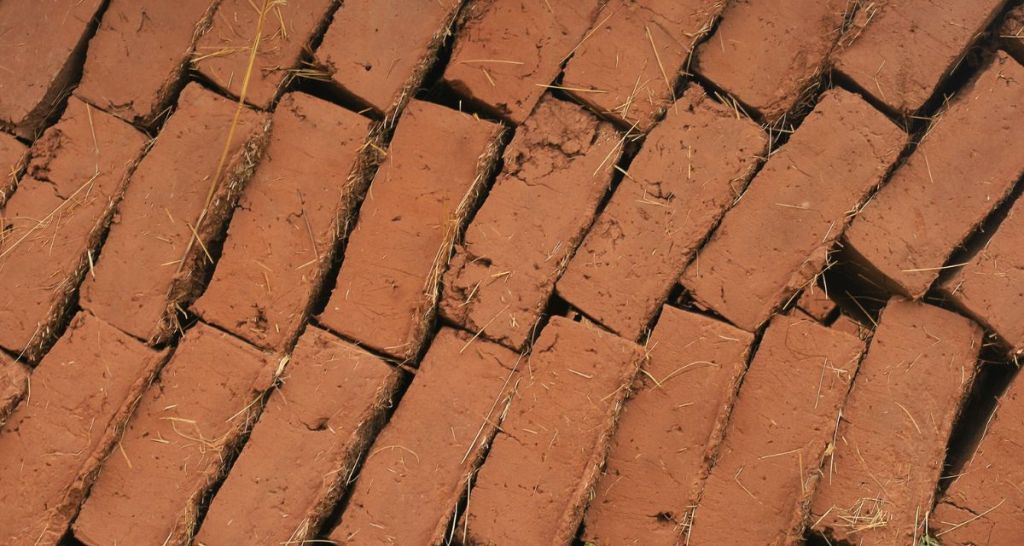
Adobe bricks, made of raw earth mixed with straw or another fibrous substance, are about as old as civilization itself. The word “adobe” traces back thousands of years to the Middle Egyptian word ḏbt, meaning “mud brick.” This evolved into the Arabic word al-tob (meaning “brick”), which was brought to Spain by the Moors. Meanwhile, Indigenous peoples in the Southwestern United States and South America were also building adobe structures. In Peru, for instance, ancient adobe monuments and cities were built more than 5,000 years ago.
When Spanish settlers finally arrived in the New World, they combined their own European construction knowledge—incorporating features like courtyards and lime plaster—with Indigenous building methods, which led to the type of adobe architecture we now see in the American Southwest and California.
Many ancient structures still stand today thanks to this natural material.
Adobe brick wall. Photo credit: Canva
It’s also worth noting that adobe is not only resilient but also cost- and energy-effective. The clay naturally regulates temperature, keeping homes cool in summer and warm in winter without heating or air conditioning, and it costs only a couple hundred dollars. It’s also mold-, insect-, and fire-resistant. All in all, it feels like the ancients figured things out a long time ago.
Why don’t we see more of these types of houses?
Well, because in 48 out of 50 states, it’s illegal. And we have stringent, standardized building codes (with possibly a dash of corporate greed) to blame.
As explained by the Lost Build Archives, in the 1880s, railroads brought lumber to the American Southwest, and towns with rail access began swapping out adobe for this material. Still, rural communities stuck with adobe.
When the first model Uniform Building Code (UBC) was introduced in 1927, the entire manual and the rules therein were for wooden structures. Anything not addressed by the code was considered an alternative material and required additional costly clearances.
In other words, while the UBC didn’t outright declare adobe houses illegal, it made them so expensive to build that people were left with little choice.
Then, in 1949, the Federal Housing Administration (FHA) established rigid rules that made any home not built from lumber or concrete ineligible for financing. This essentially wiped out the option for the middle and lower classes.
Finally, in 1970, the UBC added an explicit provision for adobe that mandated steel and cement reinforcement throughout, yet again multiplying construction costs and destroying the thermal properties that make it so energy efficient.
Interestingly, the Portland Cement Association, which represented cement manufacturers across the country, wrote that provision. It has also lobbied for building codes that require the use of cement.
This isn’t to say that adobe is necessarily superior for all climates. Earthquake- and flood-prone areas do need to take some extra precautions when using adobe. But by and large, it is the additional cost of using it that stems from arbitrary regulations.
Advocates have since fought to bypass some of this bureaucracy
One notable champion was Hassan Fathy, an Egyptian architect who famously reconstructed 150 homes in an impoverished village using adobe. There would have been more had concrete lobbyists not intervened.
Later, in Texas, a woman found a legal loophole and used it to build 600 adobe homes for low-income families. In turn, officials in New Mexico were eventually pressured to create their own adobe-centered codes in 1991 by the long-standing Pueblo communities that reside there. If a 30-year streak with “zero failures” isn’t an indicator of just how resilient adobe is, I’m not sure what is.
And now, more places are trying to give adobe a mainstream revival. In Los Angeles, for instance, which has seen its fair share of fire damage, preservationists are not only touting its safety benefits but also the “communal experience” of being able to make the bricks themselves.
It’s crazy to think that after protecting humans for thousands of years, adobe’s biggest threat isn’t nature—it’s us. But it’s also comforting to know that as cities search for more affordable and sustainable ways to build, an ancient solution is literally waiting beneath our feet.
The post Adobe houses can last thousands of years and barely cost anything to make. Here’s why they’re banned. appeared first on Upworthy.








 New Posts (Home)
 ChatBox
 Popular Posts
  Game Zone
 Top PodCasts