reactormag.com
Spicy Fables: Ayida Shonibar’s “An Unholy Terroir”
Books
Reading the Weird
Spicy Fables: Ayida Shonibar’s “An Unholy Terroir”
Laugh about degeneracy today, and you’ll be tempted into degeneracy tomorrow!
By Ruthanna Emrys, Anne M. Pillsworth
|
Published on June 17, 2026
Comment
0
Share New
Share
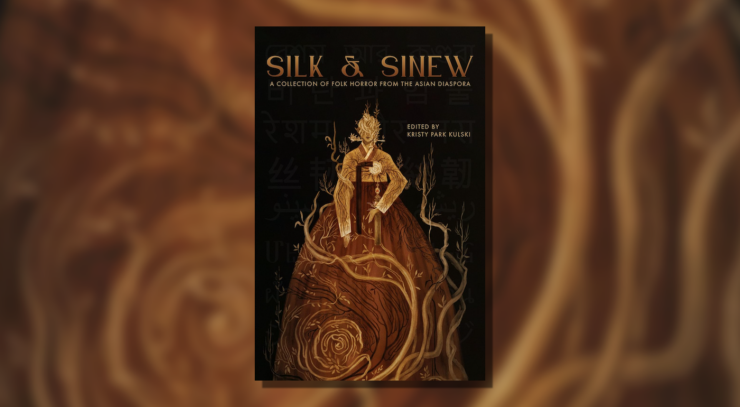
Welcome back to Reading the Weird, in which we get girl cooties all over weird fiction, cosmic horror, and Lovecraftiana—from its historical roots through its most recent branches. This week, we cover Ayida Shonibar’s “An Unholy Terroir,” first published in Kristy Park Kulski’s Stoker-winning Silk and Sinew: A Collection of Folk Horror From the Asian Diaspora. Spoilers ahead!
I. “This is a fable. Or rather, a warning.”
II. In an unnamed village, disease strikes. It robs victims of appetite, shifts their bones, and erodes their human features. Loved ones can only “grieve and watch them disintegrate.”
Desperate, the villagers turn to their Provost. In return for their “respect…and a healthy portion of [their] earnings,” he explains things for “their simple perspectives.” Otto Ludwig provides an example of how “out of the unknowable, the Provost procured an actionable warning.” Otto could be a lazy child. Recently he neglected to draw water, delaying the Provost’s laundry. Heaven sickened Otto as a punishment for everyone’s educational failures. The villagers are “never again late to deliver on [the Provost’s] requests.” Yet the sickness lingers.
Around winter solstice, a young woman arrives: hair black, skin brown, a shawl draped over her shoulders like a “woven exoskeleton.” Its brilliant colors contrast sharply with the villagers’ “uniformly monochrome attire.” They cannot stop staring.
Titli has travelled from afar, trading silks she learned to make from her family. Stories about her spread “like the disease.” Some are gleaned from Titli herself. Others are “mere speculation…spun out of… expectations and fantasies.” Angelika, the Provost’s daughter, tells a tavern gathering that she finds Titli “rather lovely.” Others believe that their “shapeless” clothing hides fibrous, scaly skin; they breathe fire; their food is heavily spiced to mask human flesh.
The Provost overhears them joking about cannibalism. Laugh about degeneracy today, he warns, and they’ll be tempted into degeneracy tomorrow! The stranger could turn them against each other, even make them oppose him!
The villagers remain drawn to Titli. One day, she overhears them wondering about fire-breathing mechanics. She storms off. Angelika leads shamefaced villagers after her to apologize. Instead they witness her fall to her knees near the town well. Her face contorts, and yellow-green-purple flame shoots from her mouth into the well. Boiling water seethes. The villagers flee.
Later, the Provost finds villagers bustling on celebratory errands. The sickness has vanished; Titli’s fire destroyed whatever contagion lurked in the well. But the Provost chastises them for rejecting heaven-sent correction! They won’t find Titli’s “oddities” captivating when her hellfire devours their homes. Titli overhears, and her eyes go dark and ugly.
The Provost writes to authorities in the southern colonies, asking if they’ve encountered exploits like Titli’s. He’s just sent the letters when he realizes the village is ablaze with gold-green-purple flames. He joins in battling the fire, gratified by villagers’ cursing their former favorite.
III. A hundred years before, northerners colonized the south. Injustice and mistreatment turned Titli’s people into dagger-fanged monsters. Robbed of their textiles, her peoples’ fingertips unravelled into silken thread that they could weave in secret. When northerners retaliated, her family bound Titli into a protective cocoon. When she emerged, her people were gone.
* * *
The second time she breathes fire, Titli ignites the village. Horrified, she rushes to help. Later, she brings Angelika water. Angelika says she knows what Titli is. Titli wasn’t the first to start a fire in town—Angelika herself once accidentally started a fire in her father’s study, a sin she’s never before confessed.
* * *
Titli’s fingertip-silk becomes thick and tough, perfect for twisting ropes to help the villagers rebuild their homes. Eventually, the villagers value her structural cording and deploy it everywhere. The Provost reprimands Angelika for eating with the demon outsider. Before long, Titli will be eating her.
IV. The Provost receives a letter from a southern authority who writes that the natives are “false people.” The fruit “that grows [in the colony] is as unholy as its terroir.” The colonists have trouble “maintaining civilization in this region.” He describes “demonic vipers shedding artificial skin” and “beastly wings projecting out of the shoulder blades.”
V. Angelika comes to Titli’s room. They sit together on her bed. Does Titli truly eat people, Angelika asks. And would Angelika be someone she’d like to eat? Titli promises that Angelika will like it, and she’ll stop if asked. Angelika blushes. “Eat me, then.”
* * *
The Provost barges into Titli’s room to find Angelika moaning, with Titli’s head between her legs. He hauls Titli into the street, to the well. Titli kicks him, knocking his belt-pouch loose. It spills a journal, a sack of gold, and a tinted bottle. Angelika grabs the bottle. It’s one of her missing cosmetic tinctures, nothing her father could want, except— Ingested, the tincture’s a powerful poison. Realization strikes Angelica. Did the Provost poison the well?
The Provost screams incoherently. Titli’s shifting in his hands, shoulders elongating, scales erupting through her clothes. Fangs erupt from her mouth. Her wings flap, lifting them both. The Provost calls for help. No one moves, and he falls howling into the well.
VI. As dawn breaks, the villagers watch Titli fly away. They whisper goodbye, though she won’t hear. As they return home, the shouts of a drowning man fade behind them.
Buy the Book
Silk & Sinew
edited by Kristy Park Kulski
A Collection of Folk Horror from the Asian Diaspora
Buy Book
Silk & Sinew
edited by Kristy Park Kulski
A Collection of Folk Horror from the Asian Diaspora
A Collection of Folk Horror from the Asian Diaspora
Buy this book from:
AmazonBarnes and NobleIndieBoundTarget
What’s Cyclopean: “Terroir” is the unique flavor that food gains from the special properties of a particular location. It comes from the minerals in the soil and water (including its poisons), from climate, from local microbiomes, and from the practices of the people laboring to produce it. And perhaps it’s not only food that gains terroir from those practices.
The Degenerate Dutch: Those people, over there, aren’t really human. Their false skins hide scales; they have wings and claws; they eat human flesh. They breathe fire. They are, in fact (according the Provost) degenerate.
Weirdbuilding: Cannibalism is no laughing matter. Without it, what horrors would we ascribe to the Others in all our stories of exotic places?
Anne’s Commentary
I can’t be the only one who glanced at Shonibar’s title and misread “Terroir” as “Terror.” Right?
Never mind. I can blame it on needing new lenses, not new eyes, or brains.
Connoisseurs of cheese, chocolate, coffee, tea, whiskey, or wine wouldn’t confuse the two words, “terroir” being a key term in their enthusiasms. I like Benjamin Bois’ definition best:
“Geographical origin is closely associated with the quality of grapevine products, and in particular wine. This connection between the place and the taste of agricultural products, probably dating back to antiquity, was formalised in the notion of “terroir.” A term of French origin used from the 12th century to designate an agricultural area, then a soil conferring singular properties to wine, the terroir has become in the 20th century a concept opening the influence of the place on the quality of the product to a very large number of natural and anthropogenic elements.”
Their orthography might trick one into thinking terroir and terror are close etymological cousins. Actually, the root of the first is the Latin terr- or terra (earth, land), whose Proto-Indo-European (PIE) root is ters- (to dry). The root of the second is derived from the Latin verb terrēre (to tremble or shake). Its PIE root is tres-, also to tremble or shake.
Latin terra goes to French terre goes to terroir. English has no snappy one-worder for this. You could go with “local character,” though that’s reminiscent of some half-crazy, half-savvy old guy in droopy overalls.
An “unholy terror” is an English idiom that puts a darker twist on the more commonly used “holy terror,” which often has playful or even affectionate overtones. In Shonibar’s story, the word “terroir” is used just once. That’s in the letter the Provost receives from a “southern colonial authority,” who writes:
“The natives of these lands are false people. Fruit that grows here is as unholy as its terroir.”
Nice double-fisted casting of calumnies, that. First, the natives are “false people.” Does this mean they’re liars? Inhuman? Both? Second, the natives are reduced to fruit, and unholy fruit at that. It’s not likely they could ripen into worthy produce, living where and how they do! And lest the Provost misconstrue his descriptions as figurative, the authority includes drawings showing the natives’ “inhumanly extended teeth, which curved over the lower lip, past the chin, and were shaded with insinuations of dried blood.”
An earlier passage describes colonization from the “native” point of view. Abused and labelled as beasts, the southerners began “fulfilling [the northerners’] prophecies of [their] savagery”: “Our fangs lengthened to daggers, our nails sharpened into swords…Our changing skeletons reached for any possibility of freedom.” Ultimately, they spun silk from their fingertips, thus clothing themselves with themselves.
The dagger-teeth, sword-nails, and ability to shift their very bones, were clues to the possible cultural inspiration for Titli. The master shape-shifters of Hindu mythology are the Rakshasas. These demons can assume any form at will, but are most often depicted as having protuberant, even tusk-like teeth, and long, razor-sharp claws. They can fly or walk upon the air, normally through the use of magic rather than on physical wings. However, they can shift into monstrous winged hybrids as well as into predatory birds entire.
Fire-breathing Rakshasas are rare, but there is the story of Analasura, the Fire Demon who terrorized gods and men alike by shooting flames out of his mouth and eyes. Eventually, Lord Ganesha dispatched Analasura by swallowing him. (Good news: No more Analasura. Bad news: Ganesha suffered terrible heartburn afterwards.)
In a Meer article, Asuras, Daityas and Rakshasas: Mythical Forces Unveiled, Shilpa Sonawane describes the Rakshasa:
“Rakshasas are often depicted as fearsome, grotesque beings who dwell in forests, cemeteries, and uninhabited terrains. Unlike Asuras and Daityas, who operate on a cosmic scale, Rakshasas are more connected to the earthly realm, representing chaos, destruction, and the untamed aspects of nature and human emotion. However, even among the Rakshasas, there are exceptions like Vibhishana, who chose virtue over familial loyalty, and Mandodari, celebrated for her wisdom and compassion.”
Gods and Monsters explains why a Rakshasa Titli would be the ultimate nemesis for the Provost, self-proclaimed defender of order and virtue in his village-kingdom:
“In the grand epics of Hindu tradition, the Rakshasas…are the disruptors of order, the challengers of gods and heroes. Their presence in stories like the Ramayana is not just as adversaries but as pivotal forces that shape the narrative. They are known to disrupt holy rituals, challenge the virtuous, and create upheaval in the celestial and earthly realms alike.”
You go, Titli, I said. I was sorry that she flew away from the village so soon, but I guess her work there was done, and there were many more repressed, monochromatic villages to disrupt into cracking open their inhabitants’ minds a little, while having fun at the same time.
Ruthanna’s Commentary
If people are going to call you inhuman, and treat you as monsters, wouldn’t it be tempting, sometimes, to prove them right? To turn metaphor into clawed reality? Grow wings to fly away, talons to fight back, fire to take the sick anger from your belly and put it out into the world?
It wouldn’t be comfortable, of course. It’s not safe. It’s more than survival, and less, to change that way. And it gives power to those who describe you, even if you become what terrifies them.
This story feels familiar, and also makes me cautious in that familiarity. Shonibar is Desi and so is the experience with colonialism from which they draw—and with which I’m not deeply familiar. There’s kinship with stories about building golems, and with flying Africans, and with Blackfeet who can draw blood from those who’ve bled them dry. With reclaiming Deep Ones and Abdul Al-Hared. But none of these are identical, or even close—and our uniquenesses, identities unblurred with others, are part of what these stories insist upon. Our terroirs.
The uniqueness that most grabs me, here, is the image of silk-spinning fingertips. Beyond the ability to fight back with violence, the silk offers economic independence and the ability to care for children. Most textile crops are grown in legible fields. This is also true in real life of silkworms and their attendant mulberries—not so for finger-spinning. Titli’s parents are able to hide their illicit production for a while, then at the last to spin her a protective cocoon. It ends her childhood, not only in the metaphorical way that parental death does, but as cocoons do, releasing her as an adult able to survive on her own. And now she, too, is shaped by the stories that people tell about her, even as she travels and lives among those people.
But the Provost’s town has some special power of its own—and it may be part of the country where the colonizers come from, but it suffers on its own from their hierarchies. (What you do elsewhere is often first practiced at home, just ask post-enclosure peasants in Britain.) So the Provost offers “actionable” lies, demands for labor, and, it turns out, horrific deaths to keep everyone in line. It’s not him punishing people for being late with his laundry, it’s god.
And it’s the Provost’s “simple” people, who must at some level recognize the unfairness of this, whose beliefs invoke Titli’s firey breath and wings. Perhaps the poison’s breakdown of their own flesh gives them some kinship with her own metamorphal abilities.
I keep coming back to the first two sentences, which are easy to forget during what follows. Even in the context of the story, none of this is literal. A fable brings together archetypes, not entirely human, to support a moral. A warning tells a specific audience to do something differently. So we can imagine Titli’s all-too-brief tryst with Angelika and how they might think of each other after Titli flies away, but the two of them as individuals aren’t the main point; you can as easily worry that those unreachable grapes would have poisoned the fox (as real grapes poison real canids). This is emphasized by the point of view—first person plural, the “we” of both the Provost’s town and Titli’s family.
This is a more complex fable than Aesop’s. It seems to me that the moral is that those suffering under colonial hierarchies in the imperial core, and those suffering in the colonies, have much to learn from each other and much to gain by working together—even though that collaboration won’t always be comfortable. Solidarity Forever! (It might say, in the little italicized sentence that appended each story, in my childhood copy of Aesop’s Fables, lest one miss the point.)
And the warning, of course, is to the Provosts of the world, secure with their poisoned wells and their demands for service. Your time is coming.
Next week, the “farce” of confession continues in Chapters 19-20 of Stephen Graham Jones’ The Buffalo Hunter Hunter.[end-mark]
The post Spicy Fables: Ayida Shonibar’s “An Unholy Terroir” appeared first on Reactor.








 New Posts (Home)
 ChatBox
 Popular Posts
  Game Zone
 Top PodCasts