reactormag.com
Double Take: Sublimation by Isabel J. Kim
Books
book reviews
Double Take: Sublimation by Isabel J. Kim
Mahvesh Murad reviews Isabel J. Kim’s novel about migration and personhood.
By Mahvesh Murad
|
Published on June 18, 2026
Comment
0
Share New
Share
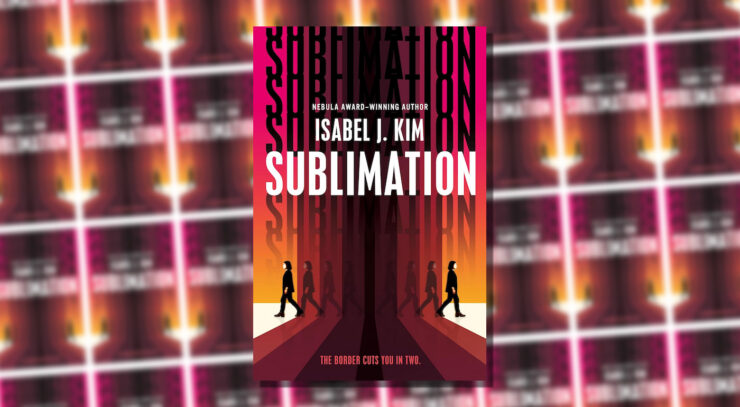
Imagine if migration literally pulled you into two. Two physical beings, two minds, two sets of desires and dreams. You become two versions of yourself, living two separate lives in two separate lands. In multi-award winning writer Isabel J. Kim’s debut novel Sublimation, this is exactly what happens when someone leaves their home country: They leave a copy or “instance” of themselves behind (or is it the copy that goes onwards?). Kim explains that an “instance is a duplicate self cleaved mitosis-like from the original—though the duplicate and the original are both referred to as “instances” in modern American vocabulary.” No one knows why it happens, just that it has always happened. It can be reversed though: If the instances meet and touch, they reintegrate and become one person again, one physical body with both sets of memories and feelings coexisting in one mind. But what happens when only one instance wants that?
Sublimation is focused on two pairs of instanced people. Soyoung and Rose, who instanced when ten year old Rose and her mother left Korea for America, and Youjin and YJ, who instanced when YJ went to America for university. In Seoul, Soyoung and Youjin are best friends, each leading their lives happily enough, with a firm sense of belonging. Soyoung has never spoken to her instance and only meets her when their (shared, singular) grandfather dies, whereas Youjin has always had a relationship with his: Youjin and YJ plan to reintegrate once YJ has received American citizenship, so that their reintegrated self can avoid the Korean draft. Four people with complicated feelings for each other and for their own lives, two very different scenarios, and one high concept premise all combine to make Sublimation a fascinating, thought-provoking and complex novel.
The story is set in our world, with the small tweak that instancing has always existed, its recorded history going as far back as 1753 BC, where the first mention of instances was found in a Babylonian text. The understanding of instancing and how the world tackles it is drip-fed to the reader slowly throughout the book to avoid any major info dumps. This is an elegant way not just to get the information across, but also to immerse the reader in the world of the story by establishing how much of it is completely familiar. It is an uncanny feeling, to think of our world as it is, with just this one tiny change… which isn’t, of course, tiny at all.
The reverberations of instancing are felt throughout the world of the novel, with Kim often referring to how our history has been affected. We are told that it is not enough to have a desire to know the world outside your boundaries:
Marco Polo famously didn’t instance. You can travel the whole world and still return home and stay singular. It’s not a bad thing, to instance. But it means that you were of two minds. It shows a desire beyond wonder. It suggests a desire for escape, an understanding that either the world outside is so beautiful it must be permanently inhabited or the world inside is so terrible that it should be escaped.
Talk to anyone who has ever migrated, for any reason, and they will tell you that all migrants live life with a foot in each world, and that the constant straddling of two homes can be a fine balancing act. The guilt of leaving may always weigh heavily against the desire to escape and start afresh. A border, after all, is “an artificial thing with practical consequences: the severing of the self from the self.” Migration is a twinning, a division, a mind-body-soul-memory torn asunder. In Sublimation, it is “want turned so deep that it manifested in reality. Instancing was pure white-hot desire. Did you consciously know you were leaving forever? No. You didn’t know what part of yourself wanted to leave.” And when you return, are you someone who can fit back in, or are you now an alien even in your home land? What part of you belongs where, if anywhere at all?
Sublimation’s main characters are all uncertain of how to feel, or whether there is even a right way to feel about their situations and about each other. One may feel a need to be whole again, just to feel at peace with the life they haven’t lived, or to have the memories of the life they didn’t live by reintegrating with their instance. But the ones who leave do not come back the same, and reintegration can never be without cost, without huge cognitive dissonance, without the burden of each solo existence wiped out. Who are we if not our experiences? How do we then accommodate living with someone else’s experiences that feel like ours, but aren’t? Is it like murder, wonders Youjin at the very start of the novel.
Buy the Book
Sublimation
Isabel J. Kim
Buy Book
Sublimation
Isabel J. Kim
Buy this book from:
AmazonBarnes and NobleiBooksIndieBoundTarget
The novel’s premise is large and heavy. It could be unwieldy, but Kim tackles the multiple complicated, modern day implications of the instancing scenario well, whether it be by choice or force, or something in the middle. She doesn’t shy away from acknowledging how colonial capitalism has caused most of the world’s instances, and that this is the “legacy of the west: a mitosis-like duplication of the self across lands already populated.” America, we are told very clearly, was populated by instances from Europe:
Instancing is written into America’s blood, into the story it tells itself: Here is where instances migrate. Give us your tired, your poor, your hungry, give us your copies and let them be fruitful and multiply, let them homestead, let them become titans of industry, let them and their non-instanced children build cities and towns and railroads.
Kim does not pander to her reader, which is always something to be appreciated. She expects you to know your history, to know who Odysseus was, how citizenship laws and visas work. She expects you to be empathetic and aware that not all lives are lived with the same freedoms, and that the idea of what freedom should look like is often a matter of power. The difference between expatriates and economic migrants, of course, is usually the colour of their skin and/or their passport. Kim’s authorial voice pulls no punches in reminding us of how many different ways there are for your home to be torn away from you.
In a worst-case scenario you instance when you are ripped away from your family and your community and your life and you are trafficked across state borders when you catch a glimpse of the sign that demarcates where your country ends. Or somewhere in between, you instance because you realise that the only real choice you have in life is to leave your beloved, broken shithole, and cross the border into a different broken shithole, one with more access to capital, that you will be able to gnaw the rind from and send back the scrapings.
The novel is character driven for the most part, with a fair bit of introspection as we switch between the four main characters. It takes a turn in the final third towards techno-thriller, which is probably what made it a great purchase for Universal Studios for a television adaptation, and why it’s being pitched as perfect for fans of the TV show Severance. It is an admirable, ambitious debut novel, full of good writing. There are some powerful philosophical arguments presented here in evocative imagery, and Kim’s use of the second person narrative for much of the novel is an excellent stylistic choice that puts the reader in the position of being an instance. This does not feel gimmicky; instead, it does what it intends to: It captures moments, feelings in a “specific time and place… the heart at the moment of stepping over a border. The mind when it knows it is leaving.”
What does life look like in a world where imperialism, citizenship laws, immigration, war, racism and xenophobia all have an immediate physical impact? What does life look like when your future can be commodified, controlled, capitalised upon? It is not just about a surge in population, it is not “a cleft of meat and bone… it is the cleave of one future from another. It is the psychological change as denoted through physical reality; it is metaphor made flesh. The physical effects are downstream from the higher-order changes taking place.” It is these higher order changes that Sublimation concerns itself with, and while it does not have all the answers, it definitely brings about a great many relevant questions.[end-mark]
Sublimation is published by Tor Books.Read an excerpt.
The post Double Take: Sublimation by Isabel J. Kim appeared first on Reactor.








 New Posts (Home)
 ChatBox
 Popular Posts
  Game Zone
 Top PodCasts