www.upworthy.com
Scientists found Vincent van Gogh’s hidden ‘fingerprint’ and it’s catching art forgers red-handed
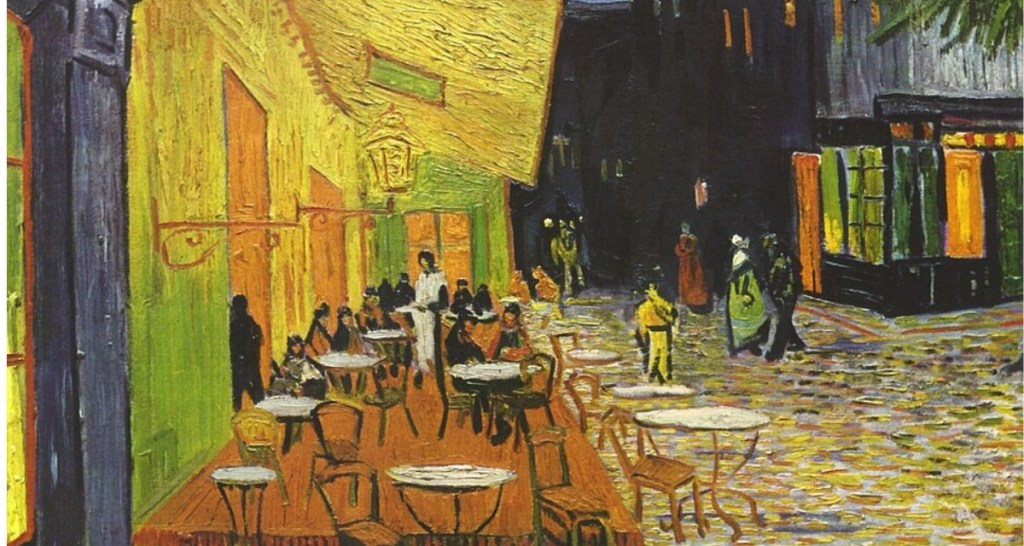
Vincent van Gogh’s work is instantly recognizable. Those swirling skies, the vibrant sunflowers, and the thick, heavy layers of paint that give his canvas a three-dimensional look. His boundary-pushing style captivates art lovers and historians alike. But as it turns out, the legendary Dutch Post-Impressionist left behind a truly unique signature. And no, we’re not talking about his name scrawled in the corner of a canvas.
Photo credit: Public domain – Van Gogh's "Café Terrace at Night"
Thanks to incredible breakthroughs in modern technology, scientists have uncovered an exciting new way to recognize an original Van Gogh with complete precision. It all starts with close-up scans of his distinctive brushstroke patterns, but that’s only the beginning. Let’s paint you a picture.
Decoding the mathematics of a masterpiece
Identifying a real Van Gogh has traditionally relied on expert analysis, historical records and documentation, and a lot of detective work. More recently, chemical analysis of paint has helped the art world get closer to the truth of the matter, but that hasn’t stopped clever fraudsters from trying to pass off convincing forgeries as the real thing. That is, until a team of brilliant researchers at the Université Polytechnique Hauts-de-France stepped in.
Instead of looking at what was painted, the scientists wanted to measure how it was painted. They started by using advanced digital mapping technology to analyze the surface texture of eight of Van Gogh’s most famous paintings. They looked at the three-dimensional ridges, peaks, and valleys that his brushwork and paints left on the canvas. What they discovered is absolutely mind-blowing.
Van Gogh painted wheatfields in the weeks before his death.
Van Gogh’s “impasto” technique (applying paint thickly so that the brushstrokes remain clearly visible) is almost like a fingerprint. How he applied pressure, moved his hand, and layered his paint created a distinct mathematical pattern. Think of it like an artistic algorithm. It’s called a fractal score; it’s a mathematical equation scientists use to authenticate Van Gogh’s paintings. Every artist has a subconscious rhythm to their movement and technique, and Van Gogh’s is so specific that his fractal score identifies his work with incredible accuracy.
To catch an artistic thief
Here’s where we start to dip into the internet’s favorite subgenre: true crime. Van Gogh’s work was not appreciated while he was alive. His fame grew after his suicide in 1890. As a result, quite a few “lost masterpieces” are passed off as legitimate works over the years.
“Sunset at Montmajour” was supposedly one of those “lost works” of Van Gogh. There was documentation that the artist had spent time near Arles, the setting for this landscape piece. He even described the area in a letter dated two years before his death. The painting, purchased in 1908, is left to rot in an attic. Over 100 years later, the Van Gogh Museum in Amsterdam authenticated “Sunset…” by relying on that letter, plus a chemical analysis of the canvas and paint pigments. But would it pass the scientific fractal score test? Yes. The physical texture of the brushstrokes fell comfortably inside the reference range. Art and science backed each other up.
Sunset at Montmajour, painted in 1888. (Media Credit: Wikimedia Commons)
A small oil-on-wood panel, titled “The Plowmen,” was discovered in Paris in the 1990s. The press suspected the painting was a fake. In the early 2000s, the Van Gogh Museum rejected it as a clever imitation. When the Université Polytechnique Hauts-de-France finally had an opportunity to conduct a fractal analysis on “The Plowmen,” it scored far outside Van Gogh’s established fractal range. Once again, the tech confirmed what the experts believed: the painting was not his—they caught a forgery red-handed!
By blending art and technology, science is working to make sure that future art lovers will know that the Van Gogh’s works they see are the genuine article. It’s also going to make it a whole lot harder to be in the art forgery business.
The post Scientists found Vincent van Gogh’s hidden ‘fingerprint’ and it’s catching art forgers red-handed appeared first on Upworthy.








 New Posts (Home)
 ChatBox
 Popular Posts
  Game Zone
 Top PodCasts