reactormag.com
Beyond the Infinite Two Minutes: Charmingly Low-Stakes Time Loop Hijinks
Column
Science Fiction Film Club
Beyond the Infinite Two Minutes: Charmingly Low-Stakes Time Loop Hijinks
A bunch of friends accidentally discover a time paradox-vortex-loop thingy in this goofy, delightful comedy.
By Kali Wallace
|
Published on June 24, 2026
Credit: Europe Kikaku / Tollywood
Comment
0
Share New
Share
Credit: Europe Kikaku / Tollywood
Beyond the Infinite Two Minutes (Japanese: ドロステのはてで僕ら, trans. We at the End of the Droste) (2020) Directed by Junta Yamaguchi. Written by Makoto Ueda. Starring members of the Europe Kikaku theater troupe.
Over the past few weeks, we’ve watched a selection of low-budget, high-concept films that make use of minimal productions to place characters in strange and unsettling science fictional situations. It feels fitting to end the month with a film that reminds us we needn’t take everything so seriously all the time—not even accidentally creating a time paradox with your friends in a Kyoto café after hours.
Beyond the Infinite Two Minutes is a mere 70 minutes long, and it spends barely five of those minutes establishing its science fictional premise. Kato (Kazunari Tosa), a café owner in Kyoto, discovers one night after work that the computer in his café is linked to the computer in his apartment upstairs by a two-minute time glitch. When he looks at his home monitor, he can see what is happening exactly two minutes in the future from the perspective of the café’s computer.
This is, of course, completely bewildering to Kato, but he doesn’t get much time to think it over before café worker Aya (Riko Fujitani) and friend Komiya (Gôta Ishida) catch on and begin playfully testing the curious little time loop. Two more friends, Tanabe (Masashi Suwa) and Ozawa (Yoshifumi Sakai), show up to join in. In spite of Kato’s misgivings, the other characters want to figure out what they can do with this ability.
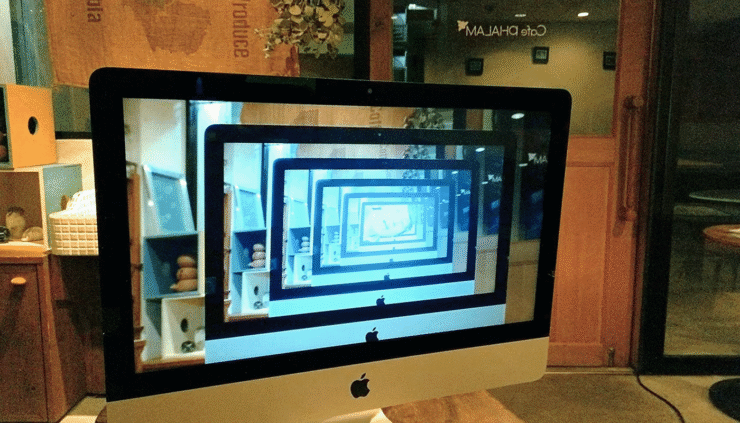
Naturally, their minds go to using the “Time TV” to make money, but they quickly realize the limitations of being able to see only two minutes into the future. Ozawa comes up with a way around that. If they set the two computers facing each other, he reasons, it will create an infinite mirror that will show each subsequent layer two minutes farther into the future. This is where the film’s Japanese title comes from: ドロステのはてで僕ら, or We at the End of the Droste, refers to the Droste effect, which describes when an image occurs recursively inside of itself. The effect is name for an advertisement created by Jan Misset in 1904; his artwork for the Dutch cocoa brand Droste shows a woman holding a cocoa tin that features the same image of her holding a cocoa tin.
Over Kato’s rather feeble objections, the group excitedly follows Ozawa’s suggestion. They place the two computers facing each other and end up with a view several minutes in the future.
(Note: I have no trouble suspending my disbelief for the timey-wimey stuff, but I kept wondering how long the cables are for this computer. Kato must be using the longest extension cord in Japan.)
That’s where things start to get a bit more complicated. Kato sees his future self excitedly announce that the woman next door, Megumi (Aki Asakura), has accepted an invitation to come see his band play. But when he goes over to ask her, she turns him down. Aya convinces him he has to tell his past self that she accepted, because he saw his future self say it, therefore not doing it will create a paradox. This is an assumption all the characters, genre-savvy as they are, bring into the situation. They accept that the future is controlling the present in some way—or they don’t want to find out what will happen if it doesn’t—and that remains true even when things take a turn for the dangerous.
Relatively dangerous, that is, because this is not the kind of movie where the tone ever dips darker than “mildly concerned.” The friends accidentally run afoul of some hapless gangsters who live upstairs, and there is an amusing sequence of events where Kato goes to confront them while carrying one screen (longest extension cord in all of Japan!) so the others can watch the future broadcast below and hurriedly prepare him.
Then the Time Cops show up, and Kato and Megumi finally ask the question that the audience has been asking all along: Why do we have to do what we see our future selves do? Can’t we just… not do that? The future isn’t actually controlling us, is it?
And they’re right, at least from their own perspectives. There is no cataclysm. They don’t accidentally create a post-apocalyptic wasteland. Life just goes on, now with the two of them getting to know each other in the café, and Kato firmly turning off his Time TV monitor.
Just about everybody involved in the making of the film came from the Kyoto-based Europe Kikaku, a theater troupe founded at Doshisha University in 1998. The troupe specializes in comedic performances with sci fi or fantasy elements, so this film is right in their wheelhouse. The setting is a real café where the members of the troupe liked to hang out, and the film was made over the course of seven days for a total cost of about ¥3 million (about $18,000). It premiered in the midst of the COVID-19 lockdowns in a small Tokyo theater to a socially-distanced audience of exactly twelve people—but it was picked up by Toho Cinemas, the theater-owning arm of the Japanese film giant, and would go on to screen at a number of festivals.
According to an interview with director (who was also the cinematographer, camera operator, and editor) Junta Yamaguchi, writer Makoto Ueda first conceived of the basic premise of Beyond the Infinite Two Minutes several years before they found the right time to make it. And when they did, the biggest challenge was getting the one-take, real-time aspect right.
Time for a quick diversion into film trivia! Beyond the Infinite Two Minutes was not actually filmed in a single long take; it was edited to look that way. That’s a tried-and-true approach to filmmaking that’s been around for a long time: Alejandro G. Iñárritu’s Birdman (2014) and Sam Mendes’ 1917 (2019) are two modern examples that make use of it.
Prior to the usage of digital cameras and projectors, the length of a single take was limited by the length of a reel of film. That was the problem Alfred Hitchcock ran into when he was making Rope (1948). Film stock at the time could record only seven to ten minutes of action, and two reels could be loaded into a theater film projector for a maximum twenty minutes of continuous runtime. That’s why Rope is made up of a series of seven-minute scenes in which the cuts alternate between hidden cuts (such as close-ups on the same image) and obvious cuts. (I learned from reading about this that apparently Iñárritu hates Rope and was not shy about expressing it during Birdman promotions. It’s an opinion he shares with Hitchcock himself, who considered the film a failed experiment. I quite like Rope. I like audacious experiments in film.)
The advent of video technology extended the length of a single true take considerably; Béla Tarr’s made-for-television Macbeth (1982) clocks in at 62 minutes, with a single five-minute scene followed by one that is 57 minutes long. Digital filmmaking naturally pushed the limit even farther, and now there are several movies from around the world that are true single-take films of over two hours long. These include the Tamil-language Indian horror movie Agadam (2014), filmed in a single 123-minute take; the Iranian experimental film Immortality (2016), which consists of a single 145-minute shot on a train; and the German crime thriller Victoria (2015), for which the full 138 minutes were filmed three times because the director was dissatisfied with the first two takes.
This concludes our detour into film trivia, because that’s not what Beyond the Infinite Two Minutes is doing. This movie takes it cue more directly from the 2017 Japanese zombie movie One Cut of the Dead, which is a film-within-a-film meta satire about the production of a single-cut zombie film that ends up using real zombies. That film was also made for quite a low budget over a handful of days, with Shin’ichirō Ueda both directing and editing. It was also extremely successful, demonstrating that there was at least a little bit of interest in the film world for low-budget, high-concept speculative films with some fun editing trickery.
Beyond the Infinite Two Minutes is not a long film, but making it required intense attention to detail in both filming and editing. To be able to keep moving around the characters—and following them as they haul computers up and down the stairs—Yamaguchi used a tiny, handheld camera fixed to an iPhone that served as its monitor. He said about the process, “We paid particular attention to time management. The two-minute time delay needed to be very accurate, we couldn’t go off even one second. Everything, from the camera movement to the actors, had to be very precise.”
That makes it another film, like Coherence (2014), where the confined setting and short time frame hide just how much preparation and editing go into making a film that convincingly portrays a group of people having an ordinary evening interrupted by science fictional phenomena. Making it look easy on screen is never actually easy at all.
One thing I really liked about Beyond the Infinite Two Minutes is its charming self-awareness in keeping the scale small and the stakes low. The characters even poke fun at the time travel trope of glimpsing the future and seeing a post-apocalyptic hellscape. It never tries to explain the causality or paradox built into the premise; those are not things the characters would be able to work out in an hour. They marvel at the phenomenon, they play around with it, and they only get about as far as using it for scratch tickets and gashapon prizes before getting waylaid.
All of that feels believable for a bunch of friends who accidentally discover a time paradox-vortex-loop-thing in a café one night. Beyond the Infinite Two Minutes is very silly, a bit of slapstick with a romantic comedy at its core, and quite a lot of fun.
Yamaguchi, Ueda, and the Europe Kikaku troupe have revisited the premise of two-minute time travel in River (2023), which is about a group of people at a ryokan getting caught in a two-minute time loop. I haven’t watched it yet, but critics seem to have liked it, so it’s probably worth checking out.
What do you think of Beyond the Infinite Two Minutes? What would you do if your computer showed you exactly two minutes into the future? Maybe it does and you’ve just never looked at the right window…
I have recently reached a milestone here at the Science Fiction Film Club: As of this month, I’ve written about over 100 films. For the first week of July, I’m going to write something about favorites, hidden gems, pleasant surprises, and other things related to what I’ve watched, researched, and learned over the past couple of years.
After that, we’ll get back to the regular weekly schedule with a new theme.[end-mark]
It’s a Really Good Idea to Let Machines Do Our Thinking
I have no idea why this theme is on my mind lately. It just came to me out of nowhere. It’s just such a common sci fi story premise. I can’t explain it. So let’s watch a few cautionary tales about what happens when we let technology we don’t fully understand drive important decisions regarding things like war and peace and life and death and the fate of the entire human race.
July 8 — Colossus: The Forbin Project (1970), directed by Joseph Sargent
It’s a really good idea to give control of nuclear weapons to machines.
Find it online.
View the trailer.
July 15 — Westworld (1973), directed by Michael Crichton
It’s a really good idea to let corporate greed drive decision-making with dangerous technology.
Find it online.
View the trailer.
July 22 — Zardoz (1974), directed by John Boorman
It’s a really good idea to let a machine control human immortality.
Find it online.
View the trailer.
July 29 — The Terminator (1984), directed by James Cameron
It’s a really good idea to… you know what. Never mind. None of this is a good idea.
Find it online.
View the trailer.
The post <i>Beyond the Infinite Two Minutes</i>: Charmingly Low-Stakes Time Loop Hijinks appeared first on Reactor.








 New Posts (Home)
 ChatBox
 Popular Posts
  Game Zone
 Top PodCasts