www.newsbusters.org
MS NOW's Eddie Glaude Calls It 'Evil to Me' That Elon Musk Is a Trillionaire
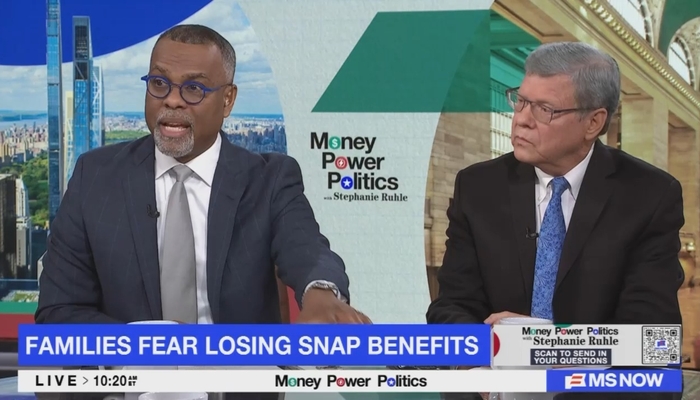
On Monday's Money, Power and Politics, MS NOW contributor Eddie Glaude declared that it is "evil to me" that Elon Musk has become a trillionaire (on paper). His comments came as the group typically compared that to the Republican push to "cut" SNAP benefits (add work requirements or proof of citizenship) and other federal spending.
The segment began with a piece by correspondent Rosa Flores as she spoke with SNAP recipients in New Mexico who complained about high food prices. Ruhle turned to Glaude and posed: "Eddie, what goes through your mind when you hear people talk about their lived experiences and sort of this growing disconnect between politicians and their actual constituents' lived experiences?"
He began:
MS NOW's Eddie Glaude Calls It 'Evil' That Elon Musk Is a Trillionaire pic.twitter.com/TLbqqho0Y6
— Brad Wilmouth (@bradwilmouth) June 22, 2026
Greed, selfishness and hatreds have the country by the throat. I don't know what the social contract is anymore in this country. I don't know what our obligations to our fellows consist in. What we do know is this -- we have one human being that is now a trillionaire. That's evil to me. One human being!
The liberal contributor continued:
We know what we have. We have the Trump family making billions. We know what we have -- the country spending billions on war. We know inflation for what? And so then you have to ask the moral question. There's something about a calloused heart here.
MS NOW's Ron Insana soon invoked the gilded age:
No, not only that, I mean, when you look at the post-midterm environment where Medicaid is going to be cut by $900 billion; SNAP benefits are going to be cut even more; 36 to 57 percent of consumer spending is done by the top 10 percent; 75 percent of the gains in the stock market have accreted to the most wealthy Americans. So income inequality, one could argue, is at its worst since the gilded age. We have this just enormous disparity between those at the bottom and those at the top.
He eventually dragged in the Coolidge years and the Reagan years: "And this is we're back to a -- almost even in excess of the 1980s or the 1920s -- a Wild, Wild West on Wall Street that has not existed for quite some time."
Ruhle asked the classic MS-DNC question: "Isn't there such a strong probability that this is going to backfire politically for Republicans?" Ex-conservative Never Trumper contributor Charlie Sykes soon complained about Elon Musk's push to cut spending, including the U.S. Agency for International Development:
I mean, the social contract has always been, you know, you work hard, you play by the rules, and you get ahead in America. And now people are looking at a system in which people are becoming, you know, the trillionaires and that this remarkable split screen that I can't get over, that the world's richest man, the richest man who ever lived, spent last year cutting benefits to the world's poorest people, not just in the United States, but globally.
Transcript follows:
MS NOW's Money, Politics, Power with Stephanie Ruhle
June 22, 2026
10:10 a.m.
ROSA FLORES: So do you fear that you could lose some of these services?
STELLA HALLER, NEW MEXICO SNAP RECIPIENT: Yeah, I'm really scared that if we don't stand up and vote properly and vote for the people that represent us, as opposed to the people that represent, to me, the top 1 percent, we're going to lose a lot of benefits. And people that are devoted to Trump, they don't realize that they're going to lose, too. There's already people that are losing.
STEPHANIE RUHLE: Rosa joins us now from Albuquerque. What surprised you most from these conversations, Rosa?
ROSA FLORES: You know, Steph, it is the sacrifices that people are making and the change in their habits. I talked to some families who make their own detergent to save money -- others who ration their detergent or their Kleenex or their toilet paper just to make ends meet. And then I heard some things that you would expect some people shopping around in various stores to get the best price, some of them coming to this store where I am -- a local mom and pop -- to get certain items at a certain price.
But then there was also the frustration. A lot of people frustrated with just how expensive everything is. They can't stretch their dollar enough. And then there was the disgust with the Trump administration's priorities because they think of all the sacrifices they have to make, and then they see how the Trump administration is spending their taxpayer dollars. I heard about Iran, about the ballroom, about the reflecting pool. And so Americans are upset because they're having to change their habits and change the way they do things just to make ends meet and put food on the table. And then they're seeing how their taxpayer dollars are spent.
(...)
RUHLE: Eddie, what goes through your mind when you hear people talk about their lived experiences and sort of this growing disconnect between politicians and their actual constituents' lived experiences?
EDDIE GLAUDE, MS NOW CONTRIBUTOR: Greed, selfishness and hatreds have the country by the throat. I don't know what the social contract is anymore in this country.
RUHLE: Wow.
GLAUDE: I don't know what our obligations to our fellows consist in. What we do know is this -- we have one human being that is now a trillionaire. That's evil to me. One human being. We know what we have. We have the Trump family making billions. We know what we have -- the country spending billions on war. We know inflation for what? And so then you have to ask the moral question. There's something about a calloused heart here. Now, we're not asking for charity. What are our obligations to each other? What constitutes the general welfare here?
And so I think it's a fundamental question to ask, right, when we are grappling with our politics, when we're grappling with these political personalities. What's happened to the moral core of the country? And we see it in stark reality -- in clear -- in clear technicolor right now. And it's not black -- just black people -- not just brown people -- not the so-called lazy folk. It's happening in red states. It's happening across the country.
RUHLE: Ron, as I turn to you, I'm reading over your shoulder, the market's up 250 in the last hour while this woman -- while this woman is talking about rationing toilet paper and tissues. What's the economic ripple effect, though? When programs like this are massively reduced or cut, these Americans don't suddenly find high-paying jobs or they don't disappear from society.
RON INSANA: No, not only that, I mean, when you look at the post-midterm environment where Medicaid is going to be cut by $900 billion; SNAP benefits are going to be cut even more; 36 to 57 percent of consumer spending is done by the top 10 percent; 75 percent of the gains in the stock market have accreted to the most wealthy Americans. So income inequality, one could argue, is at its worst since the gilded age. We have this just enormous disparity between those at the bottom and those at the top.
And, reading a book called Strong Floor, No Ceiling, by Oliver Libby, which is about, you know, taking care of those and ensuring equality of opportunity at the bottom, but also, you know, not necessarily -- and I'll agree with Eddie to a certain extent on this -- not just disparaging those who make a lot of money, but finding a way to narrow the gap through enlightened social policies, which we currently don't in any way, shape or form have when it comes to those who need it most.
And whether it's a K-shaped economy or however you want to characterize it, we have people who are falling behind rather rapidly and staying at the bottom -- that there is less upward mobility, whether it's economically or geographically, and that's a real problem for the composition of this economy.
RUHLE: Isn't there such a strong probability that this is going to backfire politically for Republicans? Or do they just hope and pray that -- that people are just going to not vote or that gerrymandering will -- will -- will lead them through?
CHARLIE SYKES, MS NOW CONTRIBUTOR: Well, hope always springs eternal. But, you know, to Eddie's point, you do feel that this is an unsustainable sort of, you know, instability. It's not just the gap between income -- it is this sort of vast concentration of wealth. I mean, the split screen and you were talking about the social contract. I mean, the social contract has always been, you know, you work hard, you play by the rules, and you get ahead in America. And now people are looking at a system in which people are becoming, you know, the trillionaires and that this remarkable split screen that I can't get over, that the world's richest man, the richest man who ever lived, spent last year cutting benefits to the world's poorest people, not just in the United States, but globally. That split screen --
RUHLE: And what did that do for us?
SYKES: Well, it did nothing for us in terms of -- it certainly degraded the moral authority of the United States. But it has created this -- this situation in which if Americans no longer believe the system works, if they no longer believe the market is fair and free, if they no longer believe this social contract, this creates a very dangerous thing, not just for Republicans in the midterm, but you kind of wonder about what it means for the future of society, where it's not just the haves and the have nots. It's this small group of oligarchical elites who not only have massive, beyond the dreams of avarice, wealth, but also tremendous power. And the rest of the country going, "Well, wait, what about us? What about our role?" And the fact that this is occurring at a moment of alleged political populism is an incredible, incredible irony.
GLAUDE: That's it. But that's precisely it. You see it across the globe. You see it not only in the United States -- you see a certain set of economic approaches that have not worked for working people. And some of them are reaching for the old languages of fascism, the old languages of populism, right, in order to articulate the fact that they're losing. They're hanging on by their fingernails, and then they're going to pass policies that's going to make it even worse.
INSANA: And, you know, Charlie says something about a free and fair market. The market is completely free right now. It's wildly unregulated. It is the Wild West. It is absolutely not fair, right. There's -- I think this is critical.
RUHLE: This is a really, really good point. Free and fair, right? They're free but not fair.
INSANA: No. I mean, you know, you see the way in which regulators are backing off completely. We're talking about whether it's, you know, betting markets, whether you're talking about now some companies are instituting new products that really are kind of irresponsible when it comes to individual investors. And then you're talking about the CFTC investigating insider trading, but not really investigating insider trading. And these gains are accumulating to very, very wealthy individuals, not the average. There was, I think, a story about one of the betting markets where there were very illusory gains made that did not actually benefit the people who made the trades or the bets, however you want to characterize it. And this is we're back to a -- almost even in excess of the 1980s or the 1920s -- a Wild, Wild West on Wall Street that has not existed for quite some time.








 New Posts (Home)
 ChatBox
 Popular Posts
  Game Zone
 Top PodCasts