reactormag.com
You Got Your Time Loop in My Ghost Ship: Rose of Nevada
Movies & TV
movie reviews
You Got Your Time Loop in My Ghost Ship: Rose of Nevada
There is work, and there is sleep, and there is no escape.
By Leah Schnelbach
|
Published on June 24, 2026
Credit: 1-2 Special
Comment
0
Share New
Share
Credit: 1-2 Special
Rose of Nevada is something special. I’m not sure it’ll be for everyone, but I’ve seen it twice now and loved it, even though it makes me queasy.
Probably because it makes me queasy.
I got to see it the first time at the New York Film Festival back in September; I saw it again more recently because the tone of the movie is so bewitching I wasn’t sure I could get it across in a review. To be honest, I’m still not sure I’ve managed it—I could write a whole other review focusing on other aspects of the film and still not capture it. The title up there maybe makes it sound a little silly, but it is both a time loop story, and a ghost ship story, and I think it honors the tropes of those types of stories well. It’s also a tragedy, an exploration of what community means, a working-class nightmare, and I think ultimately a story of sacrifice.
It actually reminded me of All of Us Strangers in a way, with a similarly delicate tone. In the interest of not shattering that tone, I’ll try not to spoil anything here.
Thirty years ago a small fishing boat called the Rose of Nevada went down with all hands. As the film begins, she floats back into the her home harbor—rusted and filthy, but whole. One villager sees her, and goes back into town to tell another, and figure out what to do.
Neither of them seem terribly surprised.
We’re in a present-day fishing village in Cornwall, a Celtic region in the extreme southwest of the UK. And I say fishing village, but really it’s an empty, aching, ghost town. The harbor is empty, the streets are quiet, the pub is deserted except for one girl, a would-be wild child named Jess who doesn’t have anyone to be wild with. The only other young people we meet are Nick and Emily, young parents to a toddler who live next to Richardsons, an elderly couple who lost their boy almost 30 years ago, and never really recovered.
Like almost every other young man in the town, he was a fisherman.
When we first see Nick (George MacKay), he’s going down to the community pantry to collect a ration of groceries. He comes home to find Mrs. Richardson on her stoop, in a nightdress in cold, pouring rain, bewildered and scared. Over one quick-cut, beautiful scene, we see everything we need to know about Nick and Emily: they usher her in, Nick tosses Emily a towel to dry the woman’s hair, the two parents maneuver around each other to give their toddler a granola bar for breakfast, Nick sorts through the now-soaked cardboard box of food to make sure everything survived.
It’s not a large box. It’s really not enough food for a family of three.
Then the roof springs a leak.
Meanwhile across town, a young man named Liam (Callum Turner) literally runs into the story, clearly escaping something. A foil to Nick, he’s the kind of person who careens from bad decision to bad decision, relying on charm and good looks to carry him through. He doesn’t seem like a bad guy, just an opportunistic one—and he doesn’t seem particularly upset to find himself sleeping rough in an abandoned shed for the night.
Credit: 1-2 Special
What follows is an intricate story of desperate choices and exploitation. Mike, the owner of Rose of Nevada, recruits Nick and Liam to crew the boat, along with a grizzled captain named Murgey (Francis Magee) who seems like he walked in out of a seafaring tale from an earlier age. Neither of the young men are solid hands at first—Nick wasn’t even born until three years after the Rose of Nevada tragedy, and he’s only known the village as it sank into obsolescence.
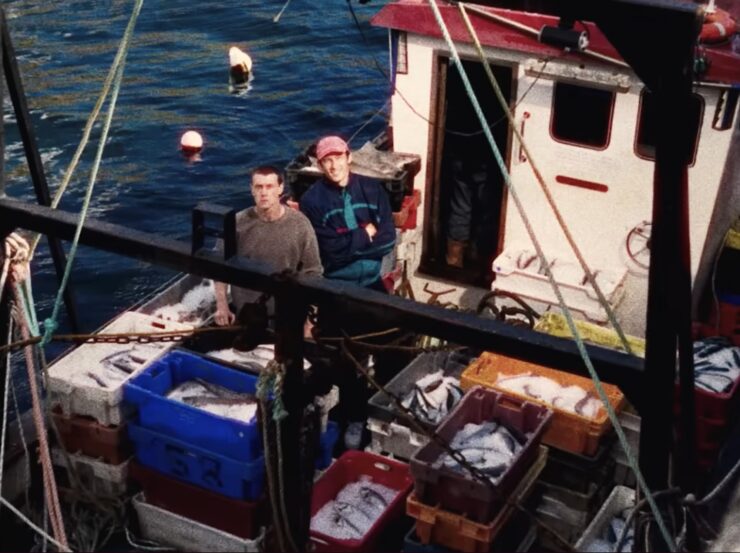
But over a maiden voyage the two learn how to cast and haul the net, how to sort and gut fish, how to tolerate the constant crying of the gulls, how to fling fish innards up and away for the birds. By the time they get back, they’re good at the gig.
But the bustling harbor and thriving village they sail into is nothing like the one they left.
Where a lot of time loop stories spend their screentime on working out the mechanics (or, as in Looper, agreeing that working out the mechanics is a fool’s errand), trying to find past loved ones, trying to figure out how to break the cycle, creating Quantum Leap-style gags about famous historical moments, Rose of Nevada isn’t exactly about its time loop. It’s much more about the idea of a community that was ravaged by tragedy, and then abandoned as the modern world trundled along without it. The village in the early ’90s is the place to be—the pub is hopping, young people are flirting, the grocery store is well-stocked, there’s great music on the radio.
But it’s all being fueled by grueling manual labor. Men spend most of their time out to sea under the sun, wrestling with slippery, reeking fish, slimy knives, crushing winches, clanking chains, endless waves. Even a good trip is dangerous, and you never get to stay home long. Back home, women and elderly people are left to do all the community building, all the teaching and childcare, and also have to be able to welcome the men back into their lives with no friction, and also have to be able to bear it if the men don’t come home.
The success of the village depends on the young men putting themselves at risk. The community feeds on their lives.
But also: the community works together for the greater good. In one vital scene, we see the men of the village gathered on the dock to knit fishing nets together. There’s no chatter, just shared work. Everyone does their part to make sure there’s a good haul, to feed that haul back into the life of the town. Liam joins in; Nick does not.
Because the way that this movie is a horror story is that a time loop that feeds on peoples’ labor doesn’t care about the individual people. It’s a true loop—we are trapped in the endless cycle of hard work and fish guts with Liam and Nick. There is no fun bank robbery, no sexy destination wedding, no meditation on Buddhism and/or Purgatory. There is work, and there is sleep, and there is no escape.
How long has the loop existed? How many times has this happened? Is everyone we meet even still alive? Has some horrific combination of necessity and fate conjured some of these characters?
Credit: 1-2 Special
The film takes all of this seriously. There’s no winking here, beyond a moment that could read as the tiniest reference to the incest fears in Back to the Future—but the film takes that in a different direction that serves the story, and it certainly doesn’t play it for laughs. It ends up adding the idea that life in this village is an unending cycle of life feeding on life. And while the film largely avoids blaring pop culture references, the camera does linger on a television ad about fighting global warming. “It’s not too late yet!” the ad chirps from 1993, as we watch from 2026, and know that nothing was done, it is too late, and the old have devoured the futures of the young.
Mark Jenkin’s previous films are Bait, a realistic drama about the fishing industry, tourism, and gentrification with a very light supernatural element, and Enys Men, a folk horror about a wildlife researcher on a remote island that takes a harder turn for the speculative. I’ll admit that I haven’t seen them yet, but they’ve shot up my list since seeing Rose of Nevada. (Rose of Nevada could be seen as the third in a loose Cornwall Trilogy.) Jenkin is from Cornwall, and has used his work to explore the culture of his home. He often works with his partner, Mary Woodvine, who played the lead in Enys Men and has a pivotal role here. He also shoots on a 16mm Bolex, in the short bursts that camera allows, records dialogue separately, and lays the dialogue, sound effects, and soundtrack over the film in the edit. This results in a film that feels different on the eye than a typical digitally shot movie—kind of like a grittier version of a 1930s and ‘40s Jack Cardiff-shot Technicolor, if that makes sense? (It’s gorgeous, but it genuinely makes me queasy. But clearly I don’t care, given that I’ve watched the film in theaters twice now.) And thanks to Jenkin’s recording style, the sound always feels off in a way that adds to the sense of being unstuck in time. The movie becomes an uncanny experience rather than something to simply watch.
The performances are perfect. Nick is a taciturn young man, but George MacKay puts everything he’s thinking into his eyes—they’re hard to look at by the end. Callum Turner meanwhile uses his body language to bring Liam to life. No matter what he’s actually doing, the man always seems like he’s leaning in a doorway, not committing either way, an inviting grin on his face and eyes that are calculating his next bad decision. Francis Magee is by turns hilarious and frightening as Murgey—what starts off as a slightly ironic performance as a salty old seafarer soon becomes a loop of its own. And all the supporting cast are excellent—both the versions in the present day and those back in the ‘90s. The film only works if all the characters feel like their younger selves, and the cast rises to every occasion.
In the end the film feels to me like it’s lamenting a lost past and shouting a curses at it at the same time. The hard work was exhausting, but also honorable; if the wider world had cared for these workers the village wouldn’t need to feed on its past. In the opening we see Nick collect food for his family from a food co-op—if the larger society cared for the small villages, he wouldn’t need to use that co-op, right? But at the same time, the community provides the food, in the same way that the community came together to mend nets 30 years ago.
But that wasn’t some idyllic past—we see that even 30 years ago the young men of the town lost themselves in booze and Ecstasy when they weren’t at sea. At one point a character asks if the man who owns the Rose of Nevada is going to crew it himself, and his reply is sharp and absolute: “I’m a businessman, not a fisherman.” The town holds to its rigid roles, and anyone unlucky enough to be born poor has to risk their safety on a boat. Jenkin wrote this movie during the COVID lockdown, and he spoke in an interview about watching his community come together; he saw people caring for each other at a time when the larger government and political leaders were worse than useless. But he watched the community come together through his windows, as he and his partner were locked down in their home like almost everyone else. Somehow I think this film has captured that feeling better than almost anything else I’ve seen. Rose of Nevada shows the joy of people caring for each other, but also the ultimate terror and isolation of relying on uncaring nature for your livelihood. The terrifying trap of being forced to give up your own needs and desires, in order to meet the demands of the larger community. It also shows the extent to which people will perform the roles that are expected of them until their lives are deep grooves whose meanings they can’t even remember.
The village that suffered such terrible loss may have healed itself by the end of the film—maybe, the film remains mysterious up to the end. But if healing is only possible by sacrificing the innocent and the vulnerable, while other people in other social classes reap the benefits, can it ever be worth it?[end-mark]
The post You Got Your Time Loop in My Ghost Ship: <em>Rose of Nevada</em> appeared first on Reactor.








 New Posts (Home)
 ChatBox
 Popular Posts
  Game Zone
 Top PodCasts