reactormag.com
The Lapineid: Richard Adams’ Watership Down
Books
The Lapineid: Richard Adams’ Watership Down
What started as simple children’s stories, transformed into a full-on epic
By Judith Tarr
|
Published on June 29, 2026
Comment
0
Share New
Share
Watership Down is one of the reasons why the SFF Bestiary exists. When the editors first asked me to expand the Horseblog to include all species of animal, that was the first example they gave.
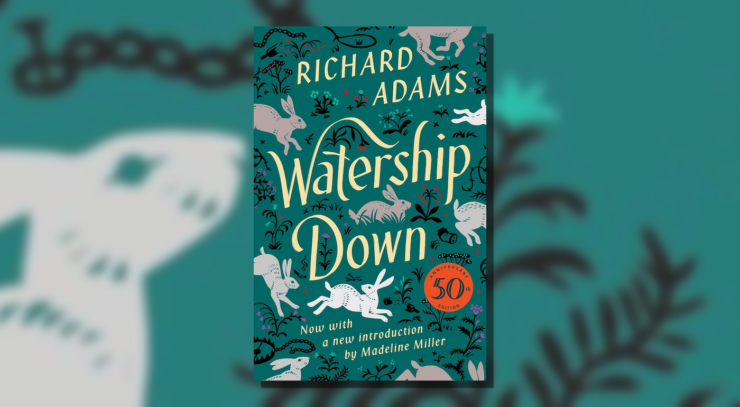
It’s taken a while, but finally I’m ready for a book that didn’t define my childhood, but it did come along at a key point in my life. By rather wonderful coincidence, the new Puffin edition includes an introduction by Madeline Miller. She begins with the story of how she first met the novel: at the age of twelve on a long car ride (which is a parallel for how the book first came to be, as stories told to Richard Adams’ daughters on long car rides). That ride, and that book, had a profound effect on the rest of her life.
I was rather older than twelve when I packed my bags for a flight across the Atlantic, all by myself, to begin a graduate degree at Cambridge in England. Ebooks did not exist then. A thick paperback, almost too thick to support its spine, was an efficient use of what space and carrying capacity I had.
I don’t remember what else I took to read. I’m a fast reader; I had at least a couple of books to tide me over till I could settle into my student lodgings with the boxes of books I’d shipped over. But that one I haven’t forgotten.
Other works had shaped my childhood and early adulthood. I wasn’t moved to reread Watership Down once I’d finished it. Maybe I was too old for Miller’s experience. I think I was too young and too distracted by all the new experiences to appreciate it fully.
Certain pundits say an ebook is a sterile experience. It affects different parts of the brain. You don’t get the smell and texture of the paper or the physical effort of holding the book, especially a book that stretches the limits of its binding. But there are other compensations: the ability to expand or contract the text to fit one’s personal preferences, the ease of highlighting passages and finding them in a global search.
The words are still there. The world they evoke. The characters who live in it.
I didn’t get, then, just how much Richard Adams achieved in transforming the stories he told his daughters into a full-on epic. Children’s literature is full of such works, and some of them have become classics. We’ve seen examples already in Bambi and The Wind in the Willows—the latter for sure is an inspiration for Adams’ epic. He quotes it in an epigraph to one of his chapters, and certain plot elements echo the adventures of the Mole and the Water-Rat.
Talking-animal stories tend to go in one of two directions. Either they’re humans in animal suits, wearing clothes and living in houses and driving motor-cars, or they’re still animals but with human levels of intelligence, doing things that humans can relate to. We’ve seen how The Lion King depicts a human style of nuclear family and human myths of the lion as the king of beasts. Then there’s Narnia, which draws a clear line between regular animals who can’t talk, and Talking Animals.
Richard Adams sets out deliberately to write about real rabbits, rabbits as they exist in our world. He cites one particular authority, Ronald Lockley, and his 1964 study, The Private Life of the Rabbit. He follows it scrupulously and refers to it often.
But that’s just the beginning of the work Adams put into creating this world and these characters. These are rabbits, no question. They live in warrens, the does dig and the bucks not so much, there’s no such thing as romantic love, a doe under stress will eat her young, memories tend to be short, and rabbits are prone to a form of panicked paralysis for which Adams invents a word, tharn.
At the same time, the story is a classical epic. It’s not so much the more familiar Homeric Iliad and Odyssey as Virgil’s Aeneid. A thoughtful and often doubt-ridden protagonist, guided by prophecy, rescues a small group of his fellows from a falling city. He’s not the biggest or the strongest or the bravest or the smartest or the most imaginative person in the group, but he has a gift for making connections. In corporate-speak, he’s a facilitator. He brings people together.
Hazel and his friends and allies and antagonists are archetypes to an extent. Hazel is the leader of the group, the one who gathers all the information and coordinates the different viewpoints and makes the call as to what to do. Bigwig is the conventional hero, the big, bold fighter who hits first and worries later. Fiver is the prophet, the one who lives in multiple worlds, whose utterances are sometimes incomprehensible but always right. There’s Blackberry the imaginative thinker and Dandelion the teller of stories, Holly the enforcer turned advisor and Blackavar who comes through trauma to wisdom. They and the rest of the crew are individuals, but they’re at their best when they work together.
Hazel’s gift for collaboration extends outside of his own species. His most notable alliance, is the one with the displaced seagull, Kehaar. Kehaar is the expedition’s air force, and it’s thanks to him that they find their ultimate home and are able to to defend it against a powerful enemy.
That enemy is a cautionary tale. General Woundwort is everything Hazel is not. He’s huge; he’s physically strong. He’s a literal strongman, an authoritarian leader, a dictator. He’s a brilliant tactician with a keen military mind and a great deal of charisma. His warren/fortress/city is under his rigid control.
Woundwort’s totalitarian state is failing by the time Hazel and his companions come across it. It’s drastically overpopulated, and that population is under serious stress, but Woundwort won’t allow anyone to leave. When Hazel and his fellows manage to lure a group of does away to help populate their own newly formed warren, Woundwort mounts an invasion to take the does back and either kill the bucks or force them to join his own warren.
Hazel tries to meet force with diplomacy. He proposes that Woundwort allow the does to stay where they are, and that a new warren be founded between the two and populated with rabbits from each side. But Woundwort isn’t capable of thinking on that level. He has to control everything, no matter the consequences.
Woundwort is not a normal rabbit. Nor is Hazel, but Hazel is by far the more functional of the two. Woundwort is a sociopath. Hazel is an inspired leader, who thinks of others first, and most of what he does is for the good of the warren.
There’s a lesson here, of course, but it’s told in such loving detail that it goes down nicely. There’s lots of headlong adventure and nailbiting suspense, but all around and through it are woven a series of stories, lessons and parables in the form of folk tales about the trickster-hero El-ahrairah and his clever sidekick, Rabscuttle. The world they live in is the world of myth and legend, ruled over Frith, the sun, and haunted by the spirit of Death in the form of the Black Rabbit of Inlé.
El-ahrairah’s stories shine a light on what’s happening in the main narrative, and offer guidance to the characters. Toward the end we see another facet. We’re shown how history becomes legend; how the events we’ve seen, the adventures of Hazel and Bigwig and the rest, are attributed to El-ahrairah. Just as the trickster-hero loses his ears and gains a new set made partly of starlight, Hazel’s story takes on the sheen of myth.
Past me at the beginning of my own adventure into another country didn’t see all of this. Present me can see so much more, and understand it so much better. I’m glad I found my way back to it. It was well worth the wait.[end-mark]
The post The Lapineid: Richard Adams’ <i>Watership Down</i> appeared first on Reactor.








 New Posts (Home)
 ChatBox
 Popular Posts
  Game Zone
 Top PodCasts