www.dailywire.com
SCOTUS Hands Down Ruling On Trump’s Move To Fire Fed Governor
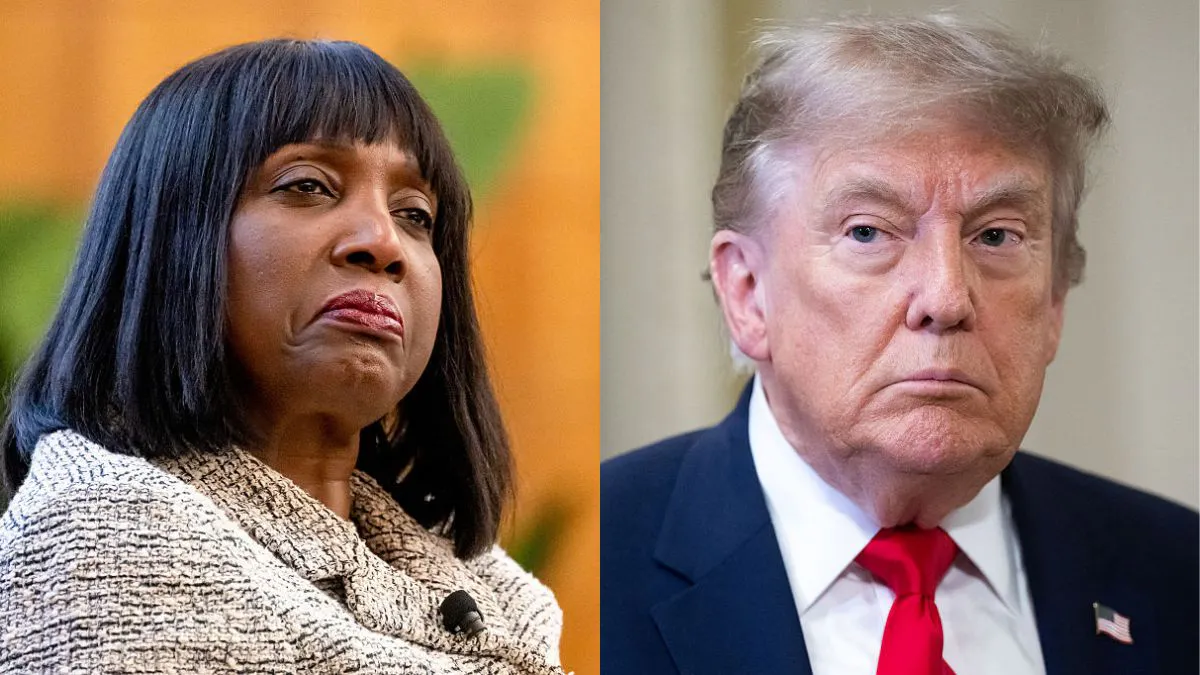
The U.S. Supreme Court on Monday ruled President Donald Trump cannot fire Federal Reserve Governor Lisa Cook over mortgage fraud allegations.
In a 5-4 ruling authored by Chief Justice John Roberts, the court blocked the president from removing Cook, dealing a defeat to the White House, which has consistently criticized the Fed over its handling of interest rates.
Conservative Justice Brett Kavanaugh joined Chief Justice Roberts and the three liberal justices in arguing that Congress properly limited the president’s ability to remove Federal Reserve Board governors.
“Any change in that scheme must come from Congress, not the courts. That is why we cannot accept the government’s contentions in this case,” Roberts wrote for the majority. “To do so would allow the president to remove a member of the Federal Reserve at any time, for any reason, without any notice before, and without any judicial check after.”
“That would turn for-cause protection into little more than at-will employment,” he added.
The decision draws a line in the sand on the extent of Trump’s executive power. On its emergency docket, the justices have previously allowed the administration to remove members of the National Labor Relations Board, the Consumer Product Safety Commission, and the Merit Systems Protection Board. In another ruling on Monday, the conservative majority overturned a decades-old legal precedent, allowing the president to fire the heads of other independent agencies.
Cook was appointed to the board of governors by President Joe Biden and is slated to stay on the board until 2038. She previously worked on the Council of Economic Advisers under President Barack Obama and at Harvard University’s Kennedy School of Government.
Under the Federal Reserve Act, the president may remove a governor only “for cause,” a term the law, until now, did not define, according to SCOTUSblog.
“To be clear, the ultimate question of whether the president can remove Cook for cause will depend in part on the underlying facts,” Roberts wrote. “In this opinion, we have not addressed the facts, as they have yet to be found or analyzed under the relevant legal standards.”
Justices Clarence Thomas, Samuel Alito, Neil Gorsuch, and Amy Coney Barrett all wrote separate dissenting opinions.
“Today’s decision is an unprecedented incursion on the Executive Branch,” Justice Thomas wrote in a scathing dissent. “Neither the parties nor the Court can point to a single time in American history that this Court has upheld an injunction against the President’s removal of an executive officer.”
In August 2025, Trump told Cook that she had been terminated, citing allegations of mortgage fraud, The Daily Wire previously reported.
“Pursuant to my authority under Article II of the Constitution of the United States and the Federal Reserve Act of 1913, as amended, you are hereby removed from your position on the Board of Governors of the Federal Reserve, effective immediately,” Trump wrote to Cook in a letter.
“The Federal Reserve Act provides that you may be removed, at my discretion, for cause,” he wrote. “I have determined that there is sufficient cause to remove you from your position.”
Trump cited allegations by Federal Housing Finance Agency Director Bill Pulte, who accused Cook of claiming two separate properties as her primary address within weeks of purchasing each with financing.
“President Trump purported to fire me ‘for cause’ when no cause exists under the law, and he has no authority to do so,” Cook said in a statement responding to Trump’s letter. “I will not resign. I will continue to carry out my duties to help the American economy as I have been doing since 2022.”
Legal challenges quickly followed, prompting the Supreme Court to take up the dispute. During oral arguments, justices across the ideological spectrum expressed concerns about the Board’s independence and questioned whether Cook had been afforded due process.
“Your position,” Kavanaugh told U.S. Solicitor General D. John Sauer, “that there’s no judicial review, no process required, no remedy available, very low bar for cause that the president alone determines — I mean, that would weaken, if not shatter, the independence of the Federal Reserve.”








 New Posts (Home)
 ChatBox
 Popular Posts
  Game Zone
 Top PodCasts