reactormag.com
Camp Is an Enchanting Tale of Grief and Magic
Movies & TV
movie reviews
Camp Is an Enchanting Tale of Grief and Magic
There is still true magic to be found in independent film.
By Leah Schnelbach
|
Published on June 29, 2026
Credit: Dark Sky Films
Comment
0
Share New
Share
Credit: Dark Sky Films
Camp shows us just how important tone is in film. In only her sophomore feature, writer/director Avalon Fast has created a movie that feels like stumbling into a fairy ring.
The plot of Camp is whisper thin: by the end of her first year in college, Emily (Zola Grimmer) has gone through two separate tragedies. She isn’t exactly to blame for either of them, but her actions did cause them. She is wracked with grief and blames herself. How do you keep getting up every morning when you’ve lost the person who was your whole life? Her father (who is great) suggests a summer camp up north—it’s designed to help “troubled” kids, and they recruit counselors who have dark things in their pasts specifically to help them. Once Emily gets to camp, she finds a knot of girls who welcome her into an obsessive love that sometimes threatens to hurt her as much as heal her.
And, of course, there’s magic.
Camp is a beautiful film—and I mean that literally. In a time when films with even a splash of color are lauded, Camp positively glows. It benefits from the natural light and vibrant greens of the forest, but at night it embraces full matte painted and animated glory, with impossibly starry skies and Technicolor sunsets. And director Avalon Fast does this in really interesting ways: In one pivotal interior scene, the sky outside bursts with shooting stars until it almost seems like the room is spinning. Animation is used to punctuate moments of magic or dream logic, blurring the line between realism and surrealism.
Credit: Dark Sky Films
Even the most mundane moments can slide into liminality. Emily travels to Camp (it’s just called “Camp”) on a train that looks like it clacked in from a different century. She researches Camp on her laptop, then pauses to answer an incoming call on the rotary phone in her sleeper car—a sleeper car that looks more like a small hotel room than the kind of pod you’d book on Amtrak. She falls asleep and wakes in a field, fully dressed, luggage neatly stacked next to her, the entrance to Camp a few yards down a grassy path. The entrance being tall wooden poles holding a sign with “CAMP” carved into it. That’s it—no fences, no parking lot, no security gate.
I’m guessing you have to walk between those poles to get in, though.
Fast gently pokes holes in her film’s setting. The script hits a couple typical “camp” tropes: the counselors wear absurd ‘70s style shirts, the Jesus-y one leads everyone in singalongs whether they like it or not, the kids are treated as a nuisance, everyone trudges through the day until their charges’ bedtime, when the counselors drink and dance around bonfires with hedonistic abandon. But time dilates and contracts in weird ways. The kids are barely in the movie. The counselors seems to have way more time to party than they possibly could. Most of them never get hungover, no matter what they do. Booze and drugs are always, inexplicably, available, even though Camp seems to be on an endless plateau surrounded by mountains and forests.
Credit: Dark Sky Films
But I think my favorite choice here is that Camp sometimes hints toward things that would be huge plot points in a more typical coming-of-age film, cliches about bad boys, summer romances, kids causing trouble or being in real danger, and then ignores those well-worn paths to go in other directions entirely. But again, this isn’t a spoof or a send-up. It’s more that it gestures toward the shape we all know this story should take, and then introduces a different shape. It’s in conversation with David Lynch and Jane Schoenbrun and a certain strain of ‘90s culture, without ever going for cheap nostalgia.
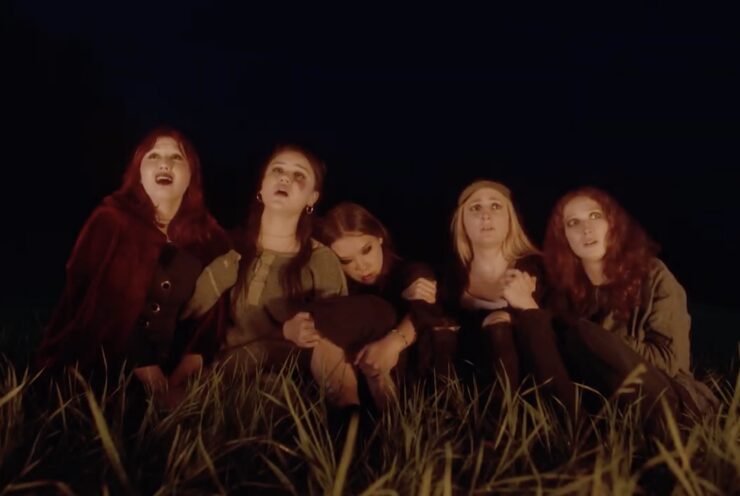
When Emily arrives at Camp, she meets Dan (Austyn Van de Kamp) and Jo (Sophie Bawks-Smith), the de facto leader of Camp and its Guidance Counselor, respectively, both friendly and helpful, and both maybe a little too eager to bring up the Lord. Luckily, Emily also meets her roommate, Rosie (Cherry Moore) a wild girl who is also friendly, but more in the way that she hopes she’s found a new ally in “getting sloppy drunk” after the campers are asleep. She introduces Emily to the rest of the group: Clara (Alice Wordsworth) who reveals herself to be the leader, Nev (Lea Rose Sebastianis), who is performing the role of “the slutty one” with maybe a little too much desperation, and the ironically named Hope (Ella Reece), whose quiet demeanor hides a deep sense of despair. The women all know each other from previous summers—and before that, at least a few of them were the “troubled kids” sent here to heal.
Credit: Dark Sky Films
As ever, I don’t want to get too into details that will spoil the experience. So let me just say that yes, of course, once the four become five, witchy shit begins to occur. But it’s very slow burn witchy shit, and while the witchy shit is important, it’s the slow burn part that’s key. This is much more a story of female friendship, specifically the type of female friendship where people become devoted to each other almost overnight, and then have to learn how to actually be friends. When do you support your bestie, and when do you tell her to get her shit together? When do you confess your darkest fears, or your deepest regrets—and what happens when you do?
Camp understands that sometimes friendship means following the whispering voice into the forest because the other four girls are going to take you somewhere you need to go, even if it’s terrifying. Sometimes these friendships are destructive, but they can nurture you, too.
This is a truly special film, and I hope goth kids are watching it at sleepovers for years to come.[end-mark]
The post <em>Camp</em> Is an Enchanting Tale of Grief and Magic appeared first on Reactor.








 New Posts (Home)
 ChatBox
 Popular Posts
  Game Zone
 Top PodCasts