reactormag.com
Irrational in a Way That Makes Complete Sense: Daniel Kahneman’s Thinking, Fast and Slow
Books
Seeds of Story
Irrational in a Way That Makes Complete Sense: Daniel Kahneman’s Thinking, Fast and Slow
Wouldn’t it be great if everyone had a little more literacy about the capabilities and compromises of their own minds?
By Ruthanna Emrys
|
Published on June 30, 2026
Comment
0
Share New
Share
Welcome to Seeds of Story, where I explore the non-fiction that inspires—or should inspire—speculative fiction. Every couple weeks, we’ll dive into a book, article, or other source of ideas that are sparking current stories, or that have untapped potential to do so. Each article will include an overview of the source(s), a review of its readability and plausibility, and highlights of the best two or three “seeds” found there.
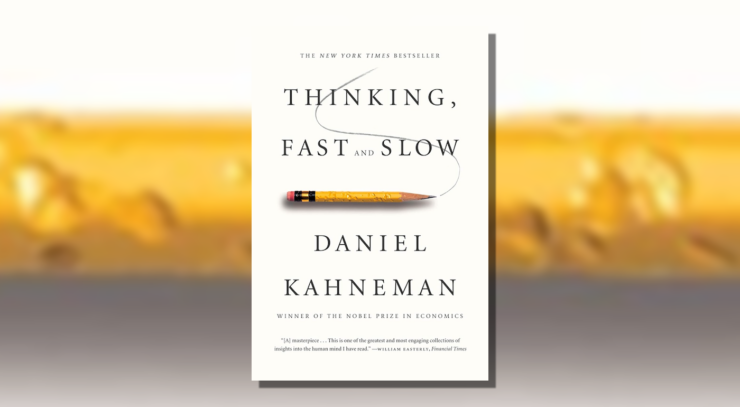
This week, I cover Daniel Kahneman’s Thinking, Fast and Slow. Kahneman founded my area of cognitive psychology research, developing the whole concept of cognitive bias and heuristics. That area then expanded into a laundry list of ways the human mind screws up. Here, he pulls the whole thing back together, attempting to replace isolated phenomena with a shared underlying explanation. I feel extremely nerdy about it, and you should too.
What It’s About
This is the thickest, most academic book I’ve ever seen in an airport bookstore. The reason it was there is, Kahneman won a Nobel Prize in economics. The reason he won it in economics is that they don’t have one in psychology. So every once in a while, someone does excellent psych work that uses financial stimuli (because they’re easy to quantify), and applies them to pulling yet another brick from the façade of Homo economicus, and business people get excited and want to read about it. (And then they ignore what they’ve learned, because real human behavior is squirmy and complicated.)
Kahneman’s classic work is on systematic errors of thinking, and the important—even valuable—aspects of thinking that lead to those errors. This is often glossed as “humans are irrational.” It might be better explained as “real-world outcomes matter more than logic problems.” Our minds optimize for non-optimal situations. Usually, you need to make decisions in limited time and with limited, uncertain information. Real-world rationality, therefore, involves satisficing—making a decision that is good enough to scrape by, with the resources you actually have. You develop heuristic shortcuts to achieve this, all of which can lead to systematic error under atypical circumstances.
You can find a lot of atypical circumstances in a psych lab. You can find a lot of circumstances that are “atypical” for the span of human evolution, but which have become increasingly common over the past century.
My favorite example: when information-gathering is limited to your own direct experience, and reports from people who live around you, it makes sense to judge how likely an event is by how often you hear about it. Lots of tasty berries up on that crag? You’ll see them yourself, and your friends will talk about them around the campfire. Are bears sometimes going after those same berries? Someone will tell you. This is the availability heuristic, which estimates rough probabilities based on instances in your memory. But it doesn’t work so well when not only are you getting reports from around an extremely variable world, but news and social media tend to emphasize the most exciting reports regardless of accuracy. People’s estimates of their own safety are more related to how much time they spend immersed in the news than on the truths of their own neighborhoods.
Heuristics, therefore, lead inevitably to cognitive bias. Some, like availability, become all-too-common in modern life. Others, like the Linda Problem, show up mostly with specific phrasing of trick questions—but still tell us something important about how thinking works.
From Kahneman’s initial handful of heuristics, researchers have expanded to a long and occasionally trivial list of errors. They vary from near-universal to deeply culture-bound. (Robin Wall Kimmerer, for example, does not suffer in any way from “plant blindness.”) My professional opinion is that cognitive psychologists have a bias-identification bias, because you get more publications by naming a new one.
In Thinking, Fast and Slow, Kahneman alarmed everyone in the field by saying that he no longer thought focusing on individual biases was the best approach. What matters is that they’re systematic—so what are the cognitive systems involved?
System 1 is the baseline: quick and dirty and ready to satisfice. Much of it is non-conscious, with the advantages of speed and automaticity. It’s the realm of instinct and learned patterns, of well-honed expertise and intuition. System 2 is slower, but with the advantages that consciousness provides. It allows careful consideration, holding off to collect more information, and second-guessing your reflexive responses. It’s also prone to errors of its own: for example, the choice paralysis that comes with having too many options and too much uncertainty. Neither one is inherently better. At any given point, you’re in tension between slow, effortful opportunities to process the uniqueness of a problem, and easy, quick opportunities to act fast and hope the odds are in your favor. And System 1 has a lot more capacity than System 2—those conscious resources have to be spent carefully.
These systems, Kahneman warns, are a heuristic themselves—a way of thinking about two different types of thinking rather than a claim about brain areas. It’s also important to remember that they work in tandem: that System 2 can check the least helpful impulses of System 1, while System 1 minimizes the System 2 workload.
Buy the Book
Thinking, Fast and Slow
Daniel Kahneman
Buy Book
Thinking, Fast and Slow
Daniel Kahneman
Buy this book from:
AmazonBarnes and NobleiBooksIndieBoundTarget
I love this book, and am biased by how tightly it’s integrated into stuff I already know. I’ve been reading Kahneman’s stuff and running related studies since college. Often when I talk to people who aren’t immersed in heuristic research, they find it alarming—what do you mean, I can’t avoid making mistakes? What do you mean, most of my decisions will always have to be non-conscious? The differences between reality and people’s intuitions about their own minds quickly get into existential territory.
This comes up most frustratingly when people are arguing about how they remember some event. Many people take the suggestion that they’ve misremembered or misjudged something as an insult, whereas I’m more likely to go, “Ooh, confirmation bias!” This is not always a useful relationship skill, but then, neither is yelling “I told you last week!” as if you can logic someone into eidetic memory.
Researchers in this area are divided between those who frame everything in terms of error and irrationality, and those who frame everything in terms of adaptations that sometimes go awry. I fall into the latter camp—I find Kahneman’s results reassuring in that they explain why we make mistakes. It’s not simply a matter of humans being flawed (sort of a scientific take on original sin, IMO), but of handling a complex world that doesn’t present itself in the form of logic puzzles. My non-conscious cognitive processes are a part of me, shaped by the experiences and ideas that I’ve spent 50 years feeding into the compost pile, and they’re doing my best. I trust that part of my mind, and question it on a regular basis, because my System 2 processes are also me.
Kahneman presents his results as a better way to talk about our decisions—in offices, with friends and family, trying to interpret the firehose of information and disinformation that is modern life. He would like everyone to have a little more literacy about the capabilities and compromises of their own minds, which I also think is a great idea. We would all do well to have an “Ooh, confirmation bias!” reflex, especially these days when AI “search” offers an automatic yes-man for unexamined assumptions.
If I have one complaint, it’s that Kahneman’s early skill with finding memorable names for mental phenomena doesn’t continue here. Having studied this stuff all my life, I still had to double-check which one is System 1, and which System 2, before writing this blog post. You have my permission to call them the Compost Bin and the Gardening Gloves, or the Kirk and the Spock, or whatever labels make it easier to think about your thinking.
The Best Seeds for Speculative Stories
Ace Detectives and Evil Geniuses. Kahneman is particularly fond of adversarial collaborations—a method where disagreeing researchers co-design a study to test competing hypotheses. One of his, with Gary Klein, is on the circumstances that give rise to “intuitive expertise”—that is, the type of swift, accurate judgement that makes for exciting protagonists. Science fiction is full of clever scientists, navigators, mathematicians, etc., whose intuition feels (and sometimes is) nearly magical, perfect for overcoming cosmic-scale problems and infodumping about it. Klein and Kahneman found that this kind of intuition is possible only when given two conditions: a regular, predictable environment; and the opportunity to learn those regularities through practice and feedback. These regularities feed into System 1, allowing the development of fast, accurate heuristics in fields like chess, firefighting, and diagnostic medicine. Areas that lack regularity or effective feedback—stock picking and political punditry, to name two—result in “experts” who have high confidence based on inaccurate intuitions. They also result in failures by lay folk using the intuition that confidence implies accuracy.
So when creating fictional experts, we should think about how they’ve encountered the necessary conditions. Foundation, for example, posits regularities in political development that, so far as modern researchers can tell, don’t exist. But it does posit them, and that worldbuilding makes the resulting expertise possible.
About Those Adversaries… If you’re looking to add conflict to a core scientific speculation, why not have your researchers work like Klein and Kahneman—perhaps with some juicy arguments and a handful of enemies-to-lovers thrown in? For that matter, cognitive biases are a great way to think about how smart characters can make mistakes without holding an idiot ball, and how you could have two brilliant minds in understandable-yet-violent disagreement.
New Growth: What Else to Read
I am extremely picky about lay cognitive psychology books, and not going to recommend Nudge (much of which doesn’t turn out to replicate) or Blink (more dramatic than accurate in describing some research). I will happily recommend Kahneman’s Noise: A Flaw in Human Judgment, and Michael Lewis’ The Undoing Project: A Friendship That Changed Our Minds, about Kahneman’s fruitful relationship with Amos Tversky. Hugo Mercier and Dan Sperber’s The Enigma of Reason frames cognition as something we do socially rather than individually—a thought-provoking way of looking at rationality. And I’ve had my eye on Pascal Boyer’s Minds Make Societies: How Cognition Explains the World Humans Create.
Alexandra Horowitz’s On Looking: A Walker’s Guide to the Art of Observation is an excellent illustration of how expert intuition works, and how it opens (and closes) our perceptions of the world.
Lois McMaster Bujold’s Memory remains one of my favorite pieces of cognitive science fiction, all about smart people’s intuitions leading them into error; unfortunately, it’s a terrible place to start so you’ll just have to read the whole, excellent Vorkosigan series. Rosemary Kirstein’s The Steerswoman features a main character whose job involves testing her own assumptions—using the scientific method in a world with wizards. Marie Brennan’s A Natural History of Dragons is another terrific depiction of someone developing expertise in a fictional field.
What are your favorite stories about human error? Share in the comments![end-mark]
The post Irrational in a Way That Makes Complete Sense: Daniel Kahneman’s <i>Thinking, Fast and Slow</i> appeared first on Reactor.








 New Posts (Home)
 ChatBox
 Popular Posts
  Game Zone
 Top PodCasts