reactormag.com
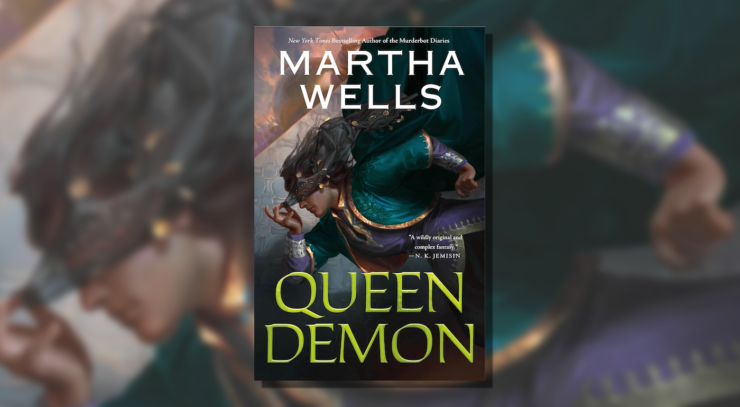
Martha Wells Book Club: Queen Demon
Books
Martha Wells Book Club
Martha Wells Book Club: Queen Demon
As Wells’ epic continues, good people are forced to do terrible things…
By Alex Brown
|
Published on June 30, 2026
Comment
0
Share New
Share
I have had Queen Demon on my desk ever since I received my advanced reader copy in summer 2025. You have no idea how hard it has been to resist reading it until now. I wanted it to be fresh for this column rather than a reread, but oh my god the anticipation has stressed me out! Now that I’ve finished, I’m even more stressed! I need the next book in this series like a dustwitch needs dust.
Queen Demon starts, in both the past and present timelines, not long after where each left off in Witch King. In the present, Kai, Ziede, and Tahren have foiled Bashat’s attempt to crown himself emperor of the Rising World. In the past, they’re plotting their next move against the Hierarchs. Let’s start in the past. Most of this portion of the book is the ramp up to and the actual confrontation with the Hierarchs and their legionaries in the port city of Descar-arik. Bashasa leads a caravan of soldiers and civilian hangers-on toward the city while other groups of rebels lead distractions and revolts elsewhere in the Hierarchs’ conquered territory. As we’ve seen in Witch King, the Hierarchs aren’t the only people who want power. A woman who declared herself the Doyen of a group of Witches with the ability to manipulate dust and brainwashed them into doing her bidding is terrorizing humans. She is a mini Hierarch lording over her Witches, and things go poorly for her once she makes a play for Kai. The remaining dustwitches join him in launching an assault on the Hierarch, demons, and legionaries holed up at Descar-arik. Good people are forced to do terrible things and to use stolen power in cruel ways in order to stop the greater threat.
Moving to the present, Dahin and another Immortal Blessed, Ilhanrun Highsun, have located what they think may be a Hierarchs’ Well. We saw the Well first hand in Witch King when it was used to eradicate the Saredi. The Blessed also have one, the Well of Thosaren, but where theirs is created with life, the Hierarchs created theirs with death. A lot of death. They fed the Well with thousands of people. That amount of power won’t fade away anytime soon. The fear is that surviving conquerors who escaped retribution by fleeing back home after Bashasa’s victory have already or will use the Well to create a new Hierarch and launch a new attack on the Rising World. Eventually the whole crew gets down to Sun-Ar, but it turns out it’s not the Hierarchs they need to worry about. The book ends on a whisper of hope in the past and a shocking moment in the present.
Much like my obsession with Moon and Chime in Wells’ Books of the Raksura, every time Kai and Bashasa are together, the one thought running through my mind is, “JUST KISS ALREADY!” I am lost for these two. They are so sweet together. Watching Bashasa get all flustered around Kai and Kai constantly not noticing or not understanding why. Ugh! I love them so much it makes my heart grow three sizes. I feel much the same for Tahren and Ziede, although at least Kai has enough sense to pick up on their attraction. A quartet of emotionally constipated dorks, aka one of my favorite romance tropes.
I find the contrast between Dahin and Highsun and between Kai and other demons really interesting. Kai suspects the Doyen may have some demonic ancestry that gives her the ability to psychically control mortals. That plus the demons he freed from the Cageling Courts only to have them turn around and willingly fight for the Hierarchs says a lot of not good things about his kin. They treat mortals as expendable in ways not dissimilar to the Blessed and the Hierarchs. We see this complexity play out in the conflict between Kai and Arnsterath. After the destruction of the Summer Halls, she attacks Kai for the crime of taking a body that wasn’t a pre-approved Saredi body, and an expositor, no less. Then she does the exact same thing. Kai uses his power to help people, at great cost to himself—he literally has to harm himself to draw on his magic instead of going the easier but more dangerous route of tapping into the Well—while Arnsterath uses her power to help herself, often at great cost to others. Arnsterath is the polar opposite of Kai. She sought to take back what control she lost when the Hierarchs decimated the Saredi, but that control is mostly personal. She wants power so that she no longer feels powerless, and she’ll take power away from others if she has to. I wouldn’t argue that she wants power for power’s sake though, at least not by the time she and Kai reunite. She has the opportunity to try and take the Well for herself, and it never seems to occur to her.
With Dahin and Highsun, both think of themselves with the same sense of entitlement all Blessed do (except Tahren). Of course it has to be Dahin who finds the Well. Of course his plan is the best plan. Of course he can treat mortals, some of whom are friends, like pawns on a chess board. Highsun is much the same way. Of course it has to be Highsun who finds the Well. Of course his plan is the best plan. Of course he can treat mortals, some of whom are friends, like pawns on a chess board. They each want different things with the Hierarchs’ Well, but they use the same tactics to get there. If Dahin stopped acting like a Blessed for five minutes (or if he had spent any of the last six decades learning from his sister instead of antagonizing her) things probably would’ve turned out much differently and with fewer deaths.
Wells digs into power and its consequences in so many ways. I appreciated what Liz Bourke said in her Locus review of Queen Demon: “Yet her argument is not, unlike many epic fantasies, that evil is a force that is extrinsic to people, a corruption that arises separate from their choices. The destructive selfishness that makes other people pay the price for your power, that produces an ideology of supremacy and enacts it in violence, is not a single choice but a whole series of choices, personal choices but also social choices of what to build and what to tear down, what to support, and when.” Everyone makes choices—from those who have power to those who do not, from those who want power to those who reject it, from those who make their power by taking from others to those who find power within themselves and through community action. Bashasa offers everyone the chance to join in the fight, to stay in the camp in the civilian attachment, to leave as refugees to one of their safe camps, or to go off on their own. Kai repeatedly offers Sanja and Tenes the opportunity to choose whether to stay with them, go to Avagantrum where Ziede’s daughter Tanis will protect them, to stay with the Cloister Witches, or go off on their own. Tenes has the most reason to want to leave (so she can try to find the family she was stolen from) but time and time again she uses what little power she has to stay and fight. Like Kai, she chooses to do the right thing, the hard thing, the thing that could cost her everything, even for people she barely knows. She has weighed her options and the consequences of each choice and made the one she believes will do the most good in the world.
Once the series is finished, I’d like to reread the whole thing chronologically, as in read first the sections from “The Past” across the series, then the present. Not that it doesn’t make sense or doesn’t work structurally to break up each book between past and present, because I actually like the way Wells jumps around in time in the series. I’d like to get a better sense of how the two sections stand apart from each other. And I think it would be a neat way to see a different angle on the story overall.
Next month we will jump to the five Ile-Rien books, a series I have intentionally tried to learn absolutely nothing about. I’m going in fresh as new-fallen snow. I figured we’d go in publication chronology, starting with the first standalone, The Element of Fire. If you’d like to read along, I’ll be using the revised version compiled in The Book of Ile-Rien, published in 2024. [end-mark]
Buy the Book
The Book of Ile-Rien
Martha Wells
Updated and revised editions of The Element of Fire and The Death of the Necromancer
Buy Book
The Book of Ile-Rien
Martha Wells
Updated and revised editions of The Element of Fire and The Death of the Necromancer
Updated and revised editions of The Element of Fire and The Death of the Necromancer
Buy this book from:
AmazonBarnes and NobleiBooksIndieBoundTarget
The post Martha Wells Book Club: <i>Queen Demon</i> appeared first on Reactor.








 New Posts (Home)
 ChatBox
 Popular Posts
  Game Zone
 Top PodCasts