www.dailysignal.com
‘MEDIEVAL’: Justices Thomas, Alito Argue ‘Birthright Citizenship’ Ruling Reverses the Declaration of Independence on Its 250th Anniversary
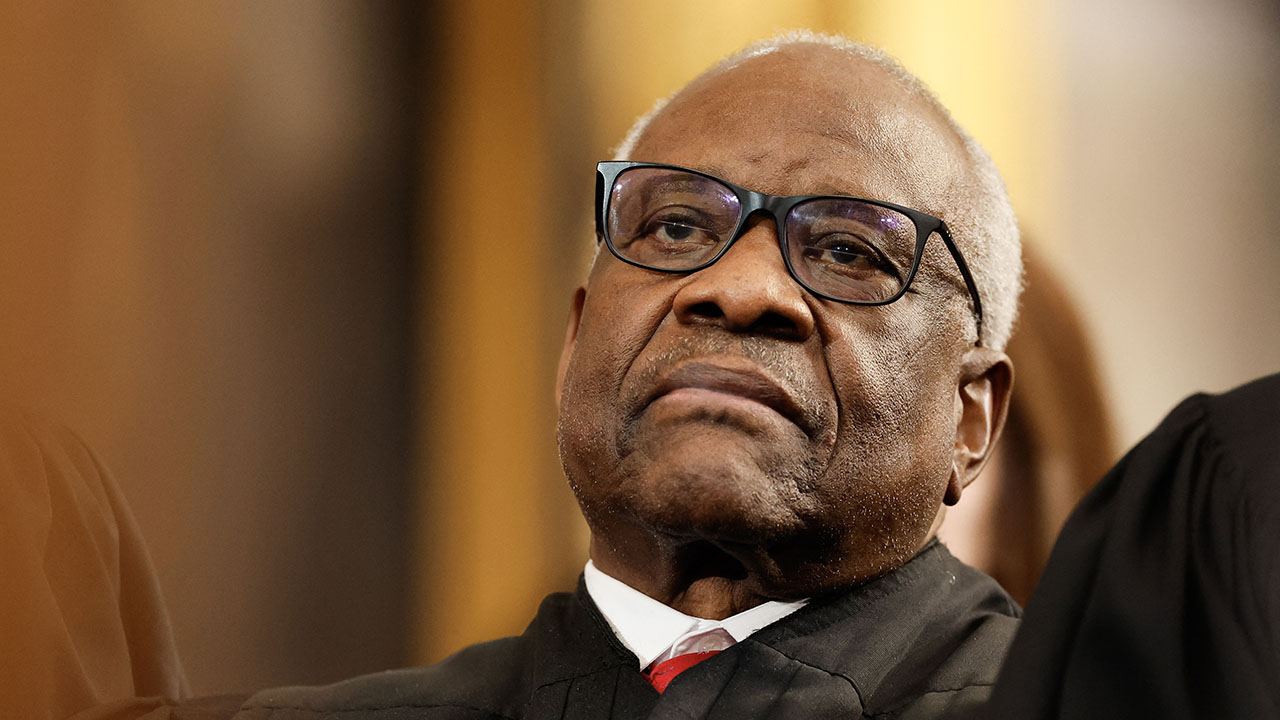
Supreme Court Justices Clarence Thomas and Samuel Alito tore into the court’s majority for imposing a “medieval” rule on “birthright citizenship” that negates the spirit of the Declaration of Independence, days before the 250th anniversary of America’s founding document.
Both justices issued dissenting opinions in Trump v Barbara (2026), in which the court’s 6-3 majority upheld the notion of “birthright citizenship,” that any baby born on U.S. soil—regardless of his parents’ immigration status—is a citizen.
Justice Thomas said the court’s majority in Trump v. Barbera (2026) presented a legal argument that was “not historically accurate.”
“American citizenship, the court says, was based on a medieval English ‘feudal’ principle, according to which each person ‘owed personal service to the lord of the soil’ as his ‘master’—a perpetual servitude that was ‘born with the child and only ended in the grave,'” he summarized. According to the court’s majority, Americans adopted the feudal principle and Congress codified it in the Civil Rights Act and the 14th Amendment.
Alito, for his part, cautioned that “before saddling the nation with a medieval rule, we had better be certain the Constitution requires it.”
He warned that the court’s decision confers citizenship on “birth tourists,” the children of women who travel to the United States just to give birth.
Alito also noted that analysis of the 14th Amendment and its history shows that “it does not degrade the concept of United States citizenship in this way.” Rather, it confers citizenship only on children who “owe allegiance solely to this country” at birth.
Undermining the Declaration?
The court grounded its theory of “birthright citizenship” in English common law and the principle that “the king … owes those ‘born within the dominions’ a duty of ‘protection.'”
Yet Thomas, Alito, and Justice Neil Gorsuch argued that America rejected such a “feudal” notion when declaring independence in 1776.
“This theory of monarchical power and the status of the people provided the foundation on which the rule of birthright subjecthood stood,” Alito wrote.
“In this system of soil and servitude, the court sees ’emancipation,'” Alito wrote. “But our Founders disagreed. The Declaration of Independence emphatically rejected the British theory of government. It proclaimed that governments ‘derive their just powers from the consent of the governed,’ not divine right.”
Alito called it “ironic” that the Supreme Court should embrace the opposite claim “only days before we celebrate the 250th anniversary of our Declaration of Independence, which emphatically renounced the foundation on which the British rule rested.”
As a matter of history, Alito argued that from 1776 to the Civil War, “the status of the rule in this country was unsettled,” and that the 14th Amendment’s provision “differed substantially from the British rule.”
‘Birthright Subjecthood’
In broad strokes, British common law did provide the basis for America’s legal system. Thomas and Alito do not object to this. Rather, they object to the notion that the Founders and the Congress in writing the 14th Amendment modeled U.S. citizenship off of “birthright subjecthood.”
The reasons for the court’s decision arguably trace back to United States v. Wong Kim Ark (1898). When the U.S. attempted to prevent Ark, a Chinese American born in San Francisco, from reentering the country, the Supreme Court held Ark was a citizen, citing his parents’ decision to “have a permanent domicile and residence in the United States.”
Both Alito and Thomas emphasized the “domiciled” aspect of the case. The court, however, ruled that any version of “birthright citizenship” taking such a notion into account would fail to apply the 14th Amendment faithfully.
Alito and Thomas suggest that the court started with the notion of “birthright citizenship” and reinterpreted American history in light of it. On the contrary, however, they note the plain text of the Civil Rights Act of 1866—a law that Alito argues the 14th Amendment intended to codify—which extended citizenship to persons who were “born in the United States” and “not subject to any foreign power.”
While the court’s majority held that the 14th Amendment’s clause extending citizenship to people born in the U.S. and “subject to the jurisdiction thereof” meant those physically born in the U.S., Alito and Thomas argue that the Civil Rights Act of 1866 clearly shows that “subject to the jurisdiction thereof” meant to exclude individuals “subject to any foreign power.”
Why Does ‘Birthright Citizenship’ Matter?
President Trump issued an executive order on Jan. 20, 2025, revoking “birthright citizenship” for children born in the U.S. to parents who were unlawfully or temporarily present in the country. When the court ruled that President Trump’s order reversing birthright citizenship was “facially unconstitutional,” Thomas warned, that ruling “makes it unlawful for the president to enforce the order against a single person.”
“He cannot enforce the order against a child of an alien enemy or a child of a foreign spy,” Thomas wrote. “He cannot even enforce the order against children who are raised in foreign countries, join foreign armies, and fight wars against the United States.”








 New Posts (Home)
 ChatBox
 Popular Posts
  Game Zone
 Top PodCasts