reactormag.com
Language Magic and Culture as Power: The Killing Spell by Shay Kauwe
Books
book reviews
Language Magic and Culture as Power: The Killing Spell by Shay Kauwe
The Killing Spell shines in “its exploration of power, racism and cultural erasure via limits placed on language.”
By Mahvesh Murad
|
Published on June 30, 2026
Comment
0
Share New
Share
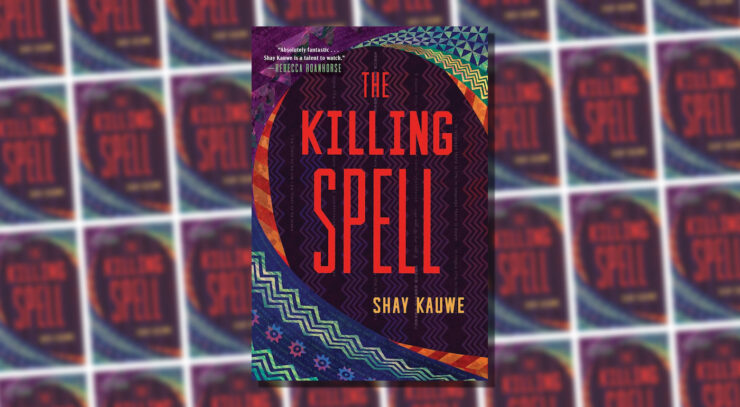
First time Hawaiian writer Shay Kauwe’s The Killing Spell is set on the west coast of the United States, 200 years after massive flooding drowned the Hawaiian islands, unleashing magic and monsters into the world, and forcing all surviving clans to enter into a land-leasing agreement with Los Angeles. The Hawaiian clans have been allowed to live in a designated area now known as the Homestead, which (while it is not explicitly meant to be) feels a lot like a reservation. Monsters appear out of the ocean occasionally even now, and attack the Homestead. Magic is controlled by spell casting, with language as the main system to channel it. People have different abilities, “sympathetic magic” that they can use, but being able to create a spell that can be used by others can only be done by “smiths,” those who have a certain command over language.
Kea is a smith, though she’s not very good at it and her abilities are unpredictable. She’s also unregulated, which means that she’s creating and selling spells without the knowledge of the powers that be. She can’t get certified to do this legally, because she’s not good with the spell casting languages, and though her native language is Hawaiian, which she casts spells in, it is not a language that is formally recognised by the LA Casters board. In fact, she isn’t terribly proficient in Hawaiian either, since the clans all speak English which was needed to assimilate into the dominant culture, and English is no good for spells.
At twenty-five, Kea is the reluctant head of her clan, which means she’s responsible not just for her siblings and a few younger cousins, but also her grandparents (in this case, that’s her entire clan). They have very little money and are heavily mortgaged, so Kea has to hustle hard to take care of them all. She just can’t catch a break though. Just when she thinks she’s on top of things, her youngest cousin breaks the wards protecting their chickens, a magic monster attacks their home, and Kea ends up in a fight with a vicious young man from another clan. It’s a fun, high octane start to the story, but none of it has very much to do with the main plot.
Someone has used a highly illegal death spell to murder LA’s most prominent political activist, a Filipino man called Angelo Reyes. Because of how language magic works, we are told that this spell could only have been written in Hawaiian, so Kea is hauled into LA, where the governing board of directors insist that she help them solve the murder to prove her innocence. In return, she will win their favour and blind eye to her illegal smithing; her family’s debts will also be paid off. It’s an offer she can’t refuse, even though she is quite certain she isn’t right for the job.
Kea is partnered with Sora, a man the board trusts. He and Kea dislike each other from the start, in a way that makes it clear that a romance will be forced upon them soon enough, even though it may feel stilted. As Kea tries to figure things out, we learn a bit more about her world and its magic systems. This is not a dystopia (aside from the occasional monster crawling out of the ocean), at least not one much further along than our current reality. Magic is controlled by language: Spoken words have power to harness the energy that flows through the universe and direct it: “Casting required tapping into the mana that flowers through the world and drawing it inside oneself. Every person’s capacity for holding mana was different—it was like everyone had a little jar of predetermined size inside them… people stored mana in their core [but] it wasn’t something anyone could create on their own. Mana came from around us, and to access it, people had to pull it into themselves.”
Buy the Book
The Killing Spell
Shay Kauwe
Buy Book
The Killing Spell
Shay Kauwe
Buy this book from:
AmazonBarnes and NobleiBooksIndieBoundTarget
Though mana may exist for all, a particular grasp of certain languages is needed to be a proficient spell caster. The purists at the LA Casters Board insist that only the classical Romance languages are used in magic, and those are the ones that are regulated and legally accepted as part of the system. The Asian languages are fighting to be recognised, and the board’s lack of acceptance of them is clearly just racism, since many of them are as old if not older than the Romance languages (see: Chinese). This is where The Killing Spell gets interesting, because even if the overall worldbuilding is a little vague, Kauwe is very clear on her political stance on cultural eradication. As Kea leads us through her investigation, we learn that even 200 years from now, in a future with magic and monsters, there remains a sort of hangover from the settler colonialism of the Americas. We don’t know if this is a system in place globally (or even what is happening outside of LA), but it is clear that control over language and its usage to access or channel magic comes from a racist colonial Eurocentric point of view. It reeks of systemic control over minority populations, cultural erasure, land grabbing, forced assimilation, takeover of power and worse. It is spelled out for us that the “slow, intentional strategy of places like Los Angeles had always been to starve us out, strip away our resources, and wait until the last of us died… No one cared about the stories of fallen societies. Their histories were overwritten with a false, shiny veneer… it would continue until we could no longer speak for ourselves—and the real way to kill a people was to cut out their tongue.”
Kea’s self doubt and her lack of Hawaiian proficiency combined are what hold her back, but ultimately it is when she realises that true power lies in community and ownership of her own language and culture against all odds that she is able to make a real mark—both as a smith, and a Hawaiian. As she points out, “We learned only the histories of people society deemed important, the ones that mattered. LA thought the Homestead didn’t matter, and if they had their way, that would be true—we’d become a blip violently erased from their history. The only way our history would survive was if our people continued to live. If we took up space unapologetically.” And so we see Kea speak up again and again, even at great risk to herself. It’s a strong point in an otherwise lukewarm narrative.
The Killing Spell is being touted as the first adult Hawaiian urban fantasy, and feels a great deal like a coming of age story of a young woman trying to find not just her own personal identity, but also her role in a larger community. It is very readable enough, though the narrative does hop around at a jerky pace for the first third or so. While its protagonist is fairly compelling, the other characters aren’t particularly well-defined, and the plot can feel a little chaotic. What it does shine in, though, is in its exploration of power, racism and cultural erasure via limits placed on language.
In her preface, Shay Kuawe writes that all “languages are beautiful, special, and important, and your effort to cross cultures with nothing but a notebook and pen is a superpower. With every word, you are making magic.” And that, in itself, is often enough.[end-mark]
The Killing Spell is published by Saga Press.Read an excerpt.
The post Language Magic and Culture as Power: <i>The Killing Spell</i> by Shay Kauwe appeared first on Reactor.








 New Posts (Home)
 ChatBox
 Popular Posts
  Game Zone
 Top PodCasts