www.dailywire.com
What ‘Toy Story 5’ Should Have Told Parents About Screens
This article is part of Upstream, The Daily Wire’s new home for culture and lifestyle. Real human insight and human stories — from our featured writers to you.
***
“Toy Story 5” has struck a nerve. Since its release on June 19, it has become the highest-grossing “Toy Story” movie ever and pulled in the second-highest Pixar opening. The film captures something many parents have felt: the age of toys is over. Play-based childhood has ended, and we are now in the age of screens. The movie’s accurate diagnosis of the crisis in modern American childhood captures the frustrations parents feel over kids and screens. If you talk to most parents, they lament the state of childhood today, but they also feel a sense that the screens are inevitable.
The film captures this sentiment well by portraying the collective action problems that screens during childhood present. As Jonathan Haidt explains in his book “The Anxious Generation,” screens and their apps create negative network effects, where even kids who aren’t on smartphones or social media can still experience their negative impacts by how it changes the group social dynamics among peers. In the film, Bonnie has no one to play with because all the other kids are sitting inside on screens.
As Jessie, the beloved cowgirl first introduced in “Toy Story 2,” says, “No wonder she can’t make a friend; she is the only one out there still playing with toys.” All the other kids are just tap, tap, tapping away inside on screens. This collective action problem pressures parents to give in to the screens, despite their initial reservations. Oftentimes, like Bonnie’s parents in the movie, parents believe that giving the screen will solve the child’s loneliness problems and help them connect more with friends.
While “Toy Story 5” captures how parents feel fed up with the screens, unfortunately, the film misses the mark on solutions and instead affirms a sense of helplessness on the part of parents that screens are now just an inevitable part of childhood. As Bonnie’s parents hand her a tablet, they note, “Now that you are eight, we figured it was time.”
Sadly, the movie is mainly reflecting our cultural reality. The combination of social pressures and the dominant modern parenting strategy of child-led, gentle parenting leads most parents, despite their reservations, to fall into the “screen-time trap.” By age 2, 40% of children have their own tablet; by age 4, over half of children (58%) own a tablet, and about 80% of kids between ages 5 to 11 interact with tablets, according to Common Sense Media’s latest survey. Despite initial concerns, parents end up relenting to the screens, and they are told by the tech companies that they can mitigate any dangers by imposing time limits and controls.
Thus, most parents (86%) have rules around when, where, or how their child can use screens, according to a Pew Research Center survey. However, in practice, only one-in-five parents say they are able to stick to their rules around screens all the time. Furthermore, even companies’ own internal research finds that their time limit tools are ineffective. TikTok created the option for parents to limit children’s time on the app, and the company set the default time limit for children to 60 minutes each day. Their internal research showed that this tool didn’t put a dent in the average time children spent on the app. Minors’ usage dropped by less than 1%, from about 108.5 minutes each day to roughly 107 minutes on the app each day.
All of this shouldn’t surprise us if we correctly understand that interactive screens are designed to be addictive to our brains, especially the developing brains of children. Brain studies show that screens activate the same reward pathway in the brain as alcohol, tobacco, and other drugs, as they release constant bursts of dopamine. Dopamine is responsible for motivation and incentivizes us to keep going to get a reward. But dopamine doesn’t produce satisfaction or fulfillment; it only creates a constant craving for more. Unlike natural rewards in real life, with screens there is no completion point, no consummation that triggers an opioid satisfaction response in the brain and then naturally winds down our motivation. Instead, a user is permanently trapped in a wanting phase, stuck dopamine chasing.
A time limit will never be enough. Even 15 minutes of screen time a day creates a biological constant compulsion for more. As one mom said to me about managing screen limits, “It’s me, a drug-dispensing machine, and an underdeveloped child.” No wonder only one in five parents can stick to their screen rules. But what are parents to do instead?
Photo courtesy of Pixar
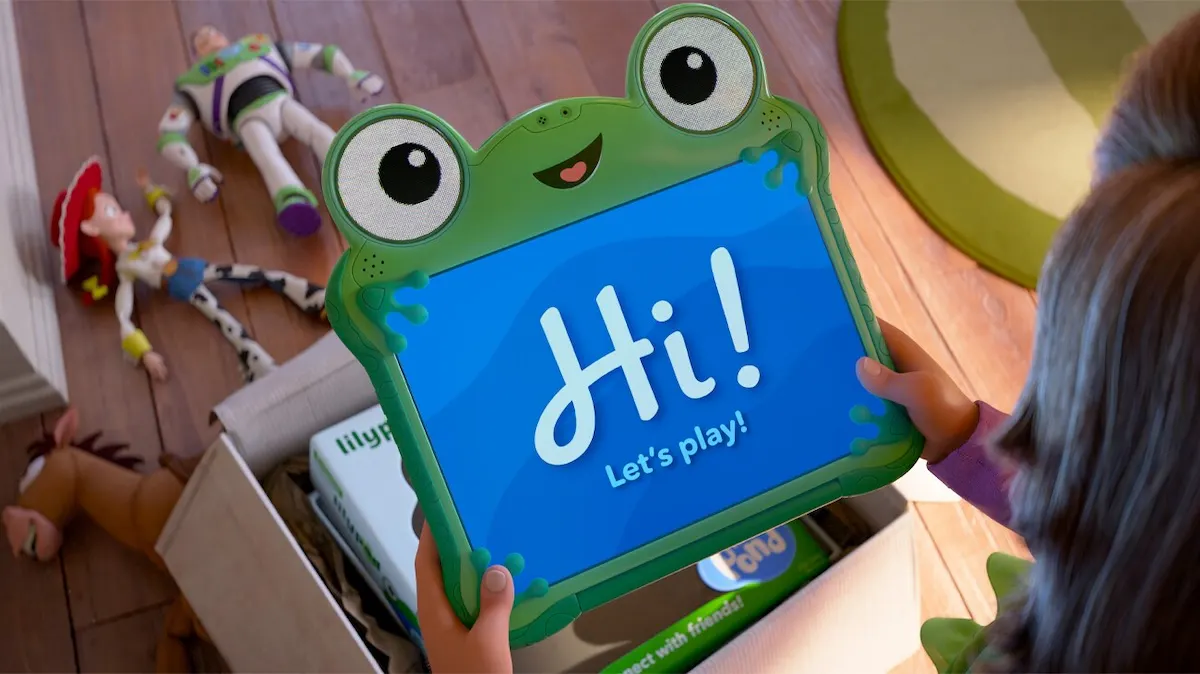
Unfortunately, “Toy Story 5” doesn’t offer parents a positive path away from the screens. The sad irony in the movie is that even once it becomes evident to her parents that Bonnie is being harmed by her screen, Lilypad, and its group chat, it is not the parents who take decisive action to take the screen away. It is Lilypad, the screen herself, who takes action when she realizes that for all the connection and friendship she promised, she has only ended up hurting Bonnie. (If only real screens were so self-aware; unfortunately, they are run by aggressive algorithms that keep kids addicted at whatever cost.)
At this cultural moment, when the evidence of the harms of screens has never been clearer, “Toy Story 5” missed its opportunity to take a stronger stance and show parents that screens do not need to be an inevitable part of modern childhood and, in fact, a better way is possible: getting rid of the screens entirely. We don’t need better uses for screens, as portrayed at the end of the film when Lilypad connects Bonnie with a new friend in real life. We need loving, yet authoritative, parents who decisively take the screens away and instead guide their children toward a life of independent, imaginary play and in-person friendships.
In my book, I outline this different path, called “the Tech Exit.” The definition of the Tech Exit is: no smartphones, social media, tablets, or video games during childhood or the teen years. If this sounds impossible, let me offer you a few tips for how to start on this journey to embracing the real-life childhood that you already want for your kids. It can be done, and it’s even possible to reverse course if you’ve already given your child screens.
First, you have to detox from all interactive screens if you have already given them. Start with a 30-day detox if you can. Prepare your family by explaining what you’re doing and why. Pick a day to start, and then do it. Get rid of all the screens from your house. Science shows that detoxes work to reset our brains — for anyone at any age at any time.
Once you have detoxed, to keep going over the long-term, you will need to find other families.
No parent can make this exit alone. From tablets in kindergarten classrooms to smartphone apps required of college and even high school students, we are all expected to participate in a society-wide social experiment. To counteract these pressures, parents must join together. By working with other families in your communities and schools, you can create counter pressures to push screens back out of childhood.
This also means parents need to take a more active role in helping a child build an in-person social life, setting up play dates, helping them set up in-person activities, and helping them find friends who also aren’t on screens. Helping your children find friends and build a healthy social life takes work.
One older mom gave me as a young mom a word of caution: “You’ll have to work at helping children build a social life, especially when they’re tweens and teens. These things used to happen more naturally, but because kids are so plugged in now, you have to be far more intentional about it as a parent.” Parents can help by facilitating social activities in their homes, like having a fire pit in their backyard for teens to hang out around, putting a ping-pong table in the basement, or organizing hikes or service projects for teens to do together.
Saying no to screens is ultimately about saying “yes” to so much more in real life. As we take screens away, we need to replace them with positive responsibilities and activities in the real world. Give children tools and tasks that foster independence and adult responsibility. For teens, it can be a car or a first job. For tweens and younger children, it can be a bike they are allowed to ride to their friend’s house or the neighborhood pool, a pet that is their responsibility, chores around the home, or even early informal jobs such as raking a neighbor’s yard or babysitting. Real-life responsibilities channel a child’s time and energy toward building productive life skills such as work ethic, care, responsibility, creativity, and problem-solving that will help them flourish both in the present and in the future.
This is the life we all want for our children and the bold solution that “Toy Story 5” should have held out to parents: Get rid of the screens entirely, get your kids outside, help them find friends in real life, and give them responsibilities. This is the path to true flourishing.
***
Clare Morell is a fellow at the Ethics and Public Policy Center and author of “The Tech Exit: A Practical Guide to Freeing Kids and Teens from Smartphones.” She previously worked in the White House Counsel’s Office and the Justice Department during the first Trump administration.








 New Posts (Home)
 ChatBox
 Popular Posts
  Game Zone
 Top PodCasts