reactormag.com
6 Things I’ve Learned From Watching More Than 100 Sci Fi Films
Column
Science Fiction Film Club
6 Things I’ve Learned From Watching More Than 100 Sci Fi Films
From campy cult classics to high art, every movie can teach us something about passion, artistry, and storytelling
By Kali Wallace
|
Published on July 1, 2026
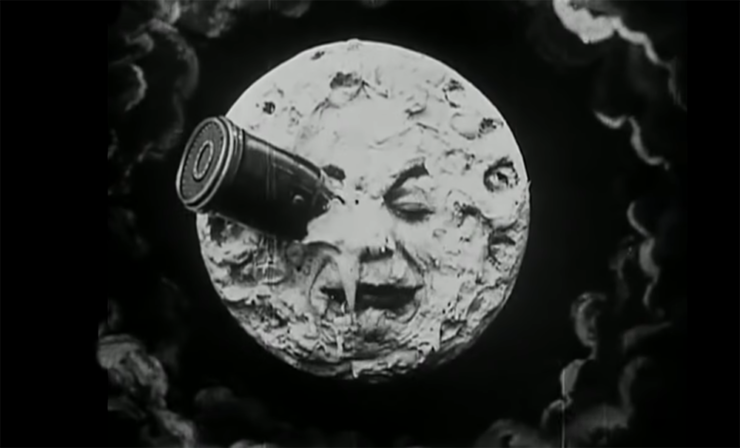
From Le Voyage dans la Lune (Georges Méliès, 1902)
Comment
0
Share New
Share
From Le Voyage dans la Lune (Georges Méliès, 1902)
I’ve been writing this column for a little over two years, and during that time I’ve watched and written about more than 100 science fiction films. That’s not a lot of movies for a real cinephile, but I didn’t go into this as a real cinephile. I went into it with a fondness for sci fi movies, a scattering of knowledge, and a desire to know more.
Now, I have a much greater fondness, a lot more knowledge, and an even stronger desire to know more. So I’m going to use this completely arbitrary milestone to look back at some of what I’ve learned along the way, while recommending some gems from among the films I’ve watched, especially those that might otherwise go overlooked or underappreciated.
From Ikarie XB-1 (Credit: Filmové Studio Barrandov)
1. People have been making sci fi movies for as long as they’ve been making movies.
But you might not know it from looking at a lot of general film history. Sure, every film history book or documentary will mention Georges Méliès A Trip to the Moon (1902), but quite a few will then just sort of skip to a brief mention of Metropolis (1927), then skip again to the post-war Atomic era films, give an obligatory nod to 2001: A Space Odyssey (1968), and only really acknowledge sci fi movies as a load-bearing part of the film industry with the release of Star Wars (1977). It’s not universal, but it is oddly common for film critics and scholars to treat the current preponderance and success of sci fi films as a recent and baffling phenomenon.
There are a lot of reasons for that and, yes, some of those reasons are that some people who write film histories are pretentious, or learned about film history during an era when gritty realism was in fashion. But you barely need to scratch the surface to see that aliens, rocket ships, mad scientists, and time travelers have been there all along, and not just in Méliès’ trick films and their imitators. As soon as Méliès and his contemporaries demonstrated to the world that film could show us things that do not and cannot exist, that’s what filmmakers started doing. A lot of the earliest films have been lost, a great many more have been dismissed as silly, unimportant thrillers or horror flicks, but they’ve always been around, and people have always been watching them.
Check out:
Ikarie XB-1 (1963), directed by Jindřich Polák. A wonderfully stylish, gorgeously designed Czechoslovak film about humanity’s journey into deep space.
World on a Wire (1973), directed by Rainer Werner Fassbinder. I know that a German television miniseries about corporate malfeasance and virtual reality in the ’70s is a tough sell for fans who come to sci fi for whiz-bang adventure, but I promise this one is worth watching.
From Man Facing Southeast (Credit: Cinequanon Pictures)
2. Every film contains a little bit of somebody’s passion.
We all know about the big passion projects, the films that one director or screenwriter or producer or actor wanted to make so badly they threw a lot of time, effort, and money into getting them made. But alongside all the Spielberg films and Tarkovsky films and Cameron films, there are quite a few movies that were made just to make money. They are the movies made quickly, cheaply, and without a whole lot of care—but even in those movies, there is always some aspect that somebody cared very strongly about. Even Rocketship X-M (1950), which was made in a whirlwind to capitalize on another film’s release, contains thoughtful themes and beautiful artwork. Even It! The Terror From Beyond Space (1958), which was made in about a week from borrowed ideas and spare props, has a memorable monster suit made by Paul Blaisdell. Even Planet of the Vampires (1965), always intended to be schlocky monster feature, has a wonderfully effective atmosphere and tension.
Not all of the movies I’ve watched for this film club are good. But movies are a complex artistic ecosystem of different parts, and there is always somebody, somewhere in the production doing their job with genuine skill and creativity.
Check out:
Save the Green Planet! (2003), directed by Jang Joon-hwan. A truly bizarre film, but it commits to its premise and tone so completely that it manages to be funny and brutal and bleak and brilliant all at the same time. (It’s recently been remade as Bugonia, but I don’t care about that, because that version doesn’t star Shin Ha-kyun in the lead role.)
Man Facing Southeast (1986), directed by Eliseo Subiela. Movies like this are why I dislike it when people reduce science fiction to being about ideas or technology. Sci fi is also about people. Messy, complicated, loving, selfish, contradictory people, and it’s lovely to find a movie that captures that so well.
From Aelita (Credit: Gorky Film Studio)
3. The ability to create entire worlds out of glue, paint, random junk, and elbow grease requires artistry and craftsmanship worth preserving.
When I first start writing this column, I didn’t have terribly strong opinions about what goes into making a movie’s visual effects. I always sort of thought, well, if it looks good, it can be CGI, it can be practical, it can be whatever.
I don’t think that anymore.
Before anybody starts typing furiously in comments, let me be clear that I’m not saying no movie should ever use computer-generated effects. I think computer visual effects have done fantastic things for what can be portrayed in film. Some of the most visually compelling films, like The Fifth Element (1997) and The Matrix (1999), use a clever combination of computer and practical effects.
But I also very much think that deprioritizing practical effects to the point where the industry is losing artists and abandoning decades of knowledge, skill, and craftsmanship is bad for the art of filmmaking. It is also, on a much grander scale, bad for humanity.
I don’t care if it saves money. (It also doesn’t always save money. A lot of lower-budget films, like Moon [2009], use practical effects because that’s the more economical option.) But even if it did, saving money is not the goal of art, and art’s value cannot be measured in how much it enhances some rich asshole’s investment portfolio. Artistic skills are not only worth developing and supporting if they are cheaper than an alternative.
Filmmakers make more interesting movies when they use the vast variety of tools at their disposal. That includes working with computer visual effects artists, yes, who are immensely skilled workers and deserve to be treated much better than the industry currently does. But it also includes working with costumers who know how to make clothing, with miniaturists who know how to create cityscapes, with painters who know how to make backgrounds, with sculptors and puppeteers who know how to make monsters. Artistry and craftsmanship have a profound collective value when combined in the project of a film. One of the best things about movies is the way so many levels of expertise and creativity come together to transport us into another existence for a couple of hours, and that whole process, from the concept art and storyboards to the finished movie, is worth understanding and protecting as a showcase of human ingenuity, creativity, and skill.
Check out:
Aelita (1924), directed by Yakov Protazanov. It’s not a perfect movie, but oh, does it do a marvelous job creating a unique, unsettling Martian world through set design and costuming. A great early example of making other worlds look otherworldly.
Attack the Block (2011), directed by Joe Cornish. Sometimes all you need is a block of council flats, a cast of unknown actors, a man in a monster suit, and something to say about prejudice in modern society, and you’ve got genuine movie magic.
From Kin-dza-dza! (Credit: Roskino)
4. Approaching art with an open mind is a habit that develops with practice.
When I started writing this column, I decided that I was going to approach each movie with a willingness to see what it had to offer and a desire to find something interesting to talk about, whether that comes from its story, its production, its context, or its legacy. I didn’t really know what that would look like, living as we are in a time when media criticism is going through an existential crisis and nuance is decidedly unfashionable. I don’t find the flavor of film commentary that only points out flaws very interesting, so I wanted to avoid that, even when casting such a wide net in my selections that I knew I would be watching many films that are outdated, or offensive, or badly made, or not to my tastes.
But I like learning things, and movies are complicated creations from a complicated global industry. I soon realized that there is, in fact, always something worth talking about, and I can rarely predict ahead of time what that’s going to be. I don’t love all the movies I watch, but I do genuinely watch each one trying to appreciate what the filmmakers were doing with the tools they had available to them, even if their intentions come from a vastly different context or perspective, or if in the end they didn’t quite work overall. “I don’t like it” or “This isn’t for me” or “This has some problems” do not necessarily mean “This is a waste of time” or “This isn’t worth thinking about” or “There is nothing to get out of this.”
Also, once I got into the habit of doing that for movies, it became easier to do it for other kind of art and media as well: music, books, games, visual arts, fashion, etc. It turns out the world is much richer and more interesting when we approach it with the idea that art doesn’t have to be perfectly suited to our personal tastes to be worth understanding.
Check out:
Kin-dza-dza! (1986), directed by Georgiy Daneliya. Of all the movies I’ve watched for this column, this is without a doubt the one that has required the most willingness to go along for a baffling ride. This movie is so fucking strange. It might be off-putting, especially if you go in looking for sci fi adventure rather than, say, surreal absurdism about the collapse of the Soviet Union. But everybody should give it a chance.
Dead Mountaineer’s Hotel (1979), directed by Grigori Kromanov. Another strangely alluring oddball from the Soviet era, this Estonian noir film is weird and moody, with a wonderfully unique visual style. Also a very cute dog.
From La Jetee (Credit: Argos Films)
5. Sci fi cinema is a valuable historical artifact.
It’s a joke but it’s got some truth to it: if you ask ten people to define science fiction, you’ll get fifteen different answers. One thing I’ve learned as I’ve researched the history of sci fi cinema is that the conversations people are having today—about the purpose of sci fi, about whether it is inherently forward-thinking or reactionary, about who makes it and for what audiences, about whether ideas or people are more important, about the role of science and technology—have been there all along in global sci fi cinema. Science fiction in general, and sci fi cinema in particular, is not inherently bleak or hopeful, optimistic or skeptical, reactionary or progressive; it encompasses all of those things and more.
What it is, however, is responsive. Film as an art form grew up with the 20th century, and sci fi is a genre well-suited to capturing snapshots of change across the tumultuous past hundred and twenty-some years. From the films of German Expressionists during the Weimar Republic to the works of the early years of the Soviet republic, from the escapist extravaganzas of the Great Depression to the anxiety-ridden films of the post-WWII Atomic Era, from the experimentation of the French New Wave to the weary realism of the New American cinema of the ’70s, from the push-and-pull of earnest optimism and pointed political criticism of the Reagan era to the big ideas of the ’90s, and continuing into the new global expansion after the turn of the millennium, sci fi cinema has always been a medium for reflecting the hopes and fears and anxieties and doubts of the time in which it is made.
Check out:
Boy and the World (2013), directed by Alê Abreu. This Brazilian movie is one of the most beautiful animated films I’ve ever seen, with some of the most wonderful music, showing the heart-wrenching story of the life of both a man and his people through the lenses of colonialism, industrialization, and revolution.
La Jetée (1962), directed by Chris Marker. The short film that inspired 12 Monkeys is a fascinating example of what film can do, and what kind of world it can create, using references to real history and imagined futures, with still photograph storytelling that doesn’t normally feature in motion pictures.
From High Life (Credit: A24)
6. There’s always room for new favorites.
I’ve selected some of my long-time favorite films for this column, and it’s been a lot of fun to watch them again, learn new things, and read other people’s thoughts and feelings. I still love Alien (1979). I still love The Thing (1982). I still think The Iron Giant (1999) is perfect.
But there is no point in embarking on a project like this thinking that I already know all I need to know about what I like or dislike. Stalker (1979) was an unexpected revelation to me. It’s hard to explain the emotional impact of watching Twin Peaks: Fire Walk With Me (1992) first as a teenage girl, then as an adult, and finally understanding all of the horror and pain in the story. I’ve turned into the kind of person who will bring up the socio-political context of Godzilla (1954) at dinner parties just because I think it’s fascinating and need to share. If they don’t throw me out of the party, I’ll start doing the same with Invasion of the Body Snatchers (1956/1978) before dessert.
It is such a joyous thing to find a new favorite and to know there are many more out there waiting to be discovered.
Check out:
The Long Walk (2019), directed by Mattie Do. The young Laotian film industry is so small most of it could probably fit inside a single theater, so I had no idea what to expect from this film. It’s a beautiful, mournful exploration of violence and sexism and loneliness and grief, all wrapped up in the science fictional structure of a time loop. It’s stunning and affecting and I still think about it regularly over a year later.
High Life (2018), directed by Claire Denis. A film from a renowned director starring an A-list actor can’t exactly be a hidden gem, but I still think this movie has not gotten the attention it deserves from sci fi fans. I wasn’t quite sure what to make of it when I first watched, but I’m still thinking about it much later. It’s intense, disturbing, sometimes outlandish, and unapologetically bleak, but it’s also beautiful in a way that really gets under the skin.
So there you have it: The 100-ish movie milestone, and there are so many more to watch. I promise I still have the films you’ve all recommended before on my ever-growing list, but please comment below if there are any movies you would like to see discussed in the future!
Next week we’ll return to our regular movie-watching schedule with Colossus: The Forbin Project (1970). You can find it online in a few of the usual places.[end-mark]
The post 6 Things I’ve Learned From Watching More Than 100 Sci Fi Films appeared first on Reactor.








 New Posts (Home)
 ChatBox
 Popular Posts
  Game Zone
 Top PodCasts