www.upworthy.com
Woman swears by this ‘reverse decluttering’ method for making tidying up easier
For many of us, decluttering feels like death by a thousand choices. Whether it’s decision fatigue, or sentimentality, or a bit of scarcity fear, we might find it easier to hold onto things rather than choose what goes away.
But what if the first step wasn’t to decide what has to go? What if decluttering didn’t initially involve getting rid of anything? Would it even still be considered decluttering?
According to one organizing enthusiast, the answer is yes. And, in fact, it can make decluttering that much more effective.
Dawn Madsen, who aptly goes by “the Minimalist Mom” online, has over 800 helpful videos geared towards simple strategies to declutter homes. She also has a mentorship program for those who want some one-on-one guidance.
Recently, Madsen discussed the concept of “backwards decluttering,” which flips the script on how we normally tidy up and makes the process “fly by.” With zero “hard decisions.”
How to “Reverse Clutter”
Here’s how it works:
Step 1: Select the things you use regularly, and place them in “prime real estate”
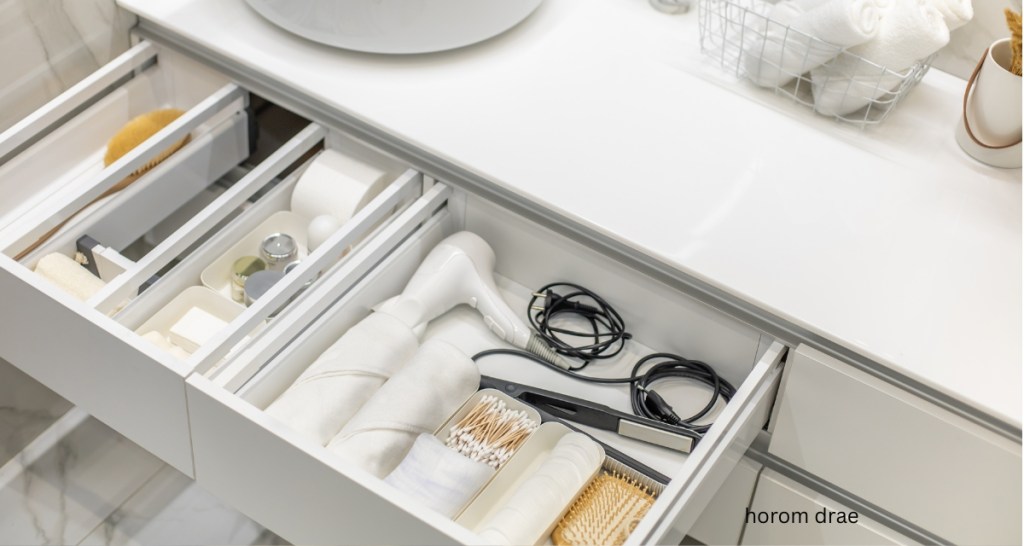
Organized bathroom drawer. Canva
Madsen suggested placing daily use items like toothpaste and moisturizer in the drawer next to the sink. That way they’re not clogging up the counter, but are still easily accessible. In place of a drawer, you could also place these items into a “get ready” bin that could either go under the sink, or live on the countertop in a much more streamlined way.
Weekly regular items would get a similar treatment, getting placed into their own bin and being put into whatever nearby storage is available.
Things that aren’t used regularly, but you know will be used (like extra bottles of products that you might have bought in bulk) would also go into the “yes” pile. If you thought their “prime real estate” would be something like a closet, they can also go under the sink. They should just be in a different container.
Step 2: Things that aren’t being used regularly go into the “time will tell” bin
Stacked storage bins. Canva
Those impulse purchases that haven’t made their way into the routine yet? These go into a lidded storage bin so that they’re not “nagging” you through your periphery. They are, however, still available should the mood strike or should you have the bandwidth to use it.
In a few months, you’ll be able to check the bin and reassess whether certain things should go or stay.
Madsen says this strategy is particularly helpful for getting a handle on our consumer habits as well. Influencers sell us so many “aspirational” products, but having all those items in one place gives tangible data on what we might be unnecessarily spending our money on.
Madsen noted that as her consumer habits shifted, her “time will tell” bin was able to grow smaller.
Step 3: Whatever’s left goes into a black trash bag
New black trash bags. Canva
Madsen suggests black so that it’s no longer in your line of sight. And though she didn’t mention having a donation pile (as her leftover items were actual trash) this is the step where you could place items of that nature aside to be donated.
The method really works
Madsen noted that our brains love for things to be separated and categorized. This method scratches that itch while eliminating any FOMO about items that may have been tossed out prematurely.
And though she demonstrated this method with bathroom items, it’s easy to see how this would be applicable in any room.
Judging by the response in the comments, plenty of viewers could see themselves giving the “time will tell bin” a try. Many got excited at the idea of “shopping” from it to keep from needless spending.
One shared, “I organize people’s homes , and I really like the ‘time will tell bin’,” one person wrote. “Because a lot of ppl hang on to stuff bc they are planning on using it , or want to keep for XYZ , and when other organizers say ‘if you don’t use it get rid of it’ you end up keeping more bc it’s the thought of throwing out money or needing it in the future and now you don’t have it , plus the TWT bin isn’t a permanent decision so it’s not as anxiety inducing , and you can move through this step of organizing, instead of getting stuck or frustrated – and ultimately giving up or getting upset.”
Sometimes backwards is the way forward
Instead of demanding an immediate answer about every item, backwards decluttering creates room for your everyday routines to reveal what actually belongs. Over time, the things you consistently reach for become obvious, and the ones you never miss become easier to part with.
For anyone who freezes at the thought of making dozens of keep-or-donate decisions in a single afternoon, that small shift in perspective could be the difference between abandoning a decluttering project halfway through and finally making lasting progress.
The post Woman swears by this ‘reverse decluttering’ method for making tidying up easier appeared first on Upworthy.








 New Posts (Home)
 ChatBox
 Popular Posts
  Game Zone
 Top PodCasts