reactormag.com
Keep Your Hands Inside the Car: Matthew MacDonald’s “How to Deal with Fallen Gods”
Books
Reading the Weird
Keep Your Hands Inside the Car: Matthew MacDonald’s “How to Deal with Fallen Gods”
The first god’s arrival was an event, now they’re just another fact of life…
By Ruthanna Emrys
|
Published on July 1, 2026
Comment
0
Share New
Share
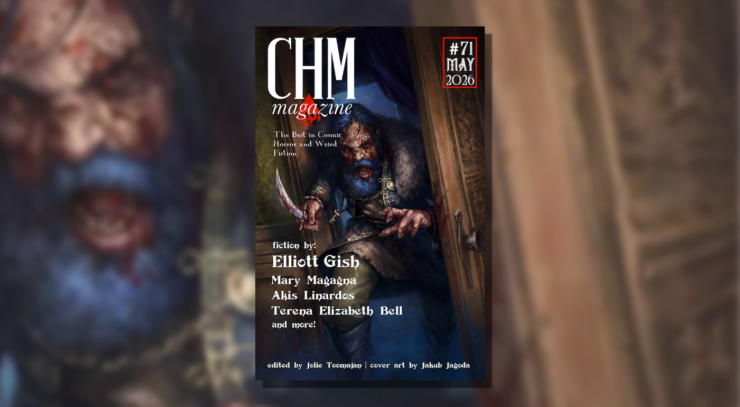
Welcome back to Reading the Weird, in which we get girl cooties all over weird fiction, cosmic horror, and Lovecraftiana—from its historical roots through its most recent branches. This week, we cover Matthew MacDonald’s “How to Deal with Fallen Gods,” first published in the May 2026 issue of Cosmic Horror Monthly. Spoilers ahead!
Understand the fallen gods may feel confused or scared, in a world so different from their far-off home. DO NOT intervene in their activities. They won’t respond, and you may be harmed.
* * *
The unnamed narrator’s (UN’s) first god sighting: Leaving Pilates class, they saw a fallen titan. A small crowd had gathered. They and UN lingered until night fell to hush their excited voices. Still, the titan did not stir. Confronted with the same sight now, UN would simply scramble over its body and go about their business.
* * *
Everyone’s first question was Why are they here?
UN’s friend Tiff thinks that the gods are all about humanity. But they don’t speak to us, UN counters, or even seem to notice us. Nor does UN buy the Facebook claim that some woman saw a god playing with her six-year-old. UN scoffs at Tiff’s conviction that the gods have an epic purpose or that they want to show us something, “a magical artifact from another dimension” or simply a message.
What UN thinks, with more anxiety than they intend to betray, is that the gods aren’t moving toward us but away from wherever they started. Here’s just where they ended up. Not innocent, nor likely ever to be at peace again.
* * *
The first ever sighting of a fallen god was on a lake, by a fisherman. A bronze-skinned “thunderous mass” with flowing blond locks lumbered clumsily out of the water. He was later identified as Forseti, the Norse god of justice, peace, and truth, but like all the earliest visitors, he wandered aimlessly, alone. Later, people would spot gods in groups; given that their interactions with each other and the world were minimal, those clumpings may have been coincidental.
Soon a subreddit would be dedicated to deity identification. UN likened their neighbors’ enthusiasm to a “slightly unusual game of Pokémon Go.” UN themselves couldn’t shake a foreboding sense of movement deep in the earth, “in a place that never shifted.”
* * *
How to speak to a god: Use a calm voice, a comforting tone. Experts think the god will understand, but probably won’t respond. DO NOT offer worship or sacrifice.
* * *
The gods damage roads and buildings, disrupt traffic, crush the unwary. When a god falls and is dragged off to a warehouse, its “psychic weight” lingers.
* * *
UN and Tiff argue about the gods before Pilates class. She claims that she locked eyes with Freyja and saw a blank emptiness, as if the god couldn’t remember why she was there. UN tells Tiff she’s crazy. She shrugs off the comment. A minute later, she asks, “Do you think they’re becoming more human?”
* * *
UN tries to live a normal life now that the “initial frenzy” has passed. They take detours around god sightings, but get to work and Pilates on time. And they resolutely push aside the feeling that “substances that should never meet and mix are slowly seeping together.”
They’ve had an encounter they haven’t shared, even with Tiff. While walking along the river, they were the first to sight a white-bearded god curled around his weathered shield. UN wanted to run but was frozen in place. The god’s unearthly black eyes burned with accusation. A question rang deafeningly in UN’s mind, would continue ringing after they’d fled:
“For what purpose did you make me?”
* * *
Thousands flock to the “Greater Midlands” since the arrival of the gods. One should take pictures from a safe distance, for gods prefer to avoid humans. But encounters do occur, which can be disturbing to both the mortal and deity. Here are newly revised guidelines:
DO NOT use “bear spray, noise canisters, or other irritants.”
DO NOT climb trees.
DO NOT make eye contact.
Above all, don’t worry, have fun. Follow these tips, and you can safely enjoy your stay!
What’s Cyclopean: “…the great limbs of a titan, body the size of a fallen redwood” sure sounds cyclopean to us! The multisyllabic vocabulary remains implicit, though: “Our eyes met, and it was like all the florid and archaic adjectives from an H. P. Lovecraft novel washed through me in an instant.”
Weirdbuilding: They are not here to share a cosmic message. They are not here to play with our toddlers. They don’t want our worship or sacrifices. “Their needs are not human needs.”
Madness Takes Its Toll: Tiffany has a “crazy” experience meeting a god’s eyes. UN scoffs, but hides some craziness of their own.
Ruthanna’s Commentary
If I had to nail down one systematic difference between early 20th century cosmic horror, and early 21st, it would be how you’re expected to react. In the wake of World War I, we expected that worldshaking events would shake the world. The lives of anyone who knew would have to change. That’s what worldshaking means, right? People leave their jobs for the front lines, or take on new work to support the war effort. The horror comes from that disruption—or from being one of the few who know, and trying to protect the tissue of normality that allows the ignorant to remain so.
In the 21st century, that tissue is a group effort. We all know, but we aren’t permitted to be shaken. There’s the economy to think of, after all. It started after 9/11, with Bush telling us to get out and shop. Twenty-five years later, people are shocked by the idea that a life-threatening pandemic would change their lifestyles for more than a month or so. You certainly can’t cancel Pilates class for an interdimensional incursion.
To be fair, the gods coming out of the Greater Midlands lake are safer than an airborne virus. They’re largely ignoring humans, causing some incidental danger via property damage. Oh, and completely undermining everyone’s understanding of how the universe works and humanity’s place in it. But you certainly can’t expect to stay home for that.
Besides, it’s a helluva tourist draw.
Putting aside my thematic cynicism, what sells this kind of thing is the little mundane details, and I love how those are handled here. Reactions move from awe to gossip to Pokémon Go. I would 100% be torn between awe and nerdy entity ID. You could add them to Merlin alongside your favorite birds! My household would be very excited by the early appearance of an obscure Frisian/Norse deity: Forseti is not one of the stars of Ragnarok, but his name—“the presiding one”—is the title for the modern Icelandic president. Which is probably also what “president” means, I just realized, shut up. (Household would also be eagerly looking out for Nehalennia, hometown fave who has an old Roman temple near us.)
The newcomers stagger around unprotected by divine auras, collapse, get carted off by Waste Removal. Don’t call 911, it’s not an emergency. And don’t, for pity’s sake, climb a tree. Bears can climb trees after you; gods can knock them down. Stay in your car. Pretend it’s a safari. Giraffes and rhinos, Horus and Tlaloc, same difference. Don’t forget to buy a t-shirt!
And yet, the existential questions aren’t entirely avoidable. Meet a visitor’s eyes and your experience will be, as Tiffany suggests, crazy. Craziness, in this case, describes the old madness of the god-touched, visions and revelations terribly inconvenient to one’s schedule. For what purpose did you make me? Maybe that’s the classic fantasy trope of gods created by human belief, the lack of which now drives them from Olympian heights. Or maybe they’ve been made by a more recent desperation, for something to break through that tissue-veil of normality in a way we’re allowed to recognize. In which case they never existed at all before emerging.
That might be preferable to some of the alternatives. Because if they’re not simply losing power in the face of modern disbelief, and if they’ve been around all this time—what’s driving them into exile? A stampede is dangerous in its own right, but sometimes the danger following behind is worse. Our narrator imagines a drifting oil tanker, out in the fog, coming nearer with its load of toxic spillage. Not a predator, not something that cares about us any more than the gods do, but some disaster beyond imagination or control.
And when that disaster arrives, how will we ever get to Pilates?
Anne’s Non-Commentary: Anne has been dragged away to a mysterious island and will return after July 4th. Unless, of course, the lake in which the island sits becomes infested by wayward deities.
Next week, we wrap up Good Stab’s gospel in Chapters 21-22 of The Buffalo Hunter Hunter.[end-mark]
The post Keep Your Hands Inside the Car: Matthew MacDonald’s “How to Deal with Fallen Gods” appeared first on Reactor.








 New Posts (Home)
 ChatBox
 Popular Posts
  Game Zone
 Top PodCasts