www.dailywire.com
The Midnight Rider Who Made America Possible Was Not Paul Revere
“Listen, my children, and you shall hear of the midnight ride of …” Caesar Rodney?
July 1776. Nearly 15 months after Paul Revere’s famous ride — forever immortalized in the poem by Henry Wadsworth Longfellow — trouble was brewing as the Continental Congress met in Philadelphia to discuss the question on everyone’s minds: will the 13 American colonies declare independence from England?
Virginia Delegate Richard Henry Lee put forth the proposition, stating that “these united colonies are, and of right ought to be free and independent states.”
A vote on the matter was set for July 2.
Delaware Delegate Caesar Rodney was at home in Dover, battling cancer and asthma and attending to his duties as an officer in the Delaware State Militia while his state’s two remaining delegates — Thomas McKean and George Read — were in Philadelphia. But when it came time to vote for independence, McKean and Read were at odds: McKean favored independence, while Read did not — and it quickly became apparent that Delaware would be the deciding vote.
A desperate McKean sent word to Rodney, a strong proponent for independence, who got the message on July 1 — and he acted without hesitation.
Meanwhile, a preliminary vote was taken on July 1 in Philadelphia. Nine colonies voted for independence. Two colonies — Pennsylvania and South Carolina — opposed. Delaware was deadlocked, and New York abstained because the delegates in Philadelphia were waiting for word from their local governments.
Rodney rode for 18 hours straight, pausing only to change horses, covering the 80 miles from Dover to Philadelphia — despite oppressive heat, dangerous storms, and his own failing health — bursting into the Pennsylvania State House (now known simply as Independence Hall) still wearing his mud-caked clothing and riding spurs.
“As I believe the voice of my constituents and all sensible and honest men is in favor of independence, and as my own judgment concurs with them, I give my vote for independence,” he declared.
Caesar Rodney’s vote broke the Delaware deadlock, and on July 2, 1776, the majority voted for independence. Pennsylvania and South Carolina voted with the majority, making the vote 12-0 with New York still abstaining. New York continued to abstain — although the delegates did not raise any objections — when they voted for the text of the Declaration of Independence on July 4.
On July 9, 1776, New York’s provincial congress voted to officially adopt the Declaration of Independence, finally making the colonies unanimous in their position.
Unanimity was of the utmost importance to the Continental Congress, largely because they believed dissent would be seen by the British as a lack of resolve and would likely be exploited as the war continued.
The consequences of Rodney’s ride — and the subsequent vote — were immediate: British loyalists in Delaware ensured that he was not reelected to either the state legislature or the Continental Congress. He did return to politics, however, and was elected to serve as the President of Delaware from 1778-1781. He also briefly served as Speaker of the Delaware Senate before his death in 1784.
Rodney’s ride seems obvious fodder for a Hollywood film — or at the very least, an epic poem — so why is it that so many in America have never heard of him?
Perhaps it’s because Rodney himself often hid from the public eye. His skin cancer, diagnosed several years prior to the war — along with surgery to remove a tumor from his nose — had left his face so severely disfigured that he often wore a green silk veil to hide it.
Or maybe it’s just that Paul Revere “had a better publicist” in Longfellow, as was noted in an episode of “Outlander” (Season 3, Episode 5). Revere, despite being immortalized in the famous poem, did not actually complete the “midnight ride” for which he is known. He set off for Lexington and Concord with William Dawes, and both were captured by the British before they could reach their destination. Dr. Samuel Prescott was the patriot rider who ultimately reached Concord in time to sound the alarm.
Rodney was not completely forgotten, however: the image of him on horseback appears on the Delaware quarters minted in 1999.
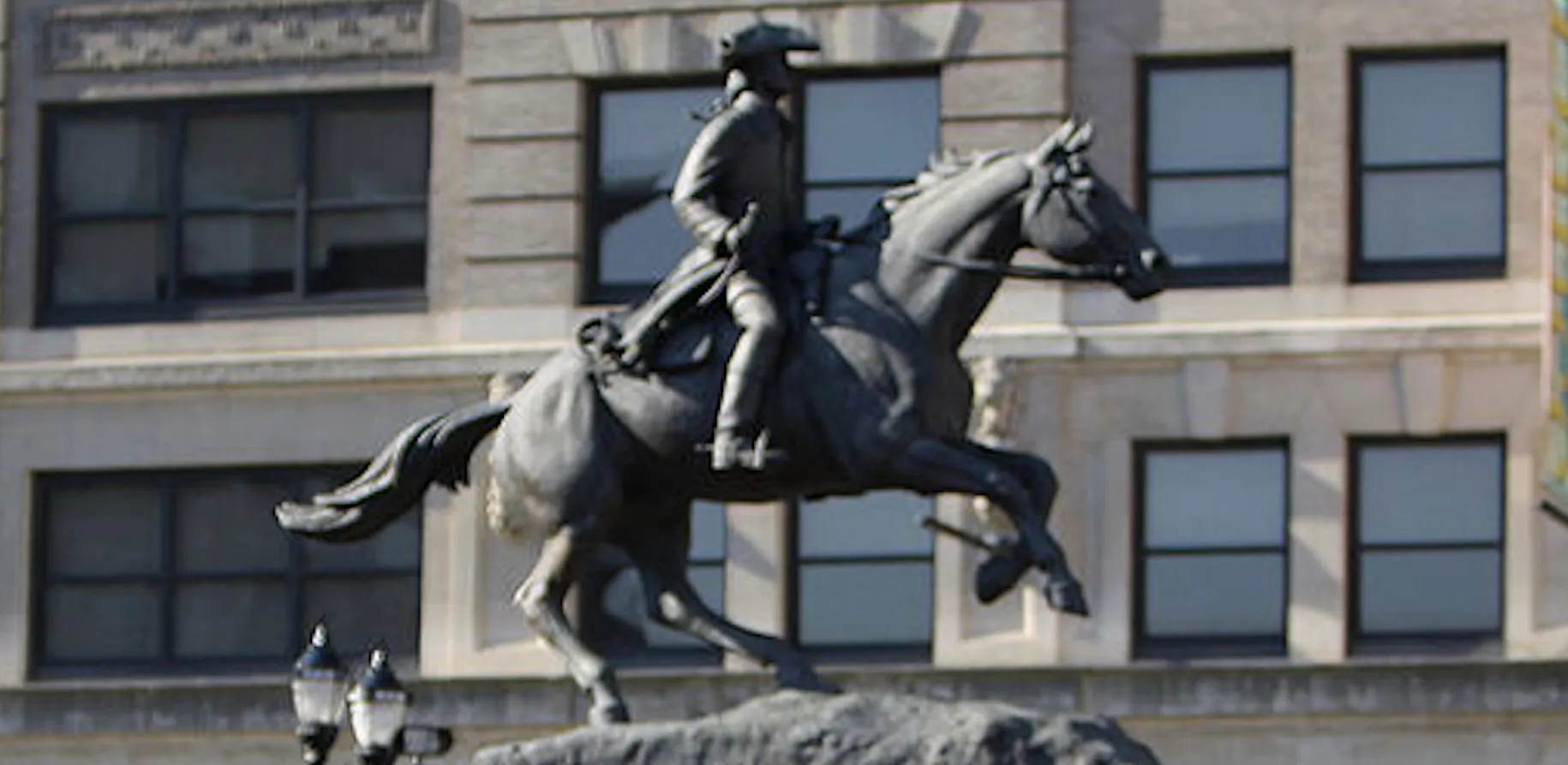
His name came up again in 2020, when Black Lives Matter protesters targeted statues of him — among many others — because he was a slave owner. A bronze statue of Rodney was taken down from its perch in Wilmington, Delaware, amid the protests that took place that summer.
In April, just ahead of the America 250 celebrations, the famed statue of Caesar Rodney was given a place in Washington, D.C.’s Freedom Plaza.
As we approach America’s 250th anniversary, @POTUS has been committed to celebrating and acknowledging the full breadth of our nation’s history, including the story of Caesar Rodney and his pivotal ride in July 1776.
Despite being gravely ill with a cancerous condition that… pic.twitter.com/0ownpdHows
— Secretary Doug Burgum (@SecretaryBurgum) April 25, 2026








 New Posts (Home)
 ChatBox
 Popular Posts
  Game Zone
 Top PodCasts