www.newsbusters.org
Morning Joe Historian Meacham on 250th: America 'Was Really Founded In 1965'
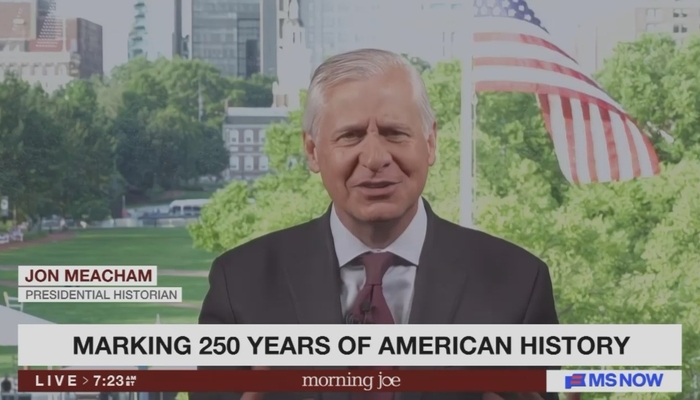
On Tuesday's Morning Joe, as the nation approaches its 250th anniversary, historian Jon Meacham delivered a revisionist riff on the founding of America.
He actually began well:
"The Declaration and the Constitution codified the centrality and sanctity of the individual and the equality, not of outcome and not of success, but equality before God and before the bar of history and before the courts of every individual soul."
So far, so good: a clear rejection of the "equity" mindset that demands equal results rather than equal opportunity under the law.
But Meacham quickly pivoted:
"There's a very good case to be made, I think, that we were really founded in 1965. That's when a multiracial, multiethnic democracy came more fully into being with the Immigration and Nationality Act, with the Voting Rights Act. And so we're really about 60 years old."
This is how many on the modern left approach American history. The New York Times’ 1619 Project sought to push the nation’s true founding backward to 1619, declaring the arrival of the first slaves as America’s real beginning. Now, Meacham effectively pushes the founding forward to 1965, to celebrate the Immigration and Nationality Act and Voting Rights Act.
The common thread is a desire to redefine America’s origins in the service of contemporary progressive priorities.
In Meacham's telling, the real founding occurred in the Great Society era. The actual Declaration and Constitution get downgraded to a kind of rough draft, with 1965 supplying the corrected, expanded edition.
This fits neatly with the narrative pushed by outlets like the New York Times. As Mara Gay of the Times editorial board suggested to Meacham, today's multiracial left is the true inheritor of the Founders' tradition.
Yet that same left aggressively champions DEI initiatives pushing "equity" — precisely the equality of outcome rather than opportunity that Meacham himself just said the Founders rejected. Meacham correctly identified the principle, but then, by situating the founding in 1965, seemed to hand the inheritance to the very movement working to dismantle it.
@Morning_Joe Historian Meacham on 250th: America 'Was Really Founded In 1965' pic.twitter.com/iaGocOFlDR
— Mark Finkelstein (@markfinkelstein) July 1, 2026
As the country prepares to mark 250 years since 1776, expect more attempts to shift the focal point to the 1960s. The actual founding documents, and the generation that risked everything for self-government, deserve better than to be treated as a preliminary sketch awaiting the real work of 1965.
Note: Meacham, an Episcopalian, offered a distinctly Protestant reading of history. He praised the Gutenberg press because “you didn’t have to depend on [Catholic] monks" to do illuminated manuscripts, celebrated the Protestant Reformation, in bringing scripture into the vernacular [from the Catholic Latin], as an important step toward democratization, and decried the old vertical order in which “Popes and princes” ruled over subjects.
In a discussion of America’s founding principles, many Catholics are apt to view Meacham's references as gratuitous critiques of their tradition.
Here's the transcript.
MS NOW
Morning Joe
7/1/26
7:23 am EDT
MIKE BARNICLE: Could you, in your, tell us what your definition today is of being an American?
JON MEACHAM: The American, right. We are blessed to be in a country that was part of an unfolding drama in the West from Magna Carta and Gutenberg forward. You know, the invention of movable type, which democratizes information. You didn't have to depend on monks to do an illuminated manuscript. Anyone could go to a printer shop and print an idea and get it out there. It was the earliest form of the internet.
The Glorious Revolution in England, which created a balanced constitution between King and Parliament — a vital reminder of how we have to keep those things in balance. The Protestant Reformation, you know, the translation of scripture into the vernacular. This whole idea, this whole shift — that the Constitution and the Declaration were, I think, the clearest political embodiments of the world being organized vertically—where Popes and princes were at the top and we were subjects.
But the world was becoming more horizontal. We were born with the capacity to determine our own destinies. And what the Declaration and the Constitution did is, they codified the centrality and sanctity of the individual, and the equality—not of outcome and not of success— but equality before God, and before the bar of history, and before the courts, of every individual soul.
MARA GAY: You know, John, we're in a moment where it feels sometimes as though there's a great battle that we're in the midst of, between a pro-democracy movement, of multiracial democracy, that claims to be the inheritor of what the Founding Fathers have given us of this great tradition. And then there are others, and you mentioned blood and soil, who want to limit what that means, and the definition of what it means to be American.
I guess, I wonder who you think actually is the inheritor of this American tradition, and how we should think about the radicalism of the Founding fathers in this moment?
MEACHAM: You know, we talk about, directly to your point, we talk about this as the 250th anniversary, which it is, of the Second Continental Congress passing the Declaration of Independence, fully beginning the Revolutionary War, which ultimately leads, in 1787 through 1789, to the framing of the Constitution, the inauguration of George Washington, and the beginning of what we would see as a recognizable experiment in self-government.
Except, that a lot of people weren't included in that. And in that important sentence about all men being created equal, men had a very particular application in that era.
It is a very — there's a very good case to be made, I think, that we were really founded in 1965. That, that's when a multiracial, multiethnic democracy came more fully into being with the Immigration and Nationality Act, with the Voting Rights Act.
And so, we're really about 60 years old.








 New Posts (Home)
 ChatBox
 Popular Posts
  Game Zone
 Top PodCasts