reactormag.com
Suspicious Minds, Rats, and Imposters: House of the Dragon, Season 3 Episode 3
Movies & TV
House of the Dragon
Suspicious Minds, Rats, and Imposters: House of the Dragon, Season 3 Episode 3
Rhaenyra sees enemies and traitors everywhere, and questions of legitimacy weaken a key alliance.
By Tyler Dean
|
Published on July 6, 2026
Credit: Ollie Upton/HBO
Comment
0
Share New
Share
Credit: Ollie Upton/HBO
Episode 3 is a great, tense bottle episode that never leaves King’s Landing, save for a single scene with Ormund Hightower at the beginning. It focuses on Rhaenyra’s struggle with ruling King’s Landing after conquering it nearly bloodlessly last episode. Despite being nearly dragon-free, it’s one of the best hours the series has had. Let’s discuss…
The Title
The title of this episode is “Rhaenyra Triumphant,” a bleak bit of irony if ever there was one. This is Rhaenyra’s moment of glory, her chance to remake the Red Keep and King’s Landing in her image. But, of course, aside from taking down the Greens’ banners and removing some Hightower-themed furniture, Rhaenyra finds little triumph in this episode. Rats overrun the Red Keep, the treasury’s gold is missing, the High Septon mistrusts her, the members of her small council are feuding with her and each other, and there are no easy answers to any of her troubles. It’s the classic Martin lesson—winning the throne and ruling are two different things, and Rhaenyra’s triumph is fleeting.
Unraveling the Opening Credits
Those drums really do add a lot to the opening credit sequence! The tapestry continues as before, but adds some panels at the end. First we see Rhaenyra’s arrival in King’s Landing, flanked by Mysaria and Daemon while Syrax roars, triumphant, behind her. As it fills in, we see the Sea Snake, Addam of Hull, and Ulf the White come into view on the right. This presents, of course, a more heroic and whitewashed version of the events of last episode. Another panel, or, perhaps, the same panel just below, shows a rat lurking beneath the melted blade of the Iron Throne. Rats in King’s Landing have been a motif throughout the series but, as we learn this episode, Aegon’s impulsive decision to indiscriminately execute all of the city’s ratcatchers following the murder of Prince Jaehaerys has led to a serious infestation.
A final panel shows what might be a crowd of supplicants before Rhaenyra (similar to what we see in her appeal to the smallfolk) or possibly a field of peasant bodies dead at the feet of whoever sits the throne. Right now, the ambiguity feels apt. The tapestry unexpectedly rips in half towards the end and through the undulation of its unfurling, with the Targaryen sigil visible at the end. Victory at what cost?
The West(eros) Wing
Credit: Ollie Upton/HBO
This episode really leans into the political thriller genre and somewhat cheekily borrows the Aaron Sorkin cinematographic trope of having dolly shots following Rhaenyra and her various advisors as they briskly walk through hallways. Combined with Kaivalya Arekar’s tense score, this episode does an excellent job of showcasing how dire things have gotten in King’s Landing.
It’s a great object lesson in the cost of war from a purely pragmatic point of view. Having executed Ironrod and Otto Hightower last episode, it is pointed out to Rhaenyra that the only people who might have been compelled to tell her where the contents of the treasury have been taken are now dead.
It’s also a shrewdly written episode that cleverly props up a number of red herrings relating to the betrayal in King’s Landing while hiding the most obvious one in plain sight. Rhaenyra suspects that Alicent has betrayed her by sending Aegon away (we know this is not the case). She believes that the High Septon is a Hightower spy when, really, both the Faith of the Seven and the Hightowers have always shared a theological suspicion of the Targaryens for their incest and their Valyrian cultural practices (which clash with the doctrines of the Faith, and remain a sore point even after their strategic conversion). She refuses to acknowledge Addam and Alyn as legitimate Velaryons out of fear of rumors about her own sons’ legitimacy when she is actually alienating her own Hand and closest ally.
But the real perfidy hanging over this episode is Ormund Hightower’s deceit in sending a merchant boy in place of Daeron Targaryen. It’s a great bait-and-switch that doesn’t exist in the original version of the story as told in Fire & Blood. As a result, book readers likely saw this coming (as did folks who closely watched casting announcements and knew that Charlie Gordon (who plays this version of Daeron) is definitely not Benjamin Evan Ainsworth, who had been announced to play Daeron last year). That said, it’s effective in setting up the crux of the episode, with the central tension of whether or not Rhaenyra will kill the innocent Daeron only to have the final rug pull reveal that such a decision was never actually one that was in her power to make. Rhaenyra boxes at shadows when her enemies close in around her.
Rhaenyra the Seriously Stressed
Credit: Ollie Upton/HBO
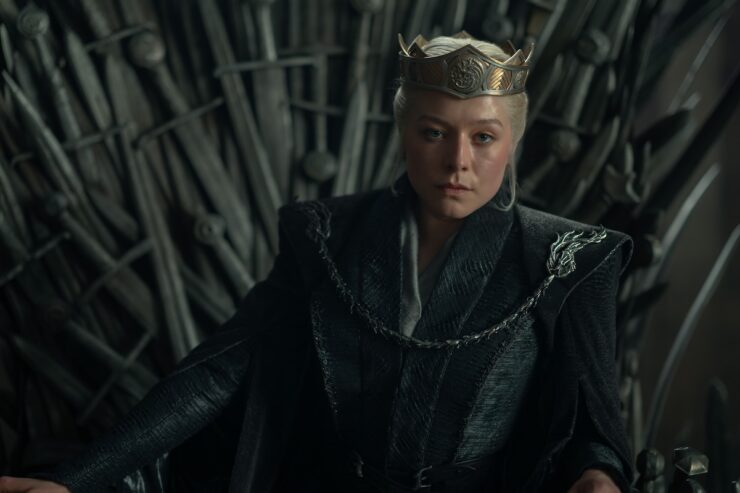
In addition to offering a tense meditation on the difficulties of stewardship, this episode is also an outstanding showcase for Emma D’Arcy’s acting chops as Rhaenyra. D’Arcy imbues the Black Queen with a perfect sense of pitiable desperation as she begins to crack under the pressure of rule. Rhaenyra starts out the episode talking about all the ghosts she sees in the Red Keep and the episode is certainly haunted by them. It would be easy to read the beats of this episode’s script and play up Rhaenyra’s agitation as madness—she hallucinates Jace walking down the hall, staring into space while a wall of non-diegetic noise bubbles up on the soundtrack—but D’Arcy deftly evokes our sympathies.
A number of fans were worried, after last season, that the show was going to defang Rhaenyra (who we know from Gyldayn’s account will not be remembered kindly). Instead, we are getting the more realistic and nuanced version of her mistakes along the way. Having lost two sons in less than a year, being forced to personally execute her father’s dear friend and advisor, and being pulled in different directions by her own squabbling advisors (two of whom she has romantic feelings for), Rhaenyra is clearly at a breaking point and Emma D’Arcy threads the needle of portraying the violence of that breakdown without ever pushing us away from the core of decency that has made the character so beloved. As Alicent tells her, “You may not rule and remain yourself.”
No More Manderly Erasure
We get our first appearance of Torrhen Manderly, played by Dan Fogler who you might know from the Fantastic Beasts movies and The Walking Dead, or as Mads Mikkelsen’s neurotic patient Franklin on Hannibal, or maybe even as the star of Balls of Fury. It’s the first time we’ve had a Manderly in the main cast of a Song of Ice and Fire series, despite the prominent role they play in the books.
The Manderlys are a House that originated from the Reach, under the reign of the Gardener kings before Aegon the Conqueror extinguished House Gardener, raising up the Tyrells in their place. They are named for the River Mander that flows throughout the Reach (though some say the river was named for the House). However, some time before the conquest, the Manderlys were exiled from the Reach as the final move in a chess game between the Manderlys and the Peakes. They were welcomed in by the Stark Kings in the North where they were granted the seat of Wolf’s Den. In the present era they are the stewards of the city of White Harbour, the most populous city in the North and the richest trade port north of the Neck.
During the events of A Feast for Crows and A Dance with Dragons (the novel that was adapted into seasons 5 and 6 of Game of Thrones, not the historical event that House of the Dragon is about), Wyman Manderly plots revenge against House Bolton, his new liege lords, for the death of his son at the Red Wedding, eventually coercing everyone at Ramsay Bolton’s wedding feast to eat some secretly murdered Freys baked into pies. The original series gave this plot point (as it gave so many) to Arya instead, and the Manderlys were largely ignored. It’s great to see their forebearers here, and Dan Fogler is an inspired choice to play Torrhen.
Speedrunning the War (Part II)
Credit: Theo Whiteman/HBO
As was the case with the previous episode, this episode chooses to eschew a number of battles in favor of getting the Hightower host to Tumbleton. In Fire & Blood, we get Gyldayn’s account of a long, slow march towards King’s Landing where Ormund first contends with other houses from the Reach that have declared for Rhaenyra. This includes House Beesbury, who defected, in part, because Lord Lyman Beesbury was murdered in the season one finale by Ser Criston Cole. After fending off raids from the Beesburys, Costaynes, and Tarlys—the Hightower host fights at the Battle of the Honeywine (the river that flows into Oldtown Harbor), fighting against the remaining Beesburys and Tarlys alongside House Rowan. They are saved from destruction by the appearance of Daeron Targaryen and his dragon, Tessarion—for which Ormund names his cousin “Daeron the Daring.”
After the Battle of the Honeywine, Ormund forces the rebel Reachlords to submit to the Hightowers and the Greens and marches across the Reach to the town of Longtable (on the Mander, in the easternmost portions of the Reach) where they lay siege. The widowed Lady Merryweather eventually yields Longtable to the Hightowers, and Ormund and Daeron march on to Bitterbridge. There, they sack the town, leading to the Lady Caswell to hang herself from the parapets. Especially detail-oriented viewers may remember that Lady Caswell’s husband, Lord Alun Caswell, is the Black loyalist who tries to leave the city and get word to Rhaenyra of the Green’s coup before being hanged in the Red Keep at the end of season 1, episode 9. (Lady Caswell also had a significant role to play in a plot point that was likely cut when Condal and the show’s writers decided to give Helaena only two children instead of three.)
Finally, after all that, Ormund, Daeron and the Hightower host reach Tumbleton, the market town at the end of the Mander, on the borders of the Crownlands and uncomfortably close to King’s Landing. It’s possible, given that Daeron is announced as having joined Ormund’s host at the end of last season, that we are meant to believe that all of this happened off-screen during season 2. Or perhaps, in all but eliminating the Beesbury rebellion, the show has simply decided not to overcomplicate Ormund’s trip east.
Either way, laying things out like this does help to sell this episode’s plot with the fake Daeron. It also gives Ormund a steely edge and a level of cunning that Gyldayn’s account lacks. Much like the battles in the Riverlands, the show seems to know that military clashes that don’t involve major characters can feel pretty unnecessary to the storytelling, and that focusing on battles like the Gullet is ultimately better for the show. Besides, we have some big military set pieces that the show can’t write around coming up.
DragonWatch
There is a brief glimpse of Tessarion during the opening shot of the episode, but she is distant and out of focus. We also get a little bit of Caraxes, Vermithor, and Silverwing in that same scene. It’s an almost dragon-free episode, for the most part, but we can’t really fault it for that.
Odds & Ends
Credit: Theo Whiteman/HBO
Rhaenyra mentions Lady Johanna of Casterly Rock. That’s Jason’s widow, the regent and mother of the current lord, Jason’s young son, Loreon Lannister. Johanna is a common Lannister name through the centuries. It’s the name of Tyrion, Jaime, and Cersei’s mother and a number of other famous Lannister women.
Daemon responds with a brief expression of sorrow and disappointment upon learning of the death of Ser Simon Strong. There is rarely time for grief in these shows and certainly not much from Daemon, but I appreciate how much Condal et al. want to drive home the sense that the two characters really forged a bond last season.
It feels a bit odd that Rhaenyra calls Sheepstealer by Rhaena’s name for him. I suppose it makes it easier for the audience to be clear on which dragon she’s searching for, so that we can be immediately sure that she is wrong in suspecting it’s a secret agent for the Greens, but Baela wouldn’t hear that name without also recognizing her sister, right?
Helaena doesn’t want to stay in her current room because it is the same one in which she witnessed the death of her son Jaehaerys in the horrific Blood and Cheese incident last season.
One great piece of visual continuity between House of the Dragon and Game of Thrones is how the foundations and stonework of the Red Keep are essentially unaltered. Rhaenyra and Mysaria pass through the small courtyard where Cersei will one day have her mosaic map of Westeros laid out.
The High Septon calls dragons a “profane magic created in darkness and pride and lust for power.” It’s a good reminder of the roiling tensions that have always existed between the Faith of the Seven and the Targaryen family. We never really see that tension in the original show (seeing as the Targaryens are all dead, save two, at that time) and, by the A Knight of the Seven Kingdoms era, the Targaryens are in the midst of a charm offensive to be seen as Westerosi first and foremost. While Septon Barth (one of Gyldayn’s predecessors) is an enthusiastic scholar of dragons, it’s nice to see the show spell out all the ways in which the dragons are anathema to nearly every cosmology on the planet. Also nice to have the idea that they were the product of Valyrian magical experiments made soft canon.
An interesting deviation from the books: Corlys Velaryon legitimates his bastard sons in F&B without any pushback. In fact, it is implied throughout the Song of Ice and Fire books that while the crown has the power to strip lands and titles away from a lord, they are not needed to confirm legitimization, similar to the “any knight can make a knight” rule that is central to Brienne and Dunk’s plots in other series. Obviously, this helps fuel tensions between the Targaryens and Velaryons that exist in F&B for slightly more complicated reasons a bit later in the original narrative, but it is interesting that House of the Dragon changed the political process in order to get us there—and to give us a little more insight into Rhaenyra’s selfishness.
Elinda Massey (Jordon Stevens), Rhaenyra’s handmaiden, returns after being absent from Dragonstone. She’s one of the few nobles of Blackwater Bay that Rhaenyra has brought with her to court.
We also get the return of Sylvi (Michelle Bonnard), the King’s Landing brothel madam beloved by Aemond and working for Mysaria. I have a feeling that they have been building her up to serve a role originally occupied by an unnamed sex worker that comes up later in the book, thus her sticking around this long.
Sunfyre’s corpse is mentioned. The first confirmation of the king’s dragon’s death since he was felled by Meleys and Vhagar last season.
Emma D’Arcy’s line read of “absolutely not” in response to Ulf wanting to take on the name Targaryen is perfect. They are remarkably funny in interviews and I’m glad to see them bring some levity to their performance of the usually solemn, intense Rhaenyra.
The banquet where Rhaenyra serves rats to the nobles of King’s Landing is not in F&B but it evokes the story of the murderous Rat Cook who cooked and ate people at the Nightfort. Fun, given future events (mentioned above) that a Manderly should be present.
It’s also interesting to see that Daemon may harbor some imperial ambitions about conquering Essos and beyond. The Valyrians were slave-holding conquerors who tried to rule half the planet and while the Targaryens are also imperialists (who turned seven separate kingdoms into one empire), one often forgets that they might have explored even broader ambitions if they had been given a chance. We might root for them here, but they are a very bad family.
The city where men have wings that Daemon mentions is a pre-existing place in Eastern Essos! As we travel farther east and get closer to the Shadowlands and Asshai, Martin populates the map with places whose names imply a “here there be dragons” sort of mystery. Other settlements include “the City of the Bloodless Men” and “the Land of the Shrykes.” Martin also sprinkles in some references to the greater Lovecraft mythos with cities called “Carcosa” and “K’Dath.” Things get weird in the East!
In Conclusion
Gotta love a bottle episode! It’s a great example of how good House of the Dragon is, even when it’s not giving us huge set pieces or sensational scenes of dragon carnage. One could hardly call this episode quiet or slow even when it is relatively uneventful compared with the first two. More and more, I think this season might be the very best of House of the Dragon and, as a result, some of the best Song of Ice and Fire-inspired TV we’ve seen to date.
But what do you think? Are you digging the season as much as I am? Are you as up for a version of The West Wing with dragons as I am? Can Emma D’Arcy ever disappoint us? Let me know in the comments below![end-mark]
The post Suspicious Minds, Rats, and Imposters: <i>House of the Dragon</i>, Season 3 Episode 3 appeared first on Reactor.








 New Posts (Home)
 ChatBox
 Popular Posts
  Game Zone
 Top PodCasts