reactormag.com
Making Things and Having Fun: The Mad Scientists’ Club by Bertrand R. Brinley
Books
Front Lines and Frontiers
Making Things and Having Fun: The Mad Scientists’ Club by Bertrand R. Brinley
The delightful adventures of a group of aspiring young scientists…
By Alan Brown
|
Published on July 7, 2026
Comment
0
Share New
Share
In this bi-weekly series reviewing classic science fiction and fantasy books, Alan Brown looks at the front lines and frontiers of the field; books about soldiers and spacers, scientists and engineers, explorers and adventurers. Stories full of what Shakespeare used to refer to as “alarums and excursions”: battles, chases, clashes, and the stuff of excitement.
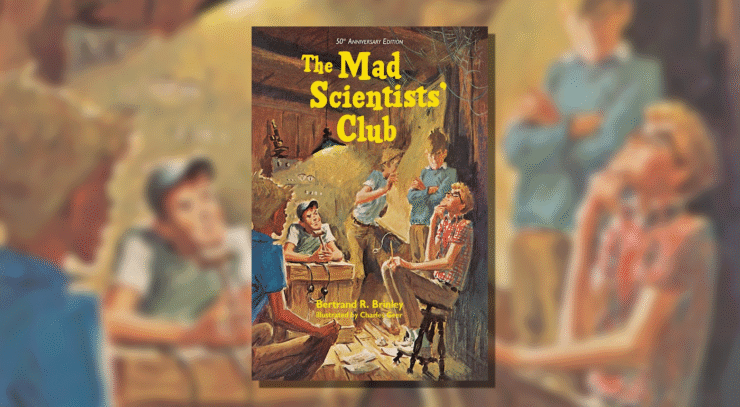
Today, I’m looking at one of my favorite books from childhood, The Mad Scientists’ Club. It is a clever and witty collection of short stories about a group of boys whose goal in life is to use science to build cool stuff, often with the goal of playing good-natured pranks on the community they lived in. It felt as if the author had drawn directly from all the stuff my friends and I wanted to do, but couldn’t quite pull off because, (1) science isn’t easy, (2) a lot of these inventions required expensive hardware, and (3) we weren’t organized enough. But these kids were clever, pooled together money (often including rewards they’d won for some accomplishment), had a clubhouse and written bylaws, and actually appeared to use Robert’s Rules of Order in conducting their club meetings.
Now, some of you might be saying that this doesn’t sound like science fiction, but I would point out that not all science fiction is set in the future—the book is fiction, and it is about aspiring scientists. I seem to remember my dad asking me what the book was about, and when I described it, he said it sounded more like a mad engineers’ club than a mad scientists’ club, because these guys were not doing experiments and testing hypotheses, they were taking established science, and applying it to achieve specific goals. My dad was a proud engineer, having done combat engineering in WWII, and working as an industrial engineer in the aerospace industry, and if his response wasn’t exactly what I remember, it is definitely the type of thing he would have said.
My copy is a Scholastic Book Services paperback copy from 1965 that I probably ordered using one of the order forms that they periodically distributed in my elementary school. It is illustrated by Charles Greer, a popular illustrator of books for youngsters in those days; I spent hours in my youth attempting to copy his drawing style, which appeared to be loose and sketchy, but was deceptively precise. Some of the stories in the book had previously been published in Boys’ Life magazine, though that would have been in the years before my family began subscribing to the magazine, so my first encounter with the tales was in this anthology.
About the Author
Bertrand R. Brinley (1917-1994) was an American author of short stories, with most of his published fiction featuring the Mad Scientists’ Club. The club’s adventures were chronicled in twelve short stories, with most (if not all) appearing in Boys’ Life magazine and later collected in book form as The Mad Scientists’ Club (1965) and The New Adventures of the Mad Scientists’ Club (1968). There were also two short novels, The Big Kerplop! (1974), and The Big Chunk of Ice (2005), although issues with the publisher prevented the novels from being widely available until years after they were written. As a civilian, Brinley worked as a systems analyst for Lockheed, and later worked for Bell Labs. He was involved in local theater groups. He served in the Army during World War II and the Korean War, working in special services and public affairs. Most of the information I could find on the author came from The Mad Scientists’ Club website, established by Bertrand Brinley’s son, Sheridan.
About the Illustrator
Charles Greer (1922-2008) was a popular American painter, illustrator, and author, whose work primarily appeared in books for children and young people. I encountered his work a number of times in my youth, in books including The Mad Scientists’ Club series, the Miss Pickerel series, The Secret Raft, and The Marvelous Inventions of Alvin Fernald.
The Joy of Making Things
Back in the 1960s, when I first read the Mad Scientists’ Club’s adventures, I was only a few years younger than the protagonists. And, while nothing my friends and I ever built was as complex and creative as the inventions the boys created in the books, we were always making things. We built treehouses and lean-tos in the woods, built rafts on the lake, and performed all manner of experiments. I remember getting chemistry sets for Christmas, and experimental sets from outfits like A.C. Gilbert and Scientific American. I built electromagnetic cranes that could pick up toy cars, and a crystal radio set that could pick up AM radio stations. There were telescopes and a whole array of gadgets, most of which did not work as intended. One particularly ill-advised invention was a diving bell that consisted of a large bucket over my head with a large rock on top that weighed it down, which in retrospect could easily have asphyxiated or drowned me.
Now here, you might think I’m gearing up for an “old man yells at cloud”-style rant, bemoaning the fact that kids don’t do things in the real world any more. And certainly, my son’s generation had video games and computers to draw their attention to the electronic world. But I did my best to encourage him to experiment, and we had a particularly good time launching rockets together, once with an ant as a passenger for a school science experiment. He became handy with tools, and married a young woman who helped her father in his part-time construction business, so they both end up helping me with things around the house more than I help them.
And in recent years, perhaps because they see artificial intelligence replacing office jobs, I’ve noticed a resurgence of interest in working in the trades among young people. An old friend of mine coaches robotics teams, and my granddaughter was involved in programming the robots for her high school team. And she has become interested in theater, working behind the scenes on lighting and sound, which involves not only programming, but physically making the gear do what it needs to in support of the performance. This work has led to her getting a part-time job in the university Information Technology department.
So, while I might sometimes be tempted to be like the old man yelling at clouds, I have to admit that there are still a lot of budding young “mad scientists” around, cleverly creating things in the real world and having fun doing it.
The Mad Scientists’ Club
Before we look at the seven short stories that make up the book, it will probably be useful for me to introduce the members of the club. The book is written in the first person, from the viewpoint of Charlie, whose name only appears once, and who, while he is always in the center of their antics, does not have a single line of dialogue. The president of the club, and generally the voice of reason in their discussions, is Jeff Crocker. The deep thinker and chief architect of most of their creations is vice-president Henry Mulligan. Dinky Poore is small and often agitated, while Freddy Muldoon is heavyset, and mostly concerned with food. Homer Snodgrass and Mortimer Dalrymple are the final two members of the club.
Other townspeople who figure in the tales include Freddy’s cousin, Harmon Muldoon, a former member of the club who was dismissed for sharing secrets with outsiders, and who now is leader of a rival group of boys. Harmon’s sister, Daphne, is pretty, and an object of affection for many club members. Mayor Scragg is a pompous and opportunistic politician, often flustered by the pranks of the club. Colonel March is the commanding officer of the local Air Force base. And Zeke Boniface is the burly owner of the local junkyard, who supplies the club with many of the raw materials for their adventures, and whose truck, Richard the Deep Breather, is often made available to support their activities.
According to Wikipedia, the fictional town of Mammoth Falls is based on the town of West Newbury, Massachusetts, where Brinley lived as a teenager, although there are locations mentioned in the story that suggested to me that the fictional town was somewhere in the Midwestern states.
The collection starts off with a bang with “The Strange Sea Monster of Strawberry Lake.” It is summer, and one of the boys gets the idea to build a sea monster to fool townspeople. They build a canvas monster on a frame built over a canoe, launch the contraption from a secluded cove, and create a sensation. The reports of the sea monster actually cause a surge in tourism, to the delight of local merchants. But their scheme goes too well, and soon their secret is at constant risk of being discovered. The boys find out hunters are plotting to bag the monster, and rather than give up, automate their creature with a small trolling motor and radio controls. After some further misadventures, they move the monster to a raft and light it on fire in the middle of the lake to destroy the evidence.
In “The Big Egg,” the gang discovers a fossil dinosaur egg and report their finding to a natural history museum in New York. Their local rivals decide to steal the egg and replace it with a fake. But there is already a fake egg in play. There is a bait-and-switch contest where the club uses radio gear to track the eggs, and thanks to Henry’s cleverness, they prevail. In the end, they decide to try to hatch the egg, and the story ends up suggesting they succeeded.
In “The Secret of the Old Cannon,” Homer starts spending time with Daphne Muldoon at the library. The boys are jealous, and then Daphne discovers that the mystery of an old unsolved bank robbery might involve a historical cannon in a local park, long ago plugged with concrete. Henry borrows a gastroscope from a local hospital (a rare device in those days that is now routinely used for colonoscopies), and snakes it into the touch hole, discovering an old valise. They boys heat the barrel to expand it, allowing them to withdraw the concrete plug and remove the valise. They replace it with another bag, and then replace the concrete. Their rival Harmon tries to take credit for the discovery, and is embarrassed when the concrete plug is broken out, and the money is not found. The boys reveal the old valise, and get the credit they (and Daphne) deserve.
“The Unidentified Flying Man of Mammoth Falls” takes place during Founder’s Day when the town of Mammoth Falls honors Hannah Kimball, a heroine who held off Native Americans with a blunderbuss and then chased them away with a stunt involving a scarecrow. The boys put a mannequin on the pedestal beside her statue with a speaker inside it, pretending the mannequin is a suicidal man who wants to jump, in a scene that, as an older reader, no longer seems humorous. Then a gas bag bursts from his chest and inflates, and he floats off. The rest of the story is a slapstick account of the boys’ efforts to retrieve their flying man without being discovered by the authorities or the Air Force (although Colonel March seems to have figured things out by the end).
“The Great Gas Bag Race” is another flying adventure, this time with the boys building a balloon to compete in a local air race. Their balloon uses helium, and they control its altitude by releasing additional helium into the bag for lift, and then running a compressor to put helium back in the gas bottle to descend (something that is theoretically possible, although I can’t say I’ve ever heard of a lighter-than-air craft doing that in the real world). To keep weight down, only Henry (to do the navigating), Charlie (to do the narrating), and Dinky (because he is small) crew the balloon. Harmon’s rival gang also has a balloon, runs into trouble and crashes into a lake, and the boys show some compassion by assisting them.
Harmon tries to show some local girls how brave he is by staying in a local haunted house in “The Voice in the Chimney.” The club naturally makes sure he and his friends have a terrifying experience, and then repeat their tricks when the mayor and local sheriff decide to show their courage by spending the night as well. They pull off their stunt successfully, but like many of the adventures in the book, this one should have had a “don’t try this at home” disclaimer appended to it.
The story “Night Rescue” ends the book on a more serious note. An Air Force fighter from the local base goes down, and the club volunteers to assist in the search. The mayor, thinking of their stunts, wants to exclude them, but Colonel March folds them into the effort. Having some experience with search and rescue, I found the description of the process quite realistic. The boys use parachute flares to determine wind patterns in the area, and then use a leapfrog technique with flashlights to follow compass bearings, find the aviator, and give him first aid. In the end they are rewarded not only with accolades, but also a ride home in Air Force helicopters.
Buy the Book
The Mad Scientists’ Club
Bertrand R. Brinley
Buy Book
The Mad Scientists' Club
Bertrand R. Brinley
Buy this book from:
AmazonBarnes and NobleIndieBoundTarget
Final Thoughts
When I was young, I read The Mad Scientists’ Club until the cover fell off, and loved every minute. The book has held up remarkably well over the years, as the technology was all realistic, and I can imagine kids today wanting to do the same type of things. About the only thing that was dated is the way boys and girls were so segregated in the world of sixty years ago. Thanks to small presses, the books are still available today, and would be well worth a read.
Now, I look forward to hearing from you, if you would like to discuss The Mad Scientists’ Club book and series specifically, or fictional adventures of young inventors in general.[end-mark]
The post Making Things and Having Fun: <i>The Mad Scientists’ Club</i> by Bertrand R. Brinley appeared first on Reactor.








 New Posts (Home)
 ChatBox
 Popular Posts
  Game Zone
 Top PodCasts